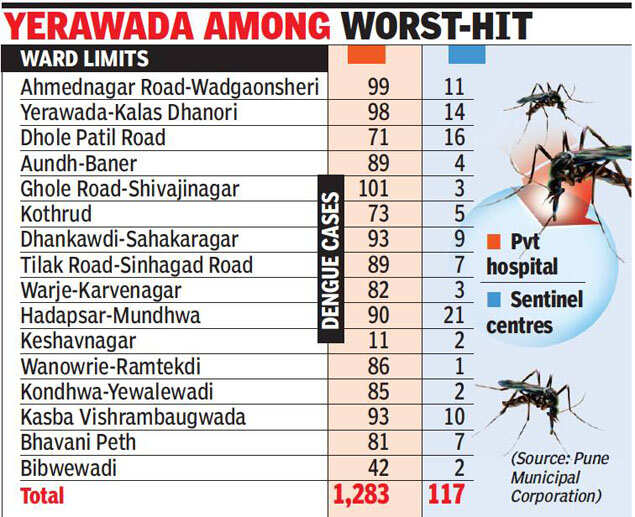
PUNE: Rainwater accumulation and poor upkeep have sent dengue cases soaring in eight of the 16 ward limits of the Pune Municipal Corporation, which account for 60% (844) of the total 1,400 dengue infections recorded in the city between January 1 and July 31 this year.
An analysis of the ward-wise distribution of these cases showed that residents of Ghole Road-Shivajinagar, Ahmednagar Road-Wadgaonsheri, Yerawada-Kalas Dhanori, Dhankawdi-Sahakarnagar, Hadapsar-Mundhwa, Kasba-Vishrambaugwada, Aundh-Baner and Tilak Road-Sihagad Road were worst-affected by the mosquito-borne disease this year.
PMC officials have intensified surveillance and preventive measures in these wards in the wake of the Zika virus detection in rural parts of Pune. The mosquito that transmits Zika virus, namely Aedes aegypti, also causes dengue and chikungunya.
Private hospitals (1,283 cases) and government-designated sentinel (117 cases) centres have collectively registered 1,400 dengue cases till July-end this year. As most of the private hospitals use rapid antigen tests, civic officials consider these cases as ‘suspected’. The government-designated sentinel centres use dengue antibody tests. Hence, these cases are considered as confirmed cases, the civic officials said.
“We have stepped up the measures. Citizens should also do their bit to keep their surroundings clean,” said PMC’s head of the insect control department Sanjeev Wavare.
“Rivers that flow through city need utmost care to keep them flowing to check mosquito menace. Stagnation of water due to hyacinth or low water-depth resulting from the accumulation of silt can result in stagnation providing conducive ground for mosquito breeding,” said health activist and medical practitioner Abhijit More.
Filling up vacant posts of entomologists/biologists, sanitary inspectors is also key to contain the diseases. “Besides, they need to rope in adequate permanent or contractual staff for identifying and destroying mosquito-breeding sites,” More said.