
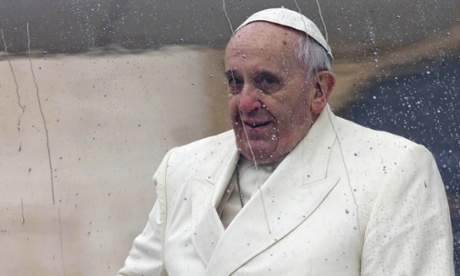
Pope Francis has released an unprecedented encyclical on climate change and the environment. The 180-page document calls on rich nations to pay their “grave social debt” to poorer countries and lambasts the UN climate talks for a lack of progress. Here are eight things we learned:
1) He thinks we should phase out coal
While renewable power from wind and solar gets up to speed as a solution to our energy needs, it’s worth considering gas over coal, he said:
We know that technology based on the use of highly polluting fossil fuels – especially coal, but also oil and, to a lesser degree, gas – needs to be progressively replaced without delay. Until greater progress is made in developing widely accessible sources of renewable energy, it is legitimate to choose the lesser of two evils or to find short-term solutions.
2) He thinks the UN climate talks have failed to achieve much
He says more than 20 years of summits have produced “regrettably few” advances on efforts to cut carbon emissions and rein in global warming. The encyclical says:
It is remarkable how weak international political responses have been. The failure of global summits on the environment make it plain that our politics are subject to technology and finance. There are too many special interests, and economic interests easily end up trumping the common good and manipulating information so that their own plans will not be affected.
3) He doesn’t like carbon trading
In this passage he seems to be referring to the only current global carbon trading scheme, the CDM:
The strategy of buying and selling “carbon credits” can lead to a new form of speculation which would not help reduce the emission of polluting gases worldwide. This system seems to provide a quick and easy solution under the guise of a certain commitment to the environment, but in no way does it allow for the radical change which present circumstances require. Rather, it may simply become a ploy which permits maintaining the excessive consumption of some countries and sectors.
4) But he does like community energy
From Francis’s point of view, small and local is beautiful:
In some places, cooperatives are being developed to exploit renewable sources of energy which ensure local self-sufficiency and even the sale of surplus energy. This simple example shows that, while the existing world order proves powerless to assume its responsibilities, local individuals and groups can make a real difference.
5) He is neither pro nor anti genetically modified food
It is difficult to make a general judgement about genetic modification (GM) ... The risks involved are not always due to the techniques used, but rather to their improper or excessive application ... This is a complex environmental issue
6) He thinks consumption is a bigger problem than population
Perhaps unsurprisingly given the church’s stance on birth control, and in common with many environmentalists, he thinks consumption rather than overpopulation is the bigger environmental problem:
To blame population growth instead of extreme and selective consumerism on the part of some, is one way of refusing to face the issues.
7) He says iPhones and all our other gadgets are getting in the way of our relationship with nature
Real relationships with others, with all the challenges they entail, now tend to be replaced by a type of internet communication which enables us to choose or eliminate relationships at whim, thus giving rise to a new type of contrived emotion which has more to do with devices and displays than with other people and with nature.
8) Our gift to the next generation may be desolation:
We may well be leaving to coming generations debris, desolation and filth. The pace of consumption, waste and environmental change has so stretched the planet’s capacity that our contemporary lifestyle, unsustainable as it is, can only precipitate catastrophes, such as those which even now periodically occur in different areas of the world. The effects of the present imbalance can only be reduced by our decisive action, here and now.












