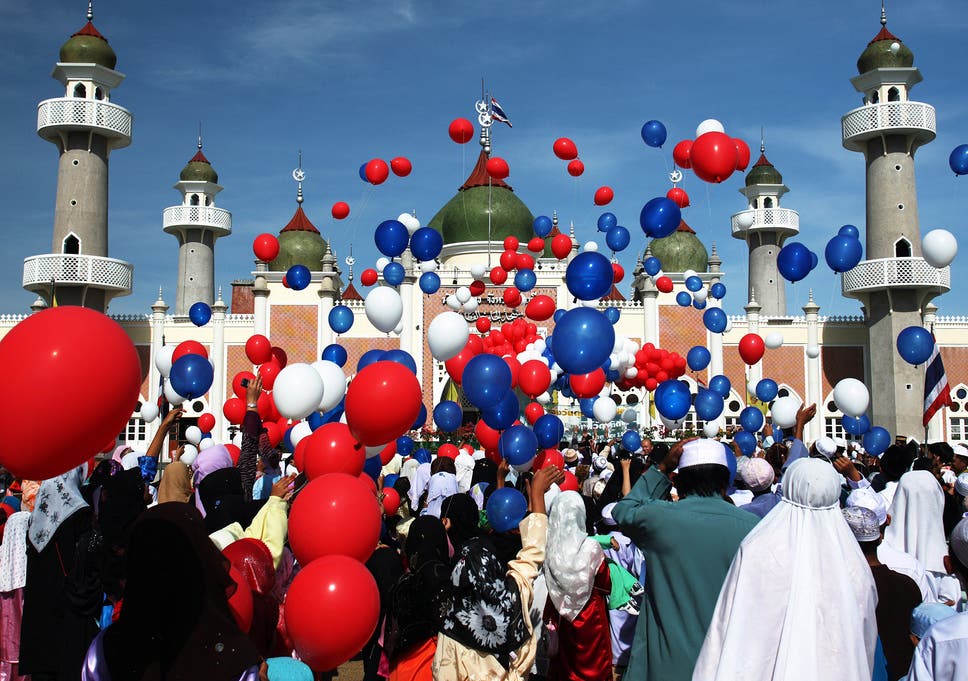
Every year, Muslims across the globe gather to celebrate Eid as the month-long fasting of Ramadan comes to a close.
Eid al-Fitr translates from Arabic as the “festival of breaking the fast” and sees the entire Muslim community come together to celebrate the completion of this annual act of devotion.
Here's everything you need to know.
When is Eid?
The exact date of Eid is yet to be determined as it depends on the lunar cycle but we know it is likely to be on one of two dates in the middle of June.
It could take place this year on the evening of Thursday 14 June or on the evening of Friday 15, depending on the sighting of the crescent moon.
Precisely when followers choose to observe it varies because there is little agreement within the faith about whether the moon must be spotted with the naked eye and whether it needs to be seen in the country where the celebrations are happening.
As there are either 354 or 355 days in the Islamic year, the day that Eid falls on in the Gregorian calendar changes annually.
Why are Muslims celebrating?
Muslims observing Ramadan have been fasting from dawn to sunset for an entire month. As the days are longer during the summer, Muslims in the UK commonly fast for 18 hours a day.
Ramadan is one of the five pillars of Islam - along with faith, prayer, charity and the pilgrimage - and gives Muslims a moment to reflect on their spiritual life in honour of the Quran being revealed to the prophet Muhammad.
Eid al-Fitr is therefore the celebration marking the end of this solemn period of reassessment.
How do Muslims celebrate Eid?
Traditionally, Eid is celebrated for three days and is a national holiday in Muslim countries. In the UK, most people tend to celebrate for a day and will take time off work or school.
As with most holidays, people celebrate differently, but Muslims typically gather together at the mosque for early prayer, with services held every hour in the morning. Followers are often forced to queue due to their popularity.
When prayer is complete, worshippers greet one another, commonly embracing three times. Children sometimes receive gifts from their elders.
The rest of the day is about spending time with friends and family, exchanging gifts and feasting, the latter taking place during daylight hours for the first time in a month.
Again, the dishes being enjoyed depend on family heritage. Bangladeshi Muslims may have biryani while Turkish Muslims settle down for lamb shish kebabs. The choice is entirely down to the individual.
What is the difference in Eid al-Fitr and Eid al-Adha?
There are two Eids every year. The second, Eid al-Adha, takes place two months later and is the festival that coincides with the Hajj, the annual pilgrimage to Mecca.
Expected to take place on August 21 or August 22 this year, it is also known as the “sacrifice feast” and honours the prophet Ibrahim's sacrifice of his son Ishmael, an act of submission to Allah's command.
How to wish someone a nice Eid
The phrase commonly used by Muslims is “Eid Mubarak”, which is Arabic for “Blessed Eid”.
Those celebrating will greet each other with this phrase throughout the day.