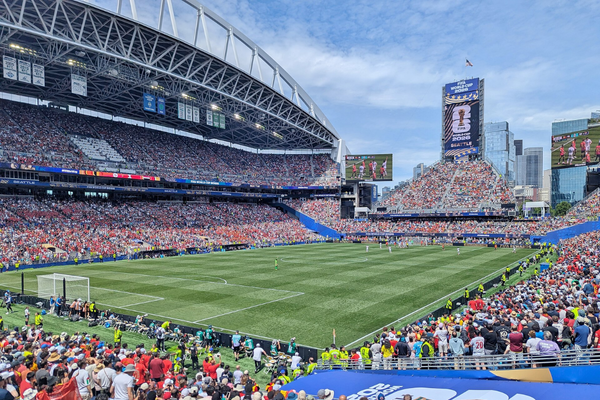
Atlanta Stadium, Atlanta — Argentina spent most of Tuesday afternoon looking like the tournament's next big shock victim. Then, in a span of thirteen minutes, the defending champions scored three times to beat Egypt 3-2 and reach the World Cup quarterfinals, leaving the Pharaohs to wonder what might have been.
An Early Shock From Ibrahim's Header
Egypt struck first, and it came from an unlikely source. Center-back Yasser Ibrahim climbed above Argentina's back line to nod in a corner delivery swung in by Marwan Attia in the 15th minute, silencing a crowd that had arrived expecting a coronation. Argentina answered almost immediately: Nicolás Tagliafico was hauled down in the box to win a penalty, but Lionel Messi's effort was turned away by goalkeeper Mostafa Shobeir — son of Ahmed Shobeir, who guarded Egypt's net at the 1990 World Cup. The younger Shobeir wasn't finished: before halftime he also smothered close-range attempts from Alexis Mac Allister and Julián Álvarez, cementing one of the individual goalkeeping displays of the tournament.


A Disallowed Goal, Then a Real One
Egypt appeared to have doubled its lead around the 58th minute when Mostafa Ziko finished off a rapid counter involving Mohamed Salah, only for the goal to be wiped out after video review flagged a foul by Attia on Lisandro Martínez earlier in the move. Egypt shrugged it off. Ziko got his goal for real in the 67th minute, and with eleven minutes left on the clock, the Pharaohs stood on the brink of a first-ever World Cup quarterfinal.
Thirteen Minutes, Three Goals, One Substitute
What followed was less a comeback than a demolition of the clock. Cristian Romero headed in a Messi cross in the 79th minute. Four minutes later, Messi buried the equalizer himself — his eighth goal of the tournament, putting him one clear of Kylian Mbappé and Erling Haaland in the race for the Golden Boot. Then, deep into stoppage time, it was substitute Lautaro Martínez — not a starter, not even on the pitch until after the hour mark — who drove forward and slid the ball across for Enzo Fernández to head home the winner. The player some assumed had been shelved for the afternoon ended up delivering the goal that won it.


The Bench Wasn't Watching — It Was Working
Head coach Lionel Scaloni made three changes to the side that had needed extra time to see off Cape Verde in the previous round, the most notable being Julián Álvarez replacing Martínez in the starting XI, alongside Leandro Paredes and Nicolás Tagliafico coming in elsewhere. Scaloni had framed the decision as tactical and restorative rather than a demotion, banking on fresh legs late in a knockout match. It paid off in the most literal way possible: rather than sitting out the fightback, Martínez became the man who finished it off with his pass to Fernández. That's the real story of Argentina's depth this tournament — not a bench full of players waiting their turn, but one that can flip a match the moment it's needed.
Messi's Costly Habit From the Spot
The Argentine captain's saved penalty against Egypt fits an uncomfortable pattern. He also missed from twelve yards earlier in the tournament against Austria, making him the first player in World Cup history to fail twice from the spot in regulation time during a single edition. It's an odd blemish on an otherwise complete performance — Messi also became the tournament's all-time assists leader after teeing up Romero, a reminder that his teammates are increasingly able to cover for him when his shooting boots misfire.
A Defense That Keeps Digging Its Own Hole
The flip side of the comeback is a back line that keeps handing out first-half leads. Conceding from a set piece within the first quarter-hour, then getting frustrated by a compact, well-drilled Egyptian defense for most of the following hour, echoes the same slow start Argentina had against Cape Verde. Teams that sit deep, defend in numbers, and wait to counter — rather than trying to match Argentina possession for possession — remain the matchup that gives Scaloni's side the most trouble.
Who Scores Next in the Quarterfinal
Messi remains the obvious answer given his tournament-leading haul, but Fernández is pushing for a bigger scoring role from midfield, and Álvarez will want a return to boost a quiet personal tally after his group-stage struggles. As for Martínez, the conversation has shifted — rather than wondering whether he'll get a recall, the question now is whether Scaloni can afford to leave him out of the XI again after what he just did with fifteen minutes on the clock.
A Different Rhythm Than Europe or South America's Usual Contenders
What made Egypt so difficult for long stretches wasn't flair or possession — it was structure. The Pharaohs, appearing in their first-ever Round of 16, built their afternoon around a compact defensive shape, quick transitions, and precision at set pieces, a style more associated with disciplined African and Middle Eastern sides than the patient passing of a European heavyweight or the improvisational flair typical of South American football. Argentina eventually broke it down, but only by trusting individual quality in tight spaces late on, rather than any coordinated tactical plan — worth watching for again as the knockout rounds continue.
Egypt Cries Foul After a Heartbreaking Exit
The result didn't sit well with the Egyptian camp. Head coach Hossam Hassan was scathing of French referee François Letexier afterward, arguing the tournament's officiating had been "directed towards Argentina," and pointing to the disallowed goal along with a late penalty shout involving Julián Álvarez and Mohamed Salah that went unreviewed. Egypt finished the match with five yellow cards to Argentina's none, a disparity Hassan also flagged as evidence of unequal treatment. Goalscorer Ziko was similarly deflated. "We were leading 2-0 and we cannot do anything, it's all up to God," he said.
For his part, Messi kept the focus on his team's mentality after the match. "This group never gives up," he said, summing up a side that trailed by two goals with eleven minutes to play and still found a way through.