
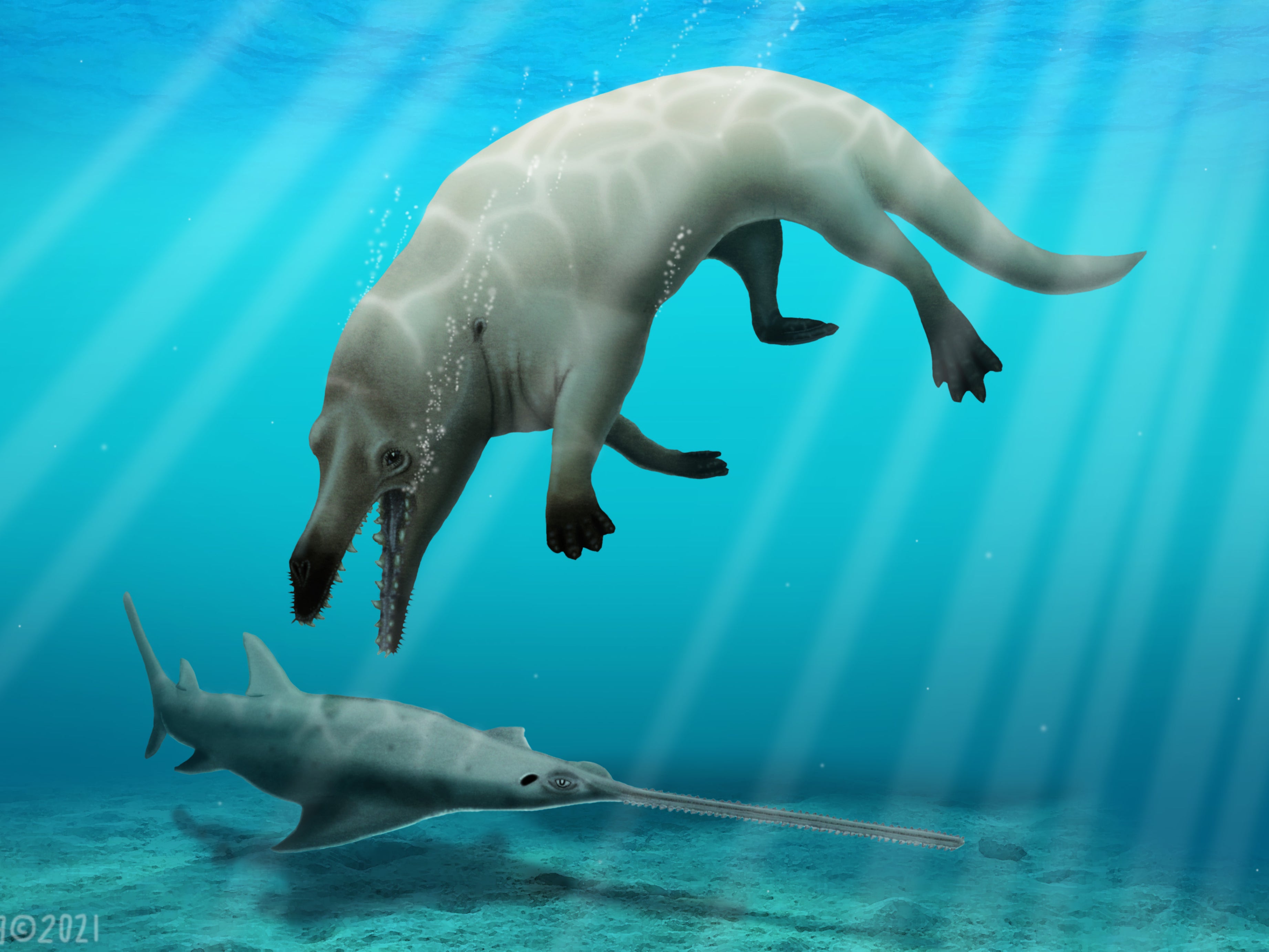
Life reconstruction of the extinct protocetid whale Phiomicetus anubis, n. gen. et sp., preying upon a sawfish.
(Picture: Photo courtesy of Robert W. Boessenecker)Another day, another remarkable discovery.
Egyptian paleontologists have uncovered a 43-million-year-old fossil of a four-legged whale that once strolled on land and swam in the vast waters.
In a research study published in the peer-reviewed journal Proceedings of the Royal Society B, the discovery provides insights into how early whales evolved from being terrestrial inhabitants to the water creatures they are today.
Abdullah Gohar, the paper’s primary author noted that this was the first time that an “Arab team” uncovered, scientifically described, and gave a name to a new fossil whale species.
The newly discovered species, known as "Phiomicetus anubis," belongs to the Protocetids, a group of semiaquatic whales that lived between 56 million and 33.9 million years ago.
The fossils were dug up in 2008 by an expedition directed by Mohamed Sameh of the Egyptian Environmental Affairs Agency, who is also a co-author on the paper, in Egypt’s Fayum Depression. The specimen was moved to the Vertebrate Paleontology Center at Mansoura University for further research.
#Phiomicetus location in Egypt!#Sallam_Lab pic.twitter.com/dY6kLrHYuc
— Hesham Sallam (@heshamsallam) August 25, 2021
Protocetids represent a unique stage in whale evolution that is still mostly unknown to scientists due to their amphibious nature.
“With rocks covering an interval of about 12 million years, we can follow the evolutionary history of many lineages, and interesting discoveries range from semiaquatic crocodile-like whales to giant fully aquatic whales such as Basilosaurus isis,” Sameh said.
The study also suggested that the Phiomectus anubis had a head shaped like a jackal’s and powerful jaws that induced a "raptorial feeding style.” The anubis also had an estimated length of about 3 m and a body mass of about 600 kg (1,300 lbs.)
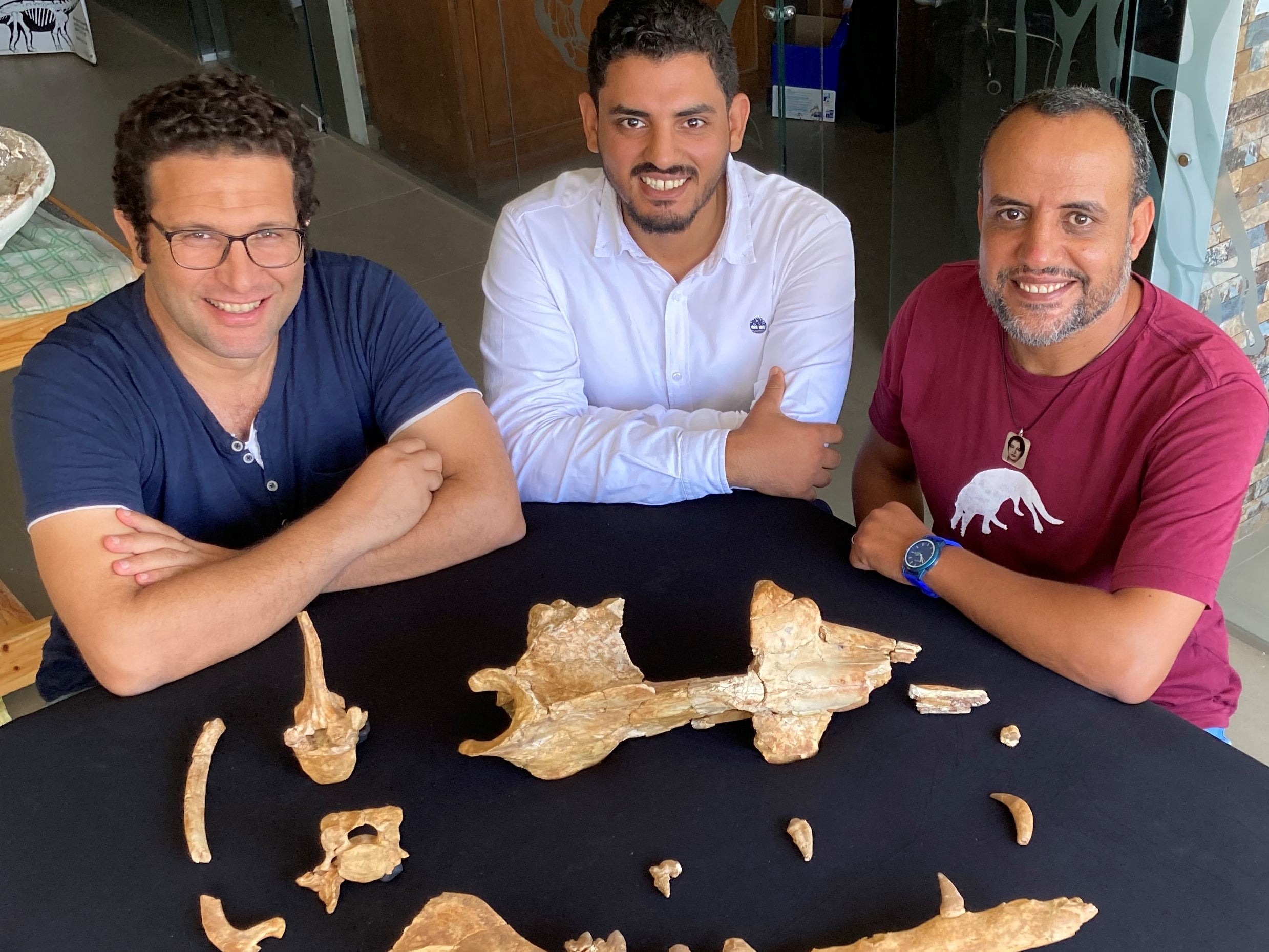
According to Gohar, the skull was one of the vital reasons why the team named it after Anubis, the Egyptian god of death.
“We believe from our anatomical studies that this whale was a god [of] Death to most of the animals that lived in its area, he said.
Overall, Gohar continued to note that the contribution “significantly advances understanding of the role that the African waters played in whale evolution during the Eocene.”
And with that, we wonder what else will be discovered about ancient ecosystems!