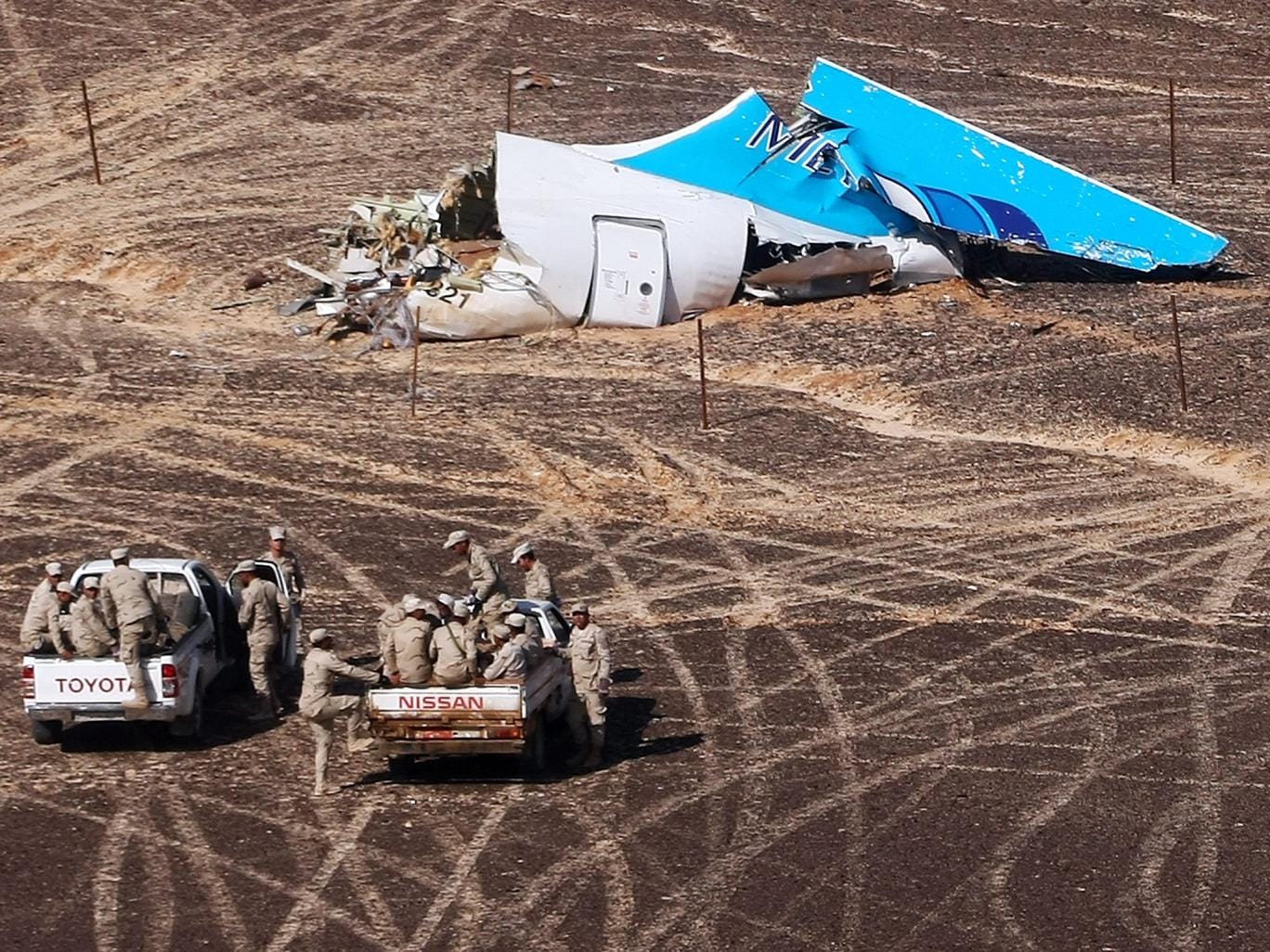
The cause of the crash of a Russian holiday flight in Egypt’s Sinai Desert remains a mystery, after the Egyptian investigators said they could find no evidence of a bomb.
The announcement by the lead investigator, Ayman al-Muqaddam, flatly contradicts the Kremlin’s insistence last month that an improvised explosive device was responsible for the deaths of the 224 passengers and crew aboard the Airbus A321. Metrojet flight 9368 crashed shortly after taking off from Sharm el Sheikh on a charter flight to St Petersburg.
Four weeks ago [16 November], Alexander Bortnikov, director of the nation’s Federal Security Service told President Putin that “traces of foreign-made explosives” had been found in the wreckage. He said: “According to our experts, a self-made explosive device equivalent up to 1 kg of TNT was set off on board, which explains why the fragments of the aircraft were scattered over a large area. We can say with confidence that this was a terrorist act.”
At the time, the announcement surprised the aviation community, because the body responsible for the investigation is Egypt’s Aircraft Accident Investigation Central Directorate.
Russia is represented in the investigation, as is France (where the plane was designed) and Ireland (home of the leasing company that owned it). It is highly irregular for parties other than the lead investigators formally to ascribe the cause of a crash.
Within days of the crash, UK and US intelligence agencies said it was “highly likely” that a bomb had brought down the jet. So strong was the belief that an IED was planted on board at Sharm el Sheikh airport that the British government banned UK airlines for flying to the resort except for carefully controlled rescue flights to bring passengers home, without their luggage.
The Foreign Office said: “There’s a significant possibility that the crash was caused by an explosive device. As a precautionary measure, we are now advising against all but essential travel by air to or from Sharm el Sheikh.” That ban remains in place.
Egyptian investigators are battling against a widely held belief that they falsified the cause of an Egyptair crash in the Atlantic in 1999, in which 217 people died on a flight from New York to Cairo. While the US investigation found that the probable cause was unlawful action by a suicidal pilot, Egypt’s Civil Aviation Authority concluded that the crash was an accident caused by mechanical failure.
Nevertheless, the announcement from Cairo puts other theories back in the mix. Some have speculated that the aircraft's pressure bulkhead, part of the system that seals the cabin from the much lower outside pressure, may have failed.
The aircraft operator insists the A321 was properly maintained. However, freely available records show that the aircraft lost on Saturday had encountered structural damage while flying for Middle East Airlines in 2001. The tail struck the runway while landing at Cairo.
Other possibilities include a fuel explosion, or a fire started by lithium batteries.