Initial examinations of black boxes from Metrojet flight 9268 show that it was not struck by a missile, a source on the investigating team handling the recorders has claimed.
Terrorism has not officially been ruled out by investigators determining the cause of Saturday’s disaster but Egyptian and Russian politicians quickly rejected Isis’ claim of responsibility.
The group’s Egyptian affiliate, Wilayat Sinai, said it downed the plane in revenge for Russian air strikes in Syria but experts pointed out missile systems controlled by the militants only have a range of 15,000ft – half the plane's altitude.
Tensions are growing over opposing accounts offered by Egytian investigators pointing to an internal problem and Metrojet bosses claiming there could have been no fault with the plane or the crew's actions.
Officials from Metrojet said that the crash could only have been caused by an "external impact”, fuelling speculation about a rocket strike or bomb planted on board.
Abdel Hamid, a spokesperson for Cairo's Civil Aviation ministry said: “They can make announcements as they want, but they will all remain speculation only.
"The ministry is not going to respond to each and every allegation until we finish the investigation. Once we do, we will be able to deny any speculation standing on a concrete ground and supported by evidence we found."
He added that an "external impact" could refer to many things "not only a bomb or a terrorist attack", the Telegraph reported.
A source on the committee analysing flight recorders, which contain audio and data, told Reuters that the plane was not struck from the outside and the pilot did not make a distress call before it disappeared from radar.
The US Director of National Intelligence, James R. Clapper, also said there was “no direct evidence” of terrorist involvement in the disaster, which killed 224 people.
When asked whether Isis affiliates had the capabilities to bring down a passenger jet, he added: “It's unlikely, but I wouldn't rule it out.”
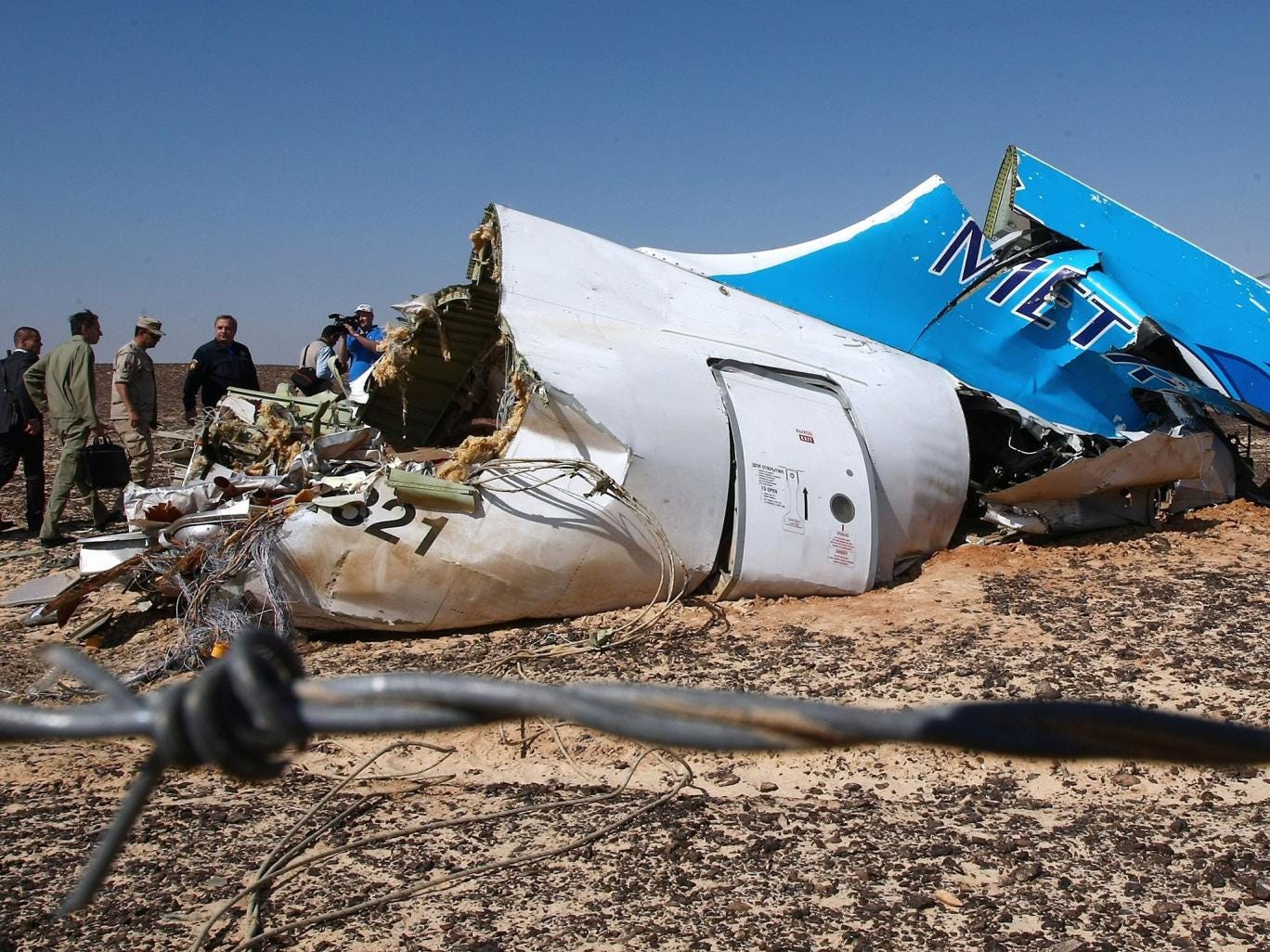
Investigations using the black boxes and wreckage being collected from the Sinai desert continued today as the victims’ bodies were flown home to Russia and Ukraine.

Russian officials have said the plane, carrying holidaymakers from the Red Sea resort of Sharm el-Sheikh to St Petersburg, probably broke up in mid-air and said the rear section caught on fire.
Vladimir Putin, who declared Sunday a national day of mourning, said everything would be done to establish an “objective picture” of what caused Russia’s worst ever air disaster.
When asked if a terrorist attack could be to blame, the Russian President’s spokesman said no theory could yet be ruled out.
Alexander Smirnov, deputy general director of airline owners Kogalymavia, said only a “technical or physical action” could have caused the aircraft to break.
“The plane was in excellent condition,” he told a news conference in Moscow. “We rule out a technical fault and any mistake by the crew.”
Robert Galan, a French aviation expert, said a possible “external impact” mentioned by Mr Smirnov could point to two possibilities: a bomb or sabotage.
Sabotage would require familiarity with the electrical or fuel systems of the Airbus A321 but he said hiding a bomb would need less knowledge, adding that dozens of mechanics and technicians can have access to each plane.
Flight 9268 was just 25 minutes into its scheduled journey from Sharm el-Sheikh to St Petersburg on Saturday morning when it disappeared from radar over the Sinai peninsula.
Egyptian officials said the pilot had previously radioed to report technical difficulties and planned an emergency landing at the nearest airport before losing contact with air traffic controllers.
Metrojet said the crew were highly experienced said both engines were inspected in Moscow on 26 October and that damage from the 2001 tail-strike had been fully repaired.
The aircraft had received a certificate of airworthiness earlier this year from regulators in Ireland, where it was registered.
Additional reporting by AP and Reuters