Summary
Here’s an evening round-up of where we are now:
- David Cameron and the visiting Egyptian president, Abdel Fatah al-Sisi, have held talks at Downing Street in the wake the British suspension of flights between the UK and the Egyptian resort of Sharm el-Sheikh. This came after UK and US officials s said they believe the Russian plane that crashed over the Sinai peninsula may have been brought down by an explosive device.
- Speaking after a meeting of the government’s Cobra emergency committee, Cameron said the Russian jet crash “more likely than not” caused by a bomb.
- Cameron defended the British action, saying it was “right to act” given the intelligence indications. Sisi, who said British security officials had inspected Sharm el-Sheikh airport ten months ago, said his country would cooperate with Britain.
- Ahead of the talks police removed campaigners who were blocking the entrance to Downing Street in protest at Sisi’s visit to the UK, because of his human rights record.
- Moves have begun to fly home 20,000 British citizens stuck in the resort. Monarch airlines will operate three “rescue flights” on Friday, while easyJet says it will run nine flights to the UK from there on Friday.
- Cameron has held phone discussions with the Russian president, Vladimir Putin, about the security situation in the wake of the plane crash. Russia had earlier criticised the UK for not sharing its intelligence about the incident.
- The German airline Lufthansa has halted flights between Germany and Sharm el-Sheikh until further notice.
Updated
Following the meeting of the government’s Cobra emergency committee, here’s some background, from David Blood in our data team, about the committee:
Today’s Cobra meeting is at least the 96th time the government’s emergency response committee has met since May 2010, according to publicly available data.
Taking its name from the Cabinet Office Briefing Room A, Cobra meetings convene senior ministers and civil servants in response to urgent national or international situations – particularly those affecting national security.
Today’s meetings were convened following revelations that the Russian flight that crashed in Sinai may have been brought down by an explosive devise.
One of the first Cobra meetings of the coalition government were called in response to the Europe-wide air travel chaos caused by the 2010 Icelandic volcano eruptions.
Subsequent meetings have been called in response to events such as the 2011 riots in England, the Ebola crisis in West Africa and following a terrorist attack in Tunisia earlier this year which left 38 people dead, including 30 Britons.
Alec Luhn in Moscow sends the official Kremlin statement on the Putin-Cameron phone call (see also this update).
The leaders exchanged views on the situation with the crash of the Russian plane over the Sinai peninsula. Vladimir Putin stressed that assessment of the causes of the crash should be based on the data that would become available in the course of the official investigation that is currently underway. The discussion also covered joint efforts to combat international terrorism.
Some more full quotes from the press conference, via PA. First from Sisi:
Ten months ago we were asked by our British friends to send a team to Sharm el-Sheikh airport to make sure all the security procedures are enough and provide the adequate safety and security for passengers.
We understood their concern because they are really interested in the safety and security of their nationals. We received the teams, we cooperated with them and they checked the security operations - they were happy with that. And we are still ready to co-operate in this particular regard, not necessarily on one airport but on all airports.
I have found complete understanding and appreciation of the Egyptian efforts. We talked about the actions needed to make sure that this will not have any negative ramification on the future of tourism in Egypt and that in the soonest time possible we restore the movement of British tourists.
And Cameron:
We are working intensively together in the spirit of close cooperation and I am immensely grateful for all the efforts the Egyptian authorities have made so far.
Not only what Egypt has done in the past to increase the security of tourists but also the further steps that can be taken today which will help to make sure British citizens can return home after their holidays...
I am sure we will be able to bring those British holidaymakers home soon because of the level of cooperation between our two governments and - more than that - I am sure that we will be able, over time, to take the necessary action to restore the holidaymaking route from Britain to Sharm el-Sheikh and vice-versa.
More news on plans to return UK tourists from Sharm el-Sheikh, following the update earlier from Monarch airlines. EasyJet says it will operate nine flights from Sharm to the UK on Friday, according to PA – two scheduled for that day, two delayed from Wednesday and five extra flights.

Cameron has had his phone conversation with Vladimir Putin, according to a Downing Street spokeswoman. Her quotes come via PA:
The prime minister reiterated his condolences over the loss of Russian life in the Sinai plane crash.
He explained that, as more information had come to light, our concerns that the plane may have been brought down by an explosive device had increased.
We had therefore taken the difficult decision to suspend flights into and out of Sharm el-Sheikh as a precautionary measure, while we sought urgent reinforcement of security measures at the airport. The safety of British citizens was our primary concern.
The prime minister and president agreed we face a common threat from terrorism. The president expressed his thanks for the call and his understanding for our concern for the safety of British citizens. They agreed to keep in close touch as the investigation progressed.

Reuters is running Cameron’s initial quotes from the press conference, which I missed. He said:
We are working intensively together in the spirit of close cooperation and I’m immensely grateful for all the efforts the Egyptian authorities have made so far.
Sisi said:
We understood their concern because they are really interested in the safety and security of their nationals.
The TV channels have cut away from the press conference. Before this, Cameron was asked by an Egyptian reporter about whether UK foreign policy was partly to blame for the rise of Islamic State – he, unsurprisingly, disagrees – and what he plans to do about the UK presence of the Muslim Brotherhood, outlawed in Egypt. Cameron says a long-delayed government review into the organisation will be published later this year.
Government review of Muslim Brotherhood will be published by the end of the year. It will show a much more robust approach, Cameron says.
— Patrick Wintour (@patrickwintour) November 5, 2015
My colleague Patrick Kingsley, previously based in Cairo, has another point to make:
A room of journos – and #Sisi. Will any of you ask about the day his troops killed 800+ protesters? Mass death-sentences? Disappearances?
— Patrick Kingsley (@PatrickKingsley) November 5, 2015
Updated
Here’s a photo of the press conference.

Updated
Cameron says he and Sisi have had “excellent discussions” on security for tourists, and further steps that could be taken.
In answer to a question about why the UK has taken the measures it has, he says:
My role is to act in the right way to keep British citizens safe and secure and to put their security first.
This is based on intelligence and advice, Cameron says, adding that there is no certainty that a bomb brought down the plane. He continues:
But if the intelligence and the judgement is that it was the more likely than not outcome, I think it was right to act in the way I did.
Cameron adds that he understands the worries of Britons either stranded in Egypt or facing a cancelled holiday there, and of the Egyptian tourism industry.
Updated
Sisi: UK experts checked security 10 months ago and were satisfied
Cameron is being quizzed at the press conference. Why, asks ITV News, is it just the UK suspending flights? Does the UK have intelligence Russia does not, or is Russia not sharing what it knows? Sisi, meanwhile, is asked whether he is offended at the inference that the UK believes Egypt cannot properly run its airport security.
Sisi responds first, reiterating that his country received a British security team at Sharm el-Sheikh ten months ago, who decreed that system there were fine. “They were happy with that,” Sis added. “We are still ready to cooperate on this.” This involves any Egyptian airport, he says.
Updated
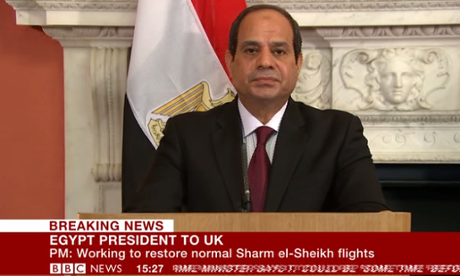
Sis has begun addressing a press conference in London.
#BREAKING Egypt 'ready to co-operate' to ensure foreign tourists' security: Sisi
— Agence France-Presse (@AFP) November 5, 2015

Here’s a photo of Sisi leaving Number 10 after his talks with Cameron.
The Press Association is reporting some initial quotes Sisi following his talks at Downing Street. The Egyptian president said he believed the countries had a “good mutual understanding” and that Egypt was “completely ready to co-operate with all of our friends” on ensuring the safety of foreign tourists.
Sis told reporters that British experts had looked at security in Egyptian airports 10 months ago found then that it was “good enough”.
German airline Lufthansa has halted flights between Germany and Sharm el-Sheikh until further notice, writes Kate Connolly in Berlin.
Lufthansa said it would continue to fly to the Egyptian capital, Cairo.
German travel agents who have clients currently holidaying on the Sinai peninsula are in consultation with the German foreign ministry about how to bring them back home.
A special transport has already been arranged to fly them back via Zurich, on Sunday, a Lufthansa spokesman said.
However holiday companies said they would continue to offer holidays to Sharm el-Sheikh. “What’s most important is the recommendations of the foreign ministry,” Sibylle Zeuch, spokeswoman for the German Travel Association (DRV) said in a statement. So far the foreign ministry in Berlin has not issued any recommendation that Germans should not travel to the Sinai peninsula. It was unclear whether it would do so.
According to the DRV around 2000 German holidaymakers are currently stranded in Sharm el-Sheik and in the seaside resort Dahab, around 90 km away. Most Germans favour the coastal resorts of Hurghada and Marsa Alam, which are not on the peninsula, the DRV said, while Sharm el-Sheikh is seen as the British and Russian resort of choice.
Stranded tourist in Sharm el-Sheikh have been voicing their frustrations.
Tens of thousands of people have been detained in Egypt since President Sisi’s predecessor Mohamed Morsi was ousted from power in July 2013. This includes journalists (for example the photojournalist Mahmoud Abu Zeid who’s been in pre-trial detention for over two years), a whole generation of young protesters, and thousands of Muslim Brotherhood members, sympathisers or even just those suspected of having Muslim Brotherhood sympathies.
By any measure it’s been a vast crackdown and Cameron cannot in all conscience ignore it. As many as 1,000 people were killed by the security forcesin a single day when it attacked pro-Morsi supporters in August 2013. No-one has been held accountable. Indeed, since Morsi’s removal, Egypt’s criminal justice system has become little more than a tool for repressing dissent. Morsi himself is one of the hundreds sentenced to death in the ensuing anti-Muslim Brotherhood purge, and the handing down of mass death sentences has become something of a hallmark of Sisi’s Egypt ...
Cameron’s revolving door of authoritarian leaders entering Downing Street is spinning again this week. But will he be able to get the stains out of the red carpet after Sisi’s walked all over it?

Updated
Russia’s foreign ministry has criticised Britain’s failure to hand over information about Saturday’s plane crash in Egypt, after London suspended flights over bomb fears.
“The British government has not given us any information about the plane crash,” Maria Zakharova, a foreign ministry spokeswoman, told reporters, according to the TASS news agency.
“If they have information and they are not presenting it that is shocking,” she added, saying it was surprising that the representative of a foreign government rather than experts were putting forward theories about the plane’s fate.
“The realisation that the British government has some kind of information that could shed light on what happened in the skies above Egypt is truly shocking,” RIA Novosti, another Russian agency, cited her as saying.
Tensions rising in Sharm el-Sheikh
Many holidaymakers in the area have not been told when they will be able to get a flight back to the UK, and have reacted angrily to being charged to stay in the resort’s hotels.
Emma Smyth, who is staying around 12 miles from the airport in the Aqua Blu hotel, said the frustrations are starting to boil over in the resort.
“Because English people are frustrated and upset, they are taking it out on the staff here, which is not fair,” she said.
“One English family, who are obviously upset and concerned, have asked the hotel if they can stay on. The hotel have set a charge and the tourists can not understand why they are being charged.
“They said they should be allowed to stay and with that one man grabbed one of the managers - they ripped his shirt, ripped his name-badge off and everything.”
Smyth, 41, who is staying in a party of nine at the hotel, was due to fly back on Friday morning but claimed she had not had any communication from easyJet about their scheduled flight.
“We are not concerned about our safety. Security in the airport felt absolutely normal and it did not worry me at all,” she said.
“I am more worried that this is going to cause an impact on the staff at the resort. The staff at the resort are stuck in the middle because they are not getting any messages to advise us of what we should be doing and we have not been contacted by easyJet to say what we should be doing.”

Updated
The UK complained about lax security at Sharm el-Sheikh airport more than a year ago, staff at the airport have told Peter Beaumont.
Britain sent an aviation security specialist and then requested tightened procedures.
Asked what he thought was the problem was an official at the airport said: “The system was the problem. The British complained then that they weren’t checking people enough. We should have done more. The security could have been improved by putting another scanner outside and updating the others.”
He made his comments as more airlines cancelled or delayed flights in and out of Sharm al-Sheikh including flights from several European destinations.
The only flights that appeared to be running normally were to Middle Eastern and Russian destinations and one route to Italy’s.
Waiting in a queue for a delayed Easyjet flight to Milan one man complained he and his family had no idea what was happening.
Several countries in northern and southern Europe are continuing to operate direct flights to Sharm el-Sheik, writes Jessica Elgot.
There are not direct flights operate to the resort from France, Germany or Spain, but Russian airlines are still flying dozens of flights over Sinai.
Here’s a breakdown of varying approaches by European countries in the wake of Saturday’s crash.
Ireland
The Department of Foreign Affairs is advising Irish citizens in Sharm el Sheikh in Egypt to avoid travelling outside the resort, and advising against all non-essential travel to Egypt.
The Irish Aviation Authority has directed all Irish airlines to avoid Sharm el Sheikh Airport and the airspace of the Sinai peninsula until further notice.
Pat Dawson, chief executive of the Irish Travel Agents Association said there was not a high demand for flights from Ireland at this time of year.
“There was a charter going throughout the summer, but that finished some weeks ago, so anyone wanting to go now would have to go via somewhere else (anyway),” he told breakingnews.ie.
Austria
The Austrian Air Berlin subsidiary Niki is still considering whether to go ahead with a scheduled flight on Saturday, a spokesman said, adding that the airline had been avoiding the northern Sinai area since the crash. “Niki is in close contact with the relevant authorities and station managers on site and monitored the situation very closely. For Niki safety is our top priority,” said spokeswoman Mielene Platzer told AustrianAviation.net.
“The implementation of the next full charter flights to Sharm el-Sheikh on November 7, 2015, is currently being evaluated, taking into account all the information available.”
Netherlands
The Dutch government has said it will wait for the results of the British safety inquiry before any decision is taken to suspend flights to the resort.
No Dutch flight is scheduled to fly over the northern Sinai until Sunday. KLM has not operated any flights over the area since Saturday, national broadcaster NOS reported. Dutch travellers are believed to currently be in the resort and were advised to contact their tour providers though there was no word on numbers.
Ukraine
Ukraine has banned flights over Sinai, according to Ukraine’s state news agency.
Earlier Egypt’s civil aviation ministry had said it expected eight flight to Sharm el-Sheikh from Ukraine today.
Italy
The Italian airline Meridiana is so far continuing to operate direct flights to Sharm el-Sheikh though one flight has been cancelled by Easyjet this morning from Milan Malpensa. Three flights from Italy are due to arrive today, according to Egypt’s civil aviation authority.
The Italian government is yet to issue any advice for tourists not to visit the resort.
Belgium
The Belgian airline Jetairfly has postponed its flight between Brussels and Sharm el-Sheikh for 24 hours, which was set to depart from Belgium with 133 passengers.
In a statement, the airline, which is part of the TUI group, said they wanted to “give ourselves the necessary time to assess the security situation correctly”, according to Het Laatste Nieuws, which reported 119 Belgian tourists are currently in Egypt, and not yet able to return home.
The Belgian government is waiting for the travel company’s assessment to be made before taking further action, De Standaard said.
Thomas Cook Belgium said its flight from Sharm el-Sheikh departed as normal this morning.
Switzerland
Swiss airline Edelweiss said it had not taken routes over the northern Sinai for some time as a precautionary measure, but said its weekly direct flights from Zurich would continue as planned. Spokeswoman Karin Müller told Swiss website 20 minuten said the airline had “increased security measures on Thursday morning to the maximum level” but said that would not affect passengers.
A fully-booked flight is scheduled to depart tomorrow and its route will remain the same for the time being, she said, but said if new security information is received the airline will consider cancelling the flight.
Tour operator Kuoni told the website it has currently 50 Swiss customers in Sharm al-Sheikh and was not planning any evacuation.
France
“We are not in the same position as Britain. There are no direct flights between France and Sharm el-Sheikh,” a diplomatic source told L’Express. “We remain extremely cautious about the region and will make decisions based on the information that will arise [after the investigation].”
The French foreign ministry, like many countries, advises against all travel to the Sinai though Red Sea resorts are classified as lower risk

Updated
If Isis was responsible for downing the Russian Metrojet what would that mean? asks Charlie Winter senior researcher at the anti-extremism thinktank Quilliam.
Increasingly, the signs seem to be pointing towards foul play. No evidence has been made public yet, but the British government has suspended all flights to and from Sharm el-Sheikh, leaving about 20,000 Britons stranded in the Red Sea resort town.
Until any concrete conclusions emerge, we are left with three working hypotheses: first, that Isis is freeloading off the publicity surrounding the crash; second, that ISIS did it; and third, that someone else is responsible.
The last option is the least likely, so let’s put it to one side.
Regarding the first hypothesis, the motivations for opportunism are replete – Isis’s claiming involvement has already thrust it to the forefront of the headlines, bolstered its perception of momentum, and ensured sustained relevance.
All of it has come – if this is the case – at next to no cost. Even if it turns out that Isis was not involved, the boons of publicity far outweigh the drawbacks to being outed as duplicitous.
If, however, it turns out that the flight was downed by Isis, the situation is markedly more complicated. It would make Isis – an organisation that has hitherto relied on high-profile self-starter terrorist attacks – responsible for the second deadliest terror attack since 9/11 (the first being Beslan).
Furthermore, it would mean ISIS had succeeded in pulling off something that its chief jihadist rival, al-Qaida, has tried and failed to do for years (blow up an aircraft mid-air).
If it does emerge that Isis caused the crash, we need to ask, first of all, how Isis came to this capability and, secondly, why it has persistently withheld any real evidence of its claims.
In answering the first question, the ability to pull off an operation like this could be a boon of Isis’s “caliphate” model and the internationalised operational capabilities it presents. For example, the attack could have been planned by Isis in Syria, the bomb could have been built by Isis in Egypt, and the operative who smuggled it on board could have been from ISIS’s Russian affiliate.
On the second question regarding the lack of evidence, there are a number of things that could be at play. First and foremost, obfuscation like this maximises attention. Just as it cultivated confusion surrounding the fate of the Jordanian pilot, Mu’adh al-Kasasbeh, earlier this year, Isis could just be drawing everything out with a view to milking the operation for all its worth. If – emphasis on if – this is the case, it is not beyond reason that Isis will release a high-profile video from one of its central propaganda outlets in the near future.
If the rumours of Isis’s sabotage become reality, the consequence would be huge. Among other things, Egypt’s tourism industry would be hit immensely hard; air travel the world over would suffer; and security restrictions would likely be revamped and maximised. Regarding Isis, in particular, the implications would be great, too. After all, it would mean that Isis had resolutely trumped al-Qaida, and would likely lead Russia to step up its anti-Isis military campaign – both things that would boost its recruitment efforts dramatically.
In any case, it is critical that, until the final crash analysis emerges, we keep our speculation rational and our assumptions grounded in real, physical evidence.
Taking Isis at its word and believing its claim on the basis of a few statements, as some have been guilty of already, is a potentially catastrophic error.
Ibrahim, a hotelier in Sharm el-Sheikh, told LBC that the Britain’s decision to cancel flights to Egypt was “premature”.
Rescue flights planned for tomorrow
As the transport secretary was speaking in the house, the Department for Transport was holding meetings with the chief operations officers of airlines telling them to restart homebound flights tomorrow, writes Gwyn Topham.
Monarch will be adding three “rescue flights” on Friday - one each to London Gatwick, Birmingham and Manchester - as well as operating the two normally scheduled from Sharm to Gatwick and Manchester.
All tour operator outbound flights for passengers are cancelled.
Flights to Hurghada, further up the Egyptian Red Sea coast, are still operating as scheduled.
If the flights go ahead it would mean that roughly a third of Monarch 3,000 customers in Sharm can expect to return on Friday.
Updated
Tourism is central to Egypt’s faltering economy and Sharm el-Sheikh is the country’s most lucrative resort, writes Mark Tran.
According to a 2014 report by the World Bank and a French aid agency international tourist numbers to Egypt reached 15 million in 2010, while tourist spending reached $12.5bn in 2013.
In the same year tourism contributed 8.1% to Egypt’s GDP and remained the country’s largest foreign exchange earner, more than worker remittances and petroleum products. In 2010, total direct and indirect employment in the sector was equivalent to 3.7 million jobs.
The industry has faltered since early 2011, when a popular uprising toppled longtime strongman Hosni Mubarak after three decades in power. Last year, fewer than 10 million tourists visited, sharply down on 2010.
Within Egyptian tourism, Sharm el-Sheikh, is considered the country’s jewel in the crown. Located on the Gulf of Aqaba, on the southern tip of the Sinai Peninsula, and part of the South Sinai Governorate, Sharm’s attractions include the nearby St Catherine Monastery, the Sinai mountains and excellent diving and snorkelling in the Red Sea.
In 2010, 35% of the country’s tourists arrived and stayed in Sharm and tourism has led to a booming population, which is forecast to reach 122,000 in 2017, from its current 73,000.
In anticipation of Sharm’s tourism growth, the African Development Bank in April approved a $140m loan to Egypt’s Sharm el-Sheikh development project, which includes construction of a new terminal, runway and control tower at Sharm el-Sheikh airport.
The project is expected to provide an additional capacity for 10 million passengers a year, bringing the airport’s total passenger capacity to 18 million annually. Sharm el-Sheikh airport has been Egypt’s fastest-growing facility and is Africa’s third-busiest airport, with an average of 10% annual growth rate in traffic over the past decade. The total number of passengers using the airport reached 8.2 million in 2010, more than the airport was designed for.
In March at a recent economic development conference in Sharm el-Sheikh in March, the government launched its strategic development strategy called Egypt’s Vision 2030. The document cites tourism as a key strategic sector for investment, and one that promotes growth of investment and large scale infrastructure.
In July 2005, Sharm el-Sheikh was hit by bombings by Islamist extremeists that killed nearly 90 people, in one of the deadliest attacks in Egypt.
As stranded British tourists began gathering at Sharm el-Sheikh’s airport more details have emerged of Wednesday’s decision to delay flights to and from the UK, writes Peter Beaumont at the resort.
According to Egyptian airport staff, the focus of tightened security at the airport has been on procedures for screening both luggage and airport staff.
Egyptian security services have tightened up checks of all vehicles at the entrance to the Red Sea resort’s airport. Security was also increased at hotels.
The measures followed an inspection of screening procedures at the airport by two aviation security experts from the UK’s Department of Transport, who flew in on Wednesday. It was this inspection – conducted in liaison with Egyptian officials – that prompted the experts to advise the Foreign Office and Downing Street to delay flights.
The delay left hundreds of passengers who were due to fly home to the UK on Thursday desperately seeking information as they converged on the airport.
British officials were apparently concerned that security measures could still be bypassed, despite the presence of scanners at several stages in the check in process.
Peter Halkyard and his wife Sheryl, from Leeds, have been visiting Sharm for 13 years, and were due to fly home on Thursday. They said security had always appeared thorough, and that they had noticed increased measures earlier this year following the terrorist attack on a tourist beach in Tunisia.
“We got scanned three times. It seemed thorough,” Peter said of previous security checks at the airport. “At the gate they would pull some people out for extra checks.”
More British embassy officials are due to arrive in Sharm el-Sheikh to assist with the effort to return an estimated 20 000 British tourists home.
Explaining the reasoning for grounding UK- bound planes – many of which were visible on the nearby runway – a spokesman for the British Embassy in Cairo said: “This is a precautionary measure. After the crash of the Russian airline on Saturday we have become increasingly concerned that it might have ben an explosive device. Because of that we have deployed a team of UK aviation experts and after an assessment it was decided to delay UK-bound flights. This is to ensure the safety of British citizens.”
Waiting for their return flights to Glasgow, Christina Marletta and her friends said information had been hard to come by.
“News about the crash was very low key here,” Marletta said. “The first we really knew was when our family called to ask if we were OK. We came to the airport today because we didn’t know what was happening with our flights. We heard about it when someone at the hotel said ‘did you hear that British flights have been cancelled’?”
Asked if she would visit Sharm el-Sheikh again, Marletta’s friend Evelyn Weir shook her head and said no, adding: “It’ll be a caravan next time.”
Despite the cancellation of the British flights, people from other countries such as Russia and Jordan continued to fly home as normal.

Updated
Here are more pictures of David Cameron meeting the Egyptian president, Abdel Fatah al-Sisi, a few minutes ago.


Updated
This is what David Cameron said in the interview earlier when he was asked about whether Russia should also be suspending flights to and from Sharm el-Sheikh.
It’s obviously a matter for the Russians about whether they continue to fly. If you look at what other countries have done, the Americans have changed their travel advice to Sharm el-Sheikh – they did that after seeing particular intelligence and concerns that they had. Because of what I’ve been briefed about, the intelligence I’ve seen and the briefing I’ve had from experts and officials, I think it was right to stop our planes from going to Sharm el-Sheikh and right to stop people returning until we have that security put in place.
I’ll obviously discuss all of this with President Putin and explain to him why we’ve taken the action we’ve taken. But obviously the action he takes about Russian tourists, that will be a matter for him.
Here are some more details from the Number 10 lobby briefing, which was devoted almost entirely to the situation at Sharm el-Sheikh.
- David Cameron chaired an hour-long meeting of the Cobra emergency committee to discuss the affair this morning.
- Cameron is calling President Putin today to discuss the matter.
- The government’s priority is to get flights up and running from Sharm back to the UK, the prime minister’s spokeswoman said. “We are working around the clock with the Egyptian authorities and the airlines on this and discussing what security measures need to be put in place so that we can be confident of the security arrangements,” she said. Once those flights have resumed, and stranded holidaymakers brought home, the government will focus on getting UK flights to and from Sharm back running normally.
- The spokeswoman said that the assessment about what caused the Russian crash had been “evolving” since the crash on Saturday. The decision to suspend flights yesterday was taken after more information came to light yesterday.
- The spokeswoman suggested that Britain may insist on installing its own security arrangements at Sharm el-Sheikh airport. When asked directly if this was the case, she did not deny it, but simply said “a range of options” were being considered to beef up security.
- Some 16 flights from Sharm, each carrying around 200 passengers, were cancelled today, the spokeswoman said. Around three or four were cancelled yesterday.
Updated
President Sisi has now arrived at Number 10 for his talks with David Cameron.
President Sisi gets a warm welcome from PM Cameron at 10 Downing Street pic.twitter.com/4fFBdODSvw
— Clarissa Ward (@clarissaward) November 5, 2015
McLoughlin says the Foreign Office has deployed people to Sharm el-Sheikh.
At the lobby briefing a few minutes ago, Number 10 said British military personnel had been sent to the airport, along with consular staff and aviation staff. The military staff were there because they had experience of the logistical difficulties of handling an evacuation, the prime minister’s spokewoman said. She played down suggestions that the government was thinking of using RAF plans to bring people home. “We are focusing on working with the airlines,” she said. There are reportedly six military staff at Sharm.
Patrick McLoughlin, the transport secretary, is making a statement to the Commons about Sharm el-Sheikh now. I will be covering it, and taking over the blog from Matthew for a while.
Patrick McLoughlin on Russian plane crash: The govt are reaching the view that a bomb on board is a "very significant possibility."
— Mollie Malone (@Mollie_malone92) November 5, 2015
Patrick McLoughlin,Transport Sec: the decisions made re Sharm flights are "very serious indeed" and are for the "safety of British citizens"
— Mollie Malone (@Mollie_malone92) November 5, 2015
The British transport secretary, Patrick McLoughlin, has said he hopes rescue flights will start on Friday.
Updated
If Islamic State did bring down a packed passenger jet over the Sinai desert, which many US and UK officials believe is a “significant possibility”, then the act would mark a significant escalation of the group’s capabilities and strategic aims, but also underline its continuing regional – rather than global – focus, writes Jason Burke.
So far, Isis has limited itself to calling on individuals in the west to strike targets where they live, rather than directly controlling or commissioning complex attacks anywhere outside the Islamic world. The focus of 99% of the group’s attention has been on its key strategic objectives: slowly but steadily expanding its base in Iraq and Syria, with an accompanying interest in building a network of affiliates.
An attack on Russian passengers in a plane would thus be an escalation, and Isis claims of responsibility for the attack last weekend, though vague, make it clear that Moscow has been added to the members of the “crusader-Zionist alliance” that militants of all stripes believe is dedicated to humiliating, dividing and subordinating Muslims.
Yet the destruction of the Airbus A321M remains nonetheless within a local context, rather than a global one. The Russians are a target because of their armed intervention in the Syrian civil war from a month ago, not because of their actions outside this theatre. The prime suspects behind the tragedy, if it does prove to be a terrorist attack, are local Isis supporters in the Sinai, according to reports of the thinking of US and UK officials. The location of the strike is within the core zone of territory of most interest to Isis.
If it was indeed an Isis bomb that brought down the plane – and both Egypt and Russia have downplayed any suggestion that the crash is linked to terrorism – then this still does not signal that the group has launched a fully fledged global campaign of violence. Yet.
Updated
Here’s PA take on the prime minister’s remarks (see earlier audio).
David Cameron has said it is “more likely than not” that a Russian airliner was downed by a terrorist bomb as he defended moves to halt flights to and from Sharm el-Sheikh.
The Prime Minister said he had “every sympathy” with Cairo’s anger over the impact on its tourist industry but that the move was “about putting the safety of British people first”.
Speaking after chairing a meeting of the Government’s Cobra emergency committee, Cameron said he would discuss the situation with Egyptian president Abdel Fatah al-Sisi who is due at Number 10 shortly.
Cameron is also due to talk with Russian president Vladimir Putin by phone about the latest developments.
“The decisions that I am taking are about putting the safety of British people first,” Mr Cameron said. “That is why we have suspended flights to Sharm el-Sheikh and that is why it is going to take some time before we can fly people out.
“What we need to put in place is more security at that airport so it is safe to fly people home.”
Egypt’s foreign ministry has criticised Britain for its failure to consult Cairo before cancelling flights.
A Foreign Affairs ministry spokesman stated that the British decision was taken unilaterally without consulting with Egypt, in spite of high level contacts between the two sides just hours before the decision was announced.
He added that Egypt has responded positively to British security concerns by enhancing security measures at Sharm el-Sheikh airport.
The spokesman said that Foreign Minister Sameh Shoukry had discussed the issue with his US counterpart John Kerry. He claimed during the call Kerry “asserted that the news reports propagated by the media regarding US assessments of the causes of the crash do not represent the official position of the US administration, which has not issued any official statement in this regard”.
Updated
Thomson Airways has cancelled all outbound flights to Sharm el-Sheikh for at least a week after reading advice from the Foreign Office.
In a statement it said:
Following the change in the Foreign and Commonwealth Office (FCO) travel advice advising against all but essential air travel to Sharm el-Sheikh, Thomson Airways can confirm it has cancelled all outbound flights to Sharm el-Sheikh up to and including Thursday 12th November.
We are doing everything we can to assist customers as we manage this evolving situation.
All customers booked to travel to Sharm el-Sheikh in this period will be provided with a full refund or can amend to any holiday currently on sale. If the new holiday is taken before the end of April 2016 we are also offering a £30 per person discount. As a priority, we are contacting customers due to travel today and ask those travelling later in the week to please bear with us as we manage this evolving situation.
Our experienced overseas resort team are updating all our customers currently on holiday in Sharm el-Sheikh of the change in FCO travel advice and we will be making arrangements to return these customers to the UK. Customers who are delayed are being accommodated in their hotels on the same board basis.
Holiday reps are regularly visiting all hotels and can be contacted for the most up to date information when it is available. Customers are advised to keep an eye on the noticeboards in the hotels or our website for the latest information.
Updated
Here’s audio of Cameron claiming that Saturday’s crash was “more likely than not” caused by a bomb. The prime minister also revealed he was about to call Russia’s president Putin about the crisis.
Cameron said stranded tourists would be rescued as soon as possible.
Updated
Cameron also said he had “every sympathy’’ with Egypt’s concerns about security and would discuss those with Sisi during his talks with the Egyptian leader.
Cameron: Russian plane crash 'more likely than not' caused by a bomb
David Cameron has warned it could “take some time” to start flying UK tourists back from Sharm el-Sheikh, PA reports.
The prime minister said but it is vital to ensure their safety after it became clear the
Russian jet crash was “more likely than not” caused by a bomb.
Updated
Protesters against President’s Sisi visit to the UK have been facing off against his supporters in Whitehall.


Photograph: Dan Kitwood/Getty Images
David Cameron is due to make a statement in Downing Street in the next few minutes after chairing a meeting of the government’s emergency Cobra committee.
Ukraine bans flights over Sinai
Ukraine has banned flights over Sinai, according to Ukraine’s state news agency.
Earlier Egypt’s civil aviation ministry said it expects eight flight to Sharm el-Sheikh from Ukraine today.
Yaroslave Troflimov from the Wall Street Journal reckons this is another big setback for the resort.
Ukraine bans its airlines from overflying Sinai. Ukraine a major source of tourists in Sharm. https://t.co/tr8EvLxEov
— Yaroslav Trofimov (@yarotrof) November 5, 2015
Updated
While Philip Hammond was talking about flying empty planes out to Egypt to bring tourists home, British Airways said it was still planning on taking UK passengers out tomorrow, writes Gwyn Topham.
BA sent Gwyn this statment:
We will be providing hotel accommodation to customers in Sharm el-Sheikh who were due to fly to Gatwick with us today.
We are working closely with the UK government to find the best possible solution for our customers who are on holiday in the resort and those due to fly out from the UK.
We understand the current situation is frustrating, however it is out of our control and the safety and security of our customers and crew is always our top priority.
Following the decision by the UK government to suspend flights, the British Airways flight (BA 2560) which was due to depart Gatwick this morning has been postponed until Friday.
The BA2561 which was due to depart Sharm el-Sheikh this evening will also depart one day later on November 6.
Customers not wishing to travel on the postponed flights on Friday will be able to claim a full refund or switch to an alternate destination.
Updated
The Egyptian authorities have yet to release any information about the examination of the black box recorders recovered from Saturday’s crash, writes Jahd Khalil in Cairo.
When asked about when there would be some results from the black box investigation, Mahmoud El Zanaty, the head of the Eygptian Civil Aviation Authority said: “They are still working on it.”
He added: “There is no new news about it. I hope that there will be some results today or tomorrow, but I don’t know what time it takes.”
Summary
Here’s a roundup of what we know so far:
-
All flights between the UK and the Egyptian resort of Sharm el-Sheikh have been suspended after US and UK officials said they believe the Russian plane that crashed over the Sinai peninsula may have been brought down by an explosive device. Hammond said there is a “significant possibility” that the plane was brought down by an explosion on board, the strongest remarks yet by an official on the cause of the crash.
- The British government has said up to 20,000 of its citizens will be evacuated from Sharm el-Sheikh from Friday regardless of the cost. British military personnel are travelling to Egypt to implement short term emergency measures before the rescue flights get underway.
- David Cameron is chairing a meeting of the government’s emergency Cobra committee, ahead of planned talks with Egypt’s president Abdel Fatah al-Sisi. The UK transport secretary, Patrick McLoughlin, is due to make a statement to Parliament at 12.30pm.
- An influential Russian politician has accused the UK of suspending flights to Egypt as a ploy to put pressure on Russia over it policy towards Syria. Konstantin Kosachyov, who chairs the foreign committee in Russia’s upper house of parliament, said the UK’s decision was meant to put “psychological pressure” on Russia over its airstrikes against Syrian rebels.
- Holiday makers in Sharm el-Sheik have been expressing their frustration at being stranded in the resort. Kate Dodd, from Didsbury in Lancashire, currently in the resort with a four-month-old baby and a five-year-old child, said “They’re not telling us much really.”
- Police have removed campaigners who were blocking the entrance to Downing Street in protest at Sisi’s visit to the UK. Sisi is due to arrive in the UK to hold talks with the British prime minister on security cooperation at Number 10 on Thursday, despite being accused of a catalogue of human rights abuses since leading an army coup in July 2013.
- A militant group linked to Islamic State has claimed responsibility for Saturday’s Russian plane crash that killed all 224 people on board. It directly blamed Russian president Putin for launching airstrikes in Syria. US officials have suggested a bomb was planted on the plane by Islamic State or an Isis affiliate, according to several media reports citing unnamed sources.
- New video footage shows the smouldering wreckage of the Russian plane after it crashed in Egypt on Saturday. According to reports, the video was filmed by Egyptian military servicemen two hours after the Airbus crashed over the Sinai peninsula.
Updated
Tour operators will be sending empty planes out to Sharm el-Sheikh to fly holidaymakers back, UK foreign secretary Philip Hammond told Sky News, writes Jamie Grierson.
Hammond estimated that it will take up to 10 days starting from tomorrow to clear the backlog of Britons stranded in the resort.
Hammond said British military aircraft may have been used to transport aviation security experts to Sharm but there was no plan to use them to carry holidaymakers back to the UK.
He said: “As we saw in aftermath of the Sousse attacks, the tour operators are actually the ones who have the capacity to organise this.
“They have access to huge numbers of aircraft and seats, they are organised they are geared up to deal with this kind of issue when it arises and we would expect the tour operators to manage all the capacity that’s needed to bring people out from Sharm el-Sheikh using regular tour operator flights, it’s just in the short term they will fly out empty in order to bring people back.”
Updated
Russian media has suggested Britain has reacted prematurely by suspending flights to Sharm el-Sheikh, writs Alec Luhn in Moscow.
While experts are working at the air crash site in Egypt and trying to establish the causes of the tragedy, in London they already know everything ahead of time,” the national daily newspaper Komsomolskaya Pravda noted in its news piece. “You can think up a lot of explanations, but not one has received official confirmation,” the newspaper said.
Many Russian carriers have continued flying while avoiding the Sinai Peninsula where the plane went down on Saturday, but the possibility of cancelling flights has not been raised by officials. Metrojet, which operated the flight that crashed, was allowed to continue its trips to Egypt after additional safety checks.
The official newspaper of the Russian government, Rossiiskaya Gazeta, said Russian and Egyptian experts had not found traces of explosives on passengers’ bodies and quoted a source saying premature speculation on the causes was negatively affecting the investigation.
Russian state television channels had reports on Thursday morning about the UK suspending flights to and from Sharm el-Sheikh, but were sceptical of such a conclusion. Instead, they were focusing on the difficulty of the crash investigation in Egypt and the recovery of bodies.
If it emerges that a terrorist attack was responsible for bringing down the flight, it could provoke doubts in the Russian air campaign against rebels in Syria. After the air strikes started in late September, several Islamic extremist groups called for attacks against Russia. Surveys have shown most Russians support military assistance for Bashar al-Assad’s regime but not the deployment of ground forces.
If Russians die in a terrorist attack, there could be “indignation with the authorities who became the reason for this tragedy with their war in Syria”, said Lev Gudkov, director of the independent polling comppany Levada Centre. But he added that this indignation would likely be matched by increased support for the government in response to the threat of Islamic terrorism, which has long been a major issue given the simmering Islamic insurgency in Russia’s Caucasus region.
By making an enemy of Isis, Putin has put Russia directly in the firing line, writes Simon Tisdall.
This will not go down well with the Russian public, which showed little support for another recent Russian interventions, in Crimea and eastern Ukraine. Body-bags, military and civilian, bring back bad memories for Russians of the disastrous war in Afghanistan in the 1980s.
For a man who is notoriously touchy about Russia’s reputation and standing, the fact that the Obama administration and British ministers publicly predicted that Putin’s intervention would make Russia a terrorist target is galling ...
There is unlikely to be any immediate political cost to Putin, given his government’s dominant control over parliament and the media. Rather, the next pressing question, if Moscow accepts that Isis caused the disaster, is what Russia may do by way of retaliation.
Putin has spoken about reacting in an appropriate way once the facts are established. What this means is unclear. It could involve significant escalation against Isis in Syria, or an expansion of Russian involvement into Iraq, where parliament has already urged the Baghdad government to seek Moscow’s help in fighting Isis in the north. Or Putin’s response could include a crackdown on Islamist militants in Chechnya and other Muslim areas, something he has done before at times of national stress.
The British government has said up to 20,000 of its citizens will be evacuated from Sharm el-Sheikh regardless of the cost, and normal flights may not resume for weeks, after UK and US intelligence sources suggested the Russian plane disaster was caused by a bomb, writes Rowena Mason.
Philip Hammond, the foreign secretary, said the UK would do whatever it took to bring tourists home, despite Egypt’s claims that its measures are premature and unwarranted.
The UK acted unilaterally on Wednesday night, as David Cameron ordered the suspension of all flights to and from Sharm el-Sheikh – the airport from which the Russian Metrojet plane that crashed in Sinai on Saturday took off.
It has now emerged that Cameron did not consult the Egyptian president, Abdel Fatah al-Sisi, who was in the air at the time on his way to London for long-scheduled talks at Downing Street. Those talks are now likely to be marred by tensions about the UK’s assessment that Egypt does not have adequate security at the Red Sea resort’s airport.
Updated
Police physically removed five anti-Sisi protesters who were lying on the ground playing dead and blocking the gates to Downing Street, writes Haroon Siddique.
Some wore white boiler suits with fake blood. One had “Freedom” written on his back and another “Human Rights”. Before removing the protesters police warned them they were committing an offence by obstructing the highway.
A sixth man taking part in the protest, Abdel Rahman Hegazi, 29, left voluntarily because of pain in his knee. Hegazi, a computer engineer from London, told the Guardian: “We belong in a democratic country and they claim [to have] British values. The whole world knows he [Sisi] killed more than 8,000 people in two years and imprisoned more than 50,000. The prime minister knows that and yet welcomes him.”
Meanwhile, across the road, large crowds gathered side-by-side for pro and anti-Sisi demonstrations. Their loud chants included “We love Sisi” and “Shame on you Cameron” respectively.
The anti demonstrations were organised by a coalition of groups including the Egyptian Revolutionary Council, Stop Sisi and Stop the War. Hany Mansour, a member of the Egyptian president’s delegation, told the Guardian he had organised the pro-demonstration.
Opposing demos now outside Downing St Pro- Sisi (L) organised by his delegation & anti-Sisi (R) #Egypt pic.twitter.com/F5ThLVlWFm
— Haroon Siddique (@Haroon_Siddique) November 5, 2015
Anti- Sisi protesters being removed from outside Downing St. All taken away bar one who left voluntarily pic.twitter.com/gSL2zpUA6o
— Haroon Siddique (@Haroon_Siddique) November 5, 2015
Updated
Police in Whitehall have been removing protesters who were blocking the entrance to Downing Street ahead of President Sisi’s talks with Cameron, Haroon Siddique reports.
Police physically remove anti- Sisi protesters outside Downing St. One still lying there #Egypt pic.twitter.com/MjJcj29DXZ
— Haroon Siddique (@Haroon_Siddique) November 5, 2015
Protesters blocking Sisi 's route into Downing Street #Egypt pic.twitter.com/Mqo4tFkFDd
— Haroon Siddique (@Haroon_Siddique) November 5, 2015
Egypt’s civil aviation ministry insists that its airports are safe and that it is expecting flights to Sharm el-Sheikh today from seven countries.
In a statement Hossam Kamal, Egypt’s minister of civil aviation of, said that all Egyptian airports apply international standards in airport security measures.
These measures are audited regularly by Egyptian civil aviation authority, international organisations and bilateral audit teams from USA and UK.
Kamal said that speculation that Saturday’s crash was the work of terrorists was “not based on facts”. He said the investigation team “does not have yet any evidence or data confirming this hypothesis”.
The ministry added: “There are 23 flights from Russia operating today to Sharm el Shiekh, eight from Ukraine, three from Italy, one from Turkey, two from Saudi Arabia, one from Jordan, one from Belgium.”
Updated
EasyJet has promised a refund to anyone who has booked flights with it to Sharm over the next fortnight.
In a statement it said:
EasyJet has cancelled its flights to and from Sharm el-Sheikh on 5 November. It will keep its flights to and from Sharm el-Sheikh under review, pending further advice from the Government. Passengers booked to travel to Sharm el-Sheikh in the next two weeks are able to request a refund, or change their flights to an alternative date or destination free of charge.
“We are doing all possible to keep all affected passengers informed and have provided hotel rooms for passengers who are delayed. We are working with the UK Government to work out the basis upon which easyJet can fly passengers in Sharm el-Sheikh back home.
“The safety and security of its passengers and crew is easyJet’s highest priority.
“The flights which were scheduled to operate today into Sharm el-Sheikh are as follows – four from London (two from Gatwick, one from Stansted and one from Luton), one from Manchester and one from Milan Malpensa.
“We would advise any passengers due to travel from Egypt with easyJet in the coming days to check on Flight Tracker for the most up to date information on easyJet.com.”
Updated
Amy Watson, a British woman stranded in Sharm el-Sheikh, told LBC that the decision to cancel flights has prompted anxiety and some panic in the resort. But she said she supported the decision and that holidaymakers had been well treated.
Updated
Russian flights to Sharm continue
The Kremlin has dismissed Britain’s decision to cancel flights to Egypt as one based on “speculation”, with Russian flights to Sharm el-Sheikh continuing as normal.
Some 23 flights are due to arrive at Sharm on Thursday, Reuters reports.
Dmitry Peskov, a spokesman for President Vladimir Putin, played down Britain’s assertion that there is a significant possibility that militants affiliated with Islamic State orchestrated a bomb attack on the Russian airliner.
“We have said this before and we will repeat it again: theories about what happened and the causes of the incident can only be pronounced by the investigation,” said Peskov, when asked about Hammond’s comments.
“So far, we have heard nothing (like this) from the investigation. Any kind of similar assumptions like this are based on information that has not been checked or are speculation.”
Peskov said Russian planes were continuing to fly to and from Sharm. He said he hoped that anyone who had information about what really happened would pass it onto investigators.
Russia’s prime minister, Dmitry Medvedev, told a government meeting on Thursday he also deemed it too early to draw any conclusions about the causes of the crash. But he ordered officials to start talks with foreign aviation authorities to see if additional security measures could be taken anyway.
Updated
Egypt’s president, Abdel Fatah al-Sisi, is still playing down the possibility that terrorists brought down the Russian plane on Saturday.
Ahead of his talks with David Cameron, Sisi insisted that the investigation was still underway, according to the BBC’s Frank Gardener.
#Egypt Pres Sisi responds to my Qn re #RussianAirliner crash: investigation still not concluded, promises transparency + nothing to hide 2/2
— Frank Gardner (@FrankRGardner) November 5, 2015
The point was echoed by Egypt’s aviation minister. Reuters quoted him saying there is no indication so far to suggest that an explosion brought down the Russian plane.
Meanwhile, human rights campaigners are gathering in Whitehall to protest against Sisi’s visit.
Protestors against visit of Egyptian President blocking entrance into Downing Street #sharmelsheikh #sharm pic.twitter.com/wjyNgsdpfz
— norman smith (@BBCNormanS) November 5, 2015
Updated
The Ministry of Defence has confirmed that more military personnel are on their way to Sharm el-Sheikh as part of the “short term emergency” measures outlined by the foreign secretary, Philip Hammond.
The MoD has been briefing defence correspondents of the BBC and the Times.
MoD say a small team of military personnel has been sent to Sharm. Will advise on security and logistics along with FCO DofT
— Jonathan Beale (@bealejonathan) November 5, 2015
UK sends small military team to Sharm el-Sheikh as part of FCO/transport mission to assess security at airport.
— Deborah Haynes (@haynesdeborah) November 5, 2015
The "handful" of UK military personnel are security and logistics experts. Half are already at Sharm el-Sheikh, other half are en route
— Deborah Haynes (@haynesdeborah) November 5, 2015
Updated
UK transport secretary Patrick McLoughlin’s statement to Parliament has been put back to 12.30.pm.
He had been due to update Parliament at 10.30am but it has now been put back until after the latest meeting of Cobra, the government’s emergency committee.
I will be holding another COBRA meeting later this morning - overseeing how we are helping British tourists in Sharm el-Sheikh.
— David Cameron (@David_Cameron) November 5, 2015
Updated
There are conflicting reports about the future of head of security at Sharm el-Sheikh airport.
Overnight there were reports that Adbel-Wahab Ali had been sacked. But the Independent quotes Adel Mahgoub, chairman of the state company that runs Egypt’s civilian airports, saying that he had in fact been “promoted” to a role as his assistant.
He said Ali was being replaced at Sharm by Emad el-Balasi, a pilot.
Russia accuses UK of trying to pressure Kremlin over Syria airstrikes
An influential Russian politician has accused the UK of suspending flights to Egypt as a ploy to put pressure on Russia over it policy towards Syria, writes Alec Luhn in Moscow.
Konstantin Kosachyov, who chairs the foreign committee in Russia’s upper house of parliament, said the UK’s decision was meant to put “psychological pressure” on Russia over its airstrikes against Syrian rebels.
“Geopolitical resistance to Russia’s actions in Syria is going on,” Kosachyov told journalists on Thursday. “As blasphemous as it sounds, there are plenty in the world who would prefer to knowingly and without the necessary grounds write off this catastrophe as jihadists’ response to Russia.”
He added that Russia had no reason yet to cancel flights to Egypt and said “most countries in the world approach such decisions more seriously and responsibly and will make them only if sufficient grounds for this appear”.
His comments come after Russian media reacted with scepticism to Britain’s decision.
Updated
Some of the holiday makers stranded in Sharm el-Sheikh have been expressing their frustration, PA reports.
Sarah Cotterill had been due to return to Gatwick on an easyJet flight on Wednesday afternoon. Speaking to the BBC she said: “We were queuing up to board the plane, at which point the news came through from the UK that they were grounding flights, so after spending about three hours at the airport we’ve been bussed back to our hotel, and that’s where we are at the moment.
“At the airport we had practically no information, and there was a few members of the Egyptian staff at the airport trying to tell us what they knew, but that was practically nothing. Just as we were leaving, some embassy staff turned up and they travelled with us to the hotel.
“While we were sat at the hotel, the lady from the embassy was telling us what was going on, but this morning we’ve not seen or heard from anybody. All we know is what we’ve managed to find on the internet, from the airline, from your website and things like that.”
Asked about whether her flight was being rescheduled, Cotterill said: “We’ve got no idea. All we know is from easyJet’s website that it’s not likely to be today, but we don’t know when it will be.”
Asked how she would feel about getting on a plane, she said: “Obviously it’s worrying, but I think now that they’re putting all this in place I think it will probably be the safest plane going from anywhere, I think, because they’re going to be really checking everything because of what’s happened, so I was concerned before but now I think they’re taking the safety very seriously.”
Adam, from Sheffield, has been staying at the Radisson Blu resort with his brother.
The pair were due to fly back to the UK with Monarch on Friday, but say they have “no idea whatsoever” about what will happen. He said he had received only “generic information” from the airline.
Adam, who declined to give his full name, said: “We have been kept in the dark a little bit. We’ve just been told all flights have been cancelled. A little bit of information would have been nice - just something.”
Having visited last year he said: “It definitely feels different for me. The mood is a bit tense ... and it has dampened my mood a little bit. “I am trying my hardest to keep it at the back of my mind.”
Jared Ashworth, believed to be from Oldham, wrote on Twitter: “Looking at the news and wondering how much longer we have out here and if we will get home!”
Currently on our 2nd day in Sharm. Looking at the news and wondering how much longer we have out here and if we will get home!
— Jared Ashworth (@JaredAshworth) November 4, 2015
Shares in holiday companies were hit after Britain suspended flights to the Egyptian resort of Sharm el-Sheikh, writes Julia Kollewe.
Thomas Cook lost more than 5% while bigger rival TUI was down 1.5%.
The companies – Europe’s biggest holiday operators – said they had cancelled all flights and holidays from Britain to the Egyptian resort, which is popular with Brits and other northern Europeans seeking winter sun, until 12 November. Customers who have already booked holidays there will receive refunds.
Numis Securities analyst Wyn Ellis said: “Sharm el-Sheikh being closed is undoubtedly going to cost them [Thomas Cook and TUI] some money.”
Updated
In his Today programme interview, Hammond said 19 flights that were due to leave the UK for Sharm el-Sheikh today and would have brought tourists home have been cancelled, but airlines expect to bring holidaymakers back to the UK from tomorrow.
Emergency measures to screen everything going on to planes will last “for as long as it takes” to bring people home, he told the BBC, adding that authorities on the ground will “only allow those planes to take off when they are absolutely confident that the measures they have designed have been fully implemented and we can absolutely assure the safety of those aircraft”.
Hammond also said he expects “more and more” countries to follow the UK’s example by suspending flights to and from Sharm el-Sheikh.
Here’s the Foreign Office’s current advice about Sharm.
On 31 October 2015, a flight from Sharm el-Sheikh to St Petersburg crashed in North Sinai. Egyptian and Russian authorities are conducting an investigation.
There is a significant possibility that the crash was caused by an explosive device. As a precautionary measure, we are now advising against all but essential travel by air to or from Sharm el-Sheikh. UK carriers will not take passengers directly to Sharm el-Sheikh airport. We are working with the Egyptian authorities and air carriers to put special security measures in place which will permit travellers in Sharm el-Sheikh to return by air, whether as scheduled at the end of their stay or before that if they wish. British nationals affected by this should contact their tour operators or carriers to arrange an orderly departure.
We are not raising the threat level in the resort. The above advice applies only to air travel to and from Sharm el-Sheikh.
Carriers will not be permitted to fly from Sharm el-Sheikh until we are satisfied that it is safe for them to do so.
We have deployed consular staff to Sharm el-Sheikh, who will be on hand at the airport and the resort, to assist British nationals.
Updated
New footage shows smouldering wreckage of the Russian plane after it crashed in Egypt on Saturday. According to reports, the video was filmed by Egyptian military servicemen two hours after the Airbus crashed over the Sinai peninsula. British and US officials have said they believe the Russian plane may have been brought down by an explosive device.
Russian media suggests Britain acted prematurely by suspending flights, underlining the sensitivity of the Kremlin’s decision to launch airstrikes against Islamic State militants in Syria, writes Alec Luhn in Moscow.
“While experts are working at the air crash site in Egypt and trying to establish the causes of the tragedy, in London they already know everything ahead of time,” the national daily newspaper Komsomolskaya Pravda noted in its news piece. “You can think up a lot of explanations, but not one has received official confirmation,” the newspaper warned after quoting foreign secretary Philip Hammond on the possibility that a bomb had brought down the plane.
Many Russian carriers have continued flying while avoiding the Sinai Peninsula where the plane went down on Saturday, but the possibility of canceling flights has not been raised by officials. Metrojet, which operated the flight that crashed, was allowed to continue its trips to Egypt after additional safety checks.
The official newspaper of the Russian government, Rossiiskaya Gazeta, said Russian and Egyptian experts had not found traces of explosives on passengers’ bodies and quoted a source saying premature speculation on the causes was negatively affecting the investigation.
Russian state television channels had reports on Thursday morning about the UK suspending flights to and from Sharm el-Sheikh, but were sceptical of such a conclusion. Instead, they were focusing on the difficulty of the crash investigation in Egypt and the recovery of bodies.
If it emerges that a terrorist attack was responsible for bringing down the flight, it could provoke doubts in the Russian air campaign against rebels in Syria. After the airstrikes started in late September, several Islamic extremist groups called for attacks against Russia. Surveys have shown most Russians support military assistance for Bashar al-Assad’s regime but not the deployment of ground forces.
If Russians die in a terrorist attack, there could be “indignation with the authorities who became the reason for this tragedy with their war in Syria,” said Lev Gudkov, director of the independent pollster Levada Centre. But he added that this indignation would likely be matched by increased support for the government in response to the threat of Islamic terrorism, which has long been a major issue given the simmering Islamic insurgency in Russia’s Caucasus region.
Updated
Rescue flights could start on Friday
Earlier, Hammond indicated to ITV’s Good Morning Britain that flights to rescue the stranded tourists could start on Friday.
He said the British authorities were working with their Egyptian counterparts and the airlines to introduce emergency measures to bring British tourists safely and securely back to the UK.
PA quotes him saying: “These are special additional measures, not necessarily something that we could do on a sustainable basis but something that we will put in as a short term special measure to get back home the people who are there now.”
In the longer term they will look at tightening routine procedures at Sharm el-Sheikh to ensure that normal flights can resume to and from the area.
But he warned: “That could take days, it could take weeks ... it depends on the experts.
“But in terms of the short term emergency measures the airline industry is indicating that they expect by tomorrow to be in a position to start bringing people out with those measures in place.”
Updated
Here’s audio of that Today programme interview with Hammond.
Hammond said the UK would do what ever was necessary to rescue the 20,000 tourists from Sharm el-Sheikh.
Hammond: 'emergency short term measures' to be introduced
Hammond said he couldn’t talk about the intelligence over the Russian plane crash. He said “emergency short term measures” would be put in place today to allow stranded tourists to return to the UK.
Updated
Hammond is being interviewed on the BBC Radio 4’s Today programme. He said the decision to suspend flights was made on Wednesday afternoon. He said President Sisi was not warned about the decision as he was probably travelling to the UK at the time.
Hammond repeated that he understood Egypt’s concerns about the decision.
Hammond: 'significant possibility' that Isis downed Russian plane
The UK foreign secretary, Philip Hammond, said there is a “significant possibility” that Islamic State militants brought down the Russian passenger jet last Saturday.
He said the assessment was based on sensitive intelligence. He added no UK-bound Aircraft will leave Sharm el-Sheikh until the intelligence services are sure it is safe.
Updated
Summary
Welcome to our continuing live coverage of the aftermath of the UK’s decision to suspend flights between Britain and Egypt’s Sharm el-Sheikh resort after intelligence suggested an explosive device may have brought down a Russian passenger jet last Saturday over the Sinai desert.
Here’s a roundup of the latest developments:
- David Cameron is due to chair another meeting of the government’s emergency committee Cobra, which will focus on how to rescue up to 20,000 stranded tourists from Sharm el-Sheikh. Patrick McLoughlin, the transport secretary, is due to update Parliament at 10.30am on the security situation at the resort.
- British experts are to inspect security arrangements at Sharm el-Sheikh airport. A team of experts arrived in Egypt overnight.
- The UK foreign secretary, Philip Hammond, said the government is now advising against all but essential travel through Sharm el-Sheikh airport in Egypt as there is a “significant possibility” that the Russian Airbus was brought down by an explosion on board, the strongest remarks yet by an official on the cause of the crash. Hammond said he recognised that it would cause immense harm to the Egyptian economy but the UK government had to put the safety of its citizens first.
- A militant group linked to Islamic State has claimed responsibility for Saturday’s Russian plane crash that killed all 224 people on board. It directly blamed Russian president Putin for launching airstrikes in Syria. US officials have suggested a bomb was planted on the plane by Islamic State or an Isis affiliate, according to several media reports citing unnamed sources.
- Hundreds of protesters have gathered in Whitehall to express anger at David Cameron’s decision to welcome the Egyptian president, Abdel Fatah al-Sisi, to Downing Street. Sisi is due to arrive in the UK to hold talks with the British prime minister on security cooperation at Number 10 on Thursday, despite being accused of a catalogue of human rights abuses since leading an army coup in July 2013.
Updated