“I think it’s a fundamental belief that services that are responsive to communities are more effective,” says Teresa Hutchins. “We believe a lot of things haven’t worked because they’re somebody else’s good idea rather than the community’s good idea. Basically communities often know what needs to happen, but they don’t know how to make it happen. Our job is to help them make it happen - that’s the expertise we have.”
Hutchins, World Vision Australia’s senior programs advisor, is discussing the charity’s work with Indigenous Australians. World Vision Australia has worked with Indigenous Australians since 1971 but seven years ago they decided to increase their commitment and critically, adapt their international development approach to here at home with programs to be more strongly led by the communities themselves, building on existing community capabilities.
Current statistics show that Indigenous Australians remain significantly more likely to miss out on essential schooling at a young age, are more likely to leave school earlier than non-Indigenous students and literacy and numeracy levels among Indigenous children remain below the national average. Indigenous Australians continue to experience higher rates of heart disease and other chronic illnesses, and they are disproportionately represented in prisons. The considerable life expectancy gap between Indigenous and non-Indigenous Australians remains at disconcerting levels.
“World Vision Australia is working in these communities because there’s a great need,” says Hutchins. “We think that our approach has something to add to what’s already happening.”
“Everybody needs services, we all need doctors and dentists and early childhood services, but there’s a level of understanding and knowledge that enables people to use those services. Sometimes in these remote communities people don’t understand what services are there to do for them, so they don’t access them, or the services don’t understand the community.”
Today, World Vision Australia supports six Indigenous community projects working in 28 Indigenous communities, alongside more than 30 implementing partners (many being Indigenous organisations) and in cooperation with more than 70 other stakeholder organisations including various government agencies. They are also developing new programs with corporate and community partners.
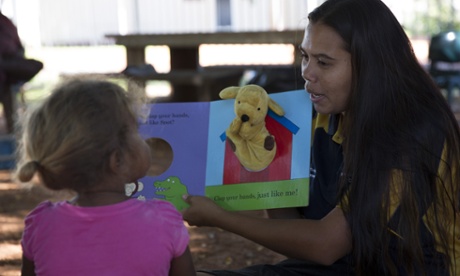
Early childhood care and development, a critical time in a child’s life to address future social, emotional, educational and health outcomes, is a key focus. Investment in the early years has been shown to be one of the most effective strategies to address the legacy of disadvantage.
When World Vision Australia commenced its work in Western Australia’s Pilbara region in 2009, there were no regular early childhood services operating in the remote communities. Today, more than 90 per cent of families in two Martu communities have participated in World Vision Australia-sponsored early childhood activities, with strong qualitative evidence demonstrating early intervention through playgroup results in improved school readiness and attendance. Significant outcomes have been reported for the Pilbara ECCD project where the percentage of children developmentally on track has increased from 16% in 2007 to 60% in 2012. Children entering school in 2012 represented statistically significant gains in emotional maturity and language and cognitive skills, and non-statistically significant gains in all other domains (Ingamells &Tennant, 2014). Noting that there has been a significant jump between 2009 and 2012 the external evaluation team from Griffith University described the overall gains for children as ‘astonishing’ and cited World Vision’s ECCD program as a significant contributor to these gains.
Hutchins says one of the significant success stories is an early childhood training program in Yuendumu in Central Australia. “The community had a poor history of being able to attract early childhood training into the community. The models that were available were mostly about people going out of the community for periods of time to do their study, and for young women with families, it’s a really big deal to take them out of their community for training.”
World Vision Australia piloted a community-based training program for early childhood workers with support from Western Australia’s Central TAFE, who flew in regularly to do training in community with the women. They also worked with the Northern Territory government’s Department of Education, who were developing innovative training models. “Several of those women who started training with us have now almost completed their diplomas - which is quite amazing,” says Hutchins.
All of the organisation’s Indigenous programs are tailored specifically for each community and respond to the specific needs identified by that community, says Hutchins. She also emphasises World Vision Australia is in it for the long haul, that overcoming trans-generational, systemic disadvantage is often a slow and gradual process. However as the positive outcomes now beginning to flow out of their programs show, positive change is becoming a reality for some of Australia’s most in-need communities.