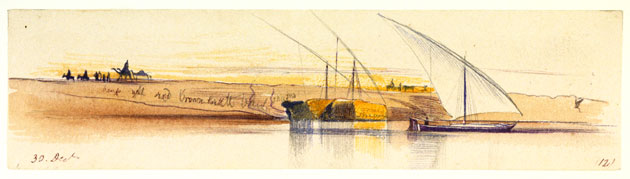
Lear and his party left Cairo just after Christmas 1853. He doesn't specify the exact location of this sketch, but the date indicates it was one of his first impressions of the river Photograph: Edward Lear/National Maritime Museum
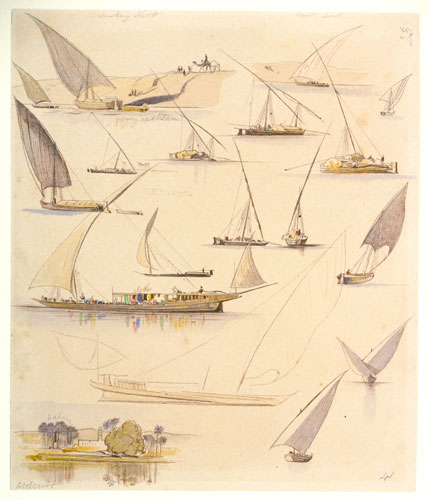
Various studies of Egyptian craft Photograph: Edward Lear/National Maritime Museum
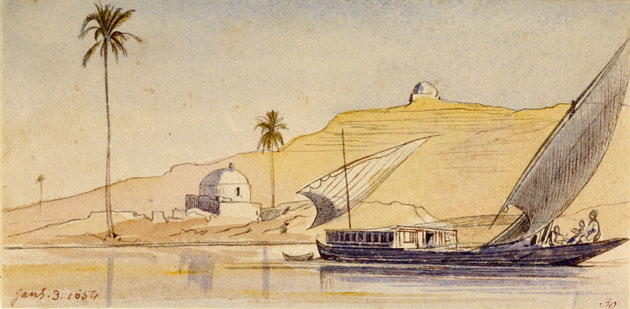
This watercolour sketch shows a large vessel passing along the river. Single palm trees and two small buildings accentuate the barren landscape and empty sky Photograph: Edward Lear/National Maritime Museum
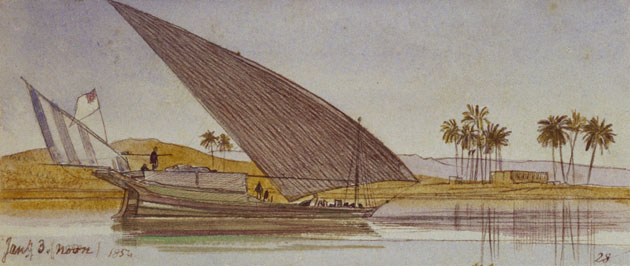
Cloudless skies above the river Photograph: Edward Lear/National Maritime Museum
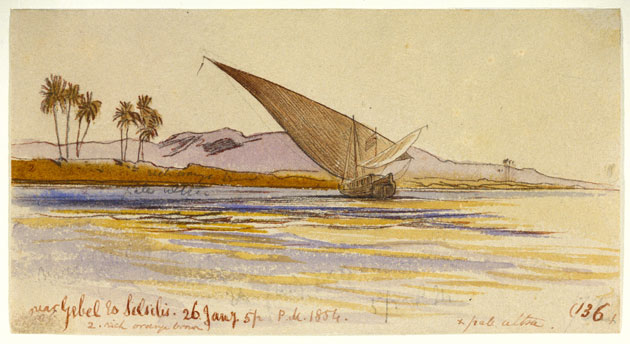
Travellers to this part of the Nile were invited to notice 'extensive quarries of sandstone, from which blocks used in the greater part of the Egyptian temples were taken' (Murray's Guide to Egypt). Lear's sketch captures the colours of the reflections on the water oscillating between blus and orange, the pale lilac mountains in the background and the orange-brown river bank Photograph: Edward Lear/National Maritime Museum
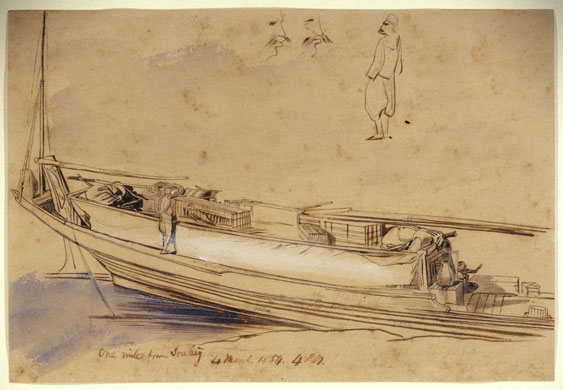
Lear was attracted by the cargo and equipment laid out on deck Photograph: Edward Lear/National Maritime Museum
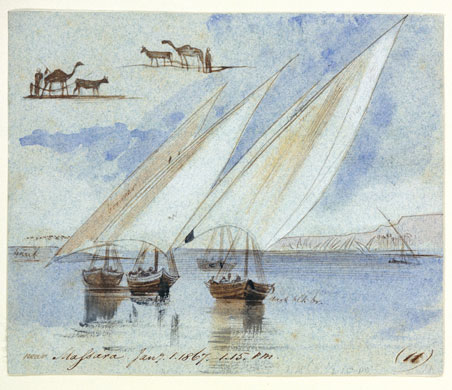
Travellers at this time were advised to undertake the journey up the Nile in winter. Steamboats had begun operating on the river, but Lear preferred the traditional craft over any signs of modernity Photograph: Edward Lear/National Maritime Museum
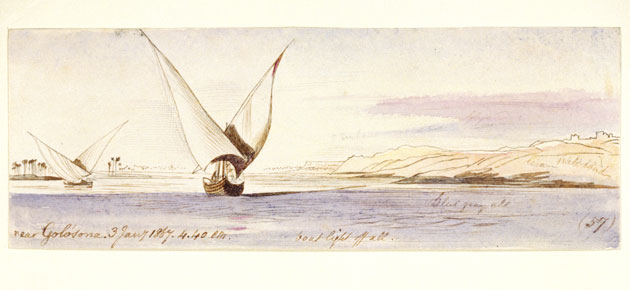
Lear was delighted by the passing boats, writing that 'the most beautiful feature is the number of boats, which look like giant moths' Photograph: Edward Lear/National Maritime Museum
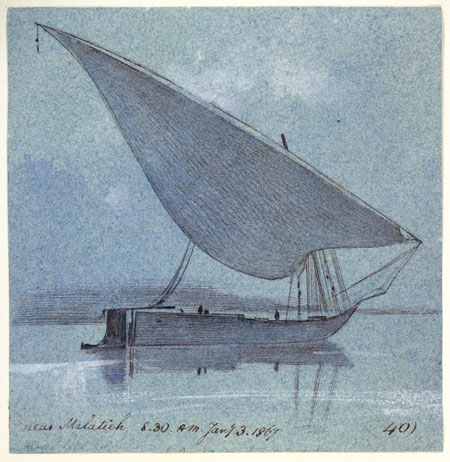
The atmosphere of this scene, captured at 8.30am, is enhanced by Lear's use of blue paper, on which he employs fine hatching to create a sense of depth Photograph: Edward Lear/National Maritime Museum
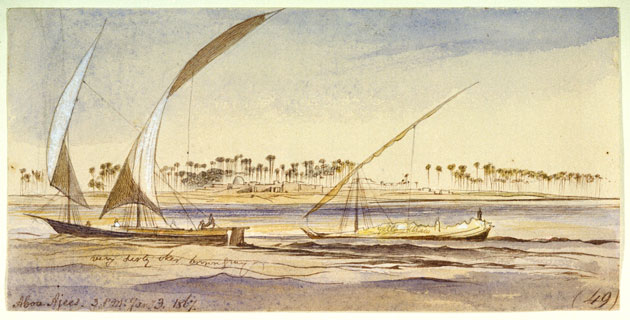
The picturesque scenery unfolding before the travellers' eyes enchanted Lear: '... it is a magnificent river, with endless villages ... all fringed with palms, & reflected in the water' Photograph: Edward Lear/National Maritime Museum
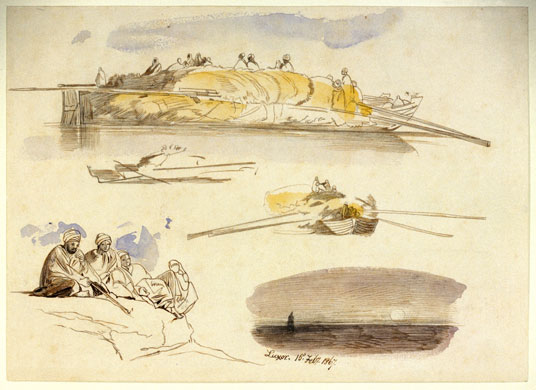
Sketches of heavily laden barges, made in Nubia Photograph: Edward Lear/National Maritime Museum
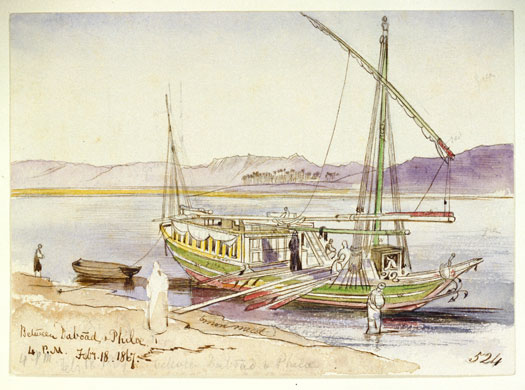
This was Lear's second visit to Philae; he discovered 'new subjects' and found the island 'more beautiful than ever', but it is the everyday experience of travel which he captures in this sketch of the dahabeeh (the traditional sailing boat used to navigate the Nile) on which his party was travelling Photograph: Edward Lear/National Maritime Museum
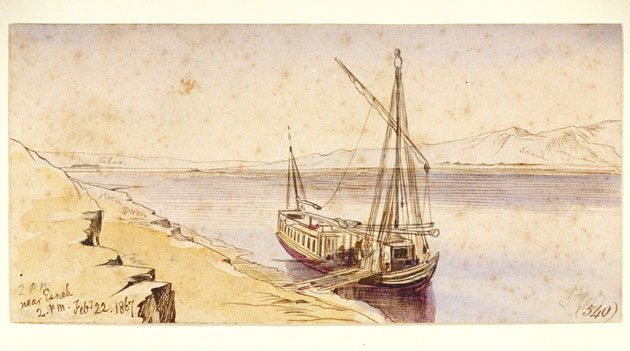
A dahabeeh drawn up on a barren stretch of river bank near the town of Esneh (now Esna) Photograph: Edward Lear/National Maritime Museum
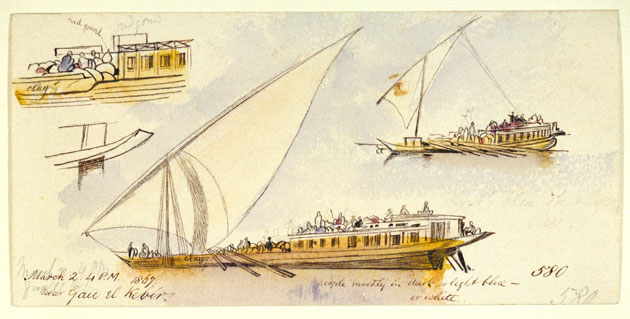
In these studies, taken near Gau el Kebir at 4pm, the boats are busy with 'people mostly in dark or light blue - or white' Photograph: Edward Lear/National Maritime Museum
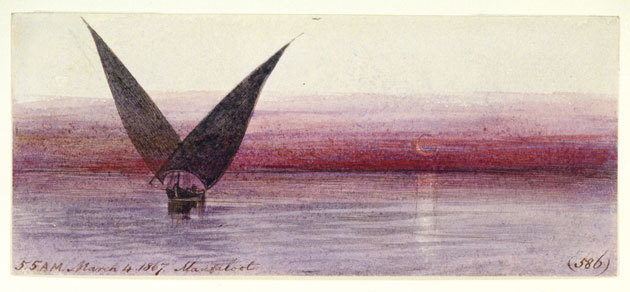
In this tranquil scene, taken five days before his return to Cairo, Lear has captured an early morning crescent moon Photograph: Edward Lear/National Maritime Museum