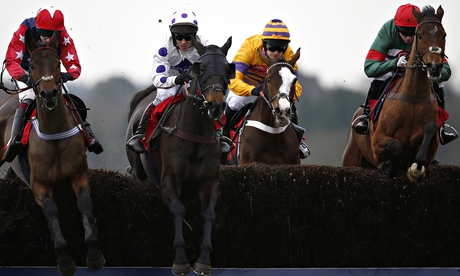
A few days ago, Ludlow staged a National Hunt card with a six-figure prize fund. This weekend, seven jumps tracks will welcome their biggest crowds of the year to their Boxing Day fixtures, while as soon as Christmas is over, the countdown to the Cheltenham Festival will begin in earnest. National Hunt racing cannot, by any worthwhile measure, be described as a sport in crisis.
There was never any room for complacency when Edward Gillespie was in charge at Cheltenham, however, or any lack of attention to detail. Under his stewardship, the festival meeting grew year-on-year to become a significant feature of Britain’s sporting landscape, encouraging huge investment in the winter code from owners in this country and Ireland as it did so. As a result, Gillespie was the obvious choice to chair the BHA’s review of jumping, which was published on Monday, and attempt to address areas of concern, such as falls in the number of horses and owners, before a full-blown crisis develops.
It could be argued National Hunt was simply less resistant than Flat racing to the global economic downturn and will bounce back in time when, or if, the outlook begins to improve. The billionaire players at the Flat’s highest level are certainly more recession-proof than most of jumping’s big hitters.
There are other factors at work too that may always make National Hunt a more difficult sell to owners than the Flat. The pool of owners is effectively limited to Britain and Ireland, the core of the campaign unfolds in the winter months and jumpers do not turn into stallions worth millions of pounds. It is also inescapable that the risk of a serious or fatal injury on the track is several times higher over jumps than on the Flat.
As Gillespie pointed out on Monday, though, the two codes have a great deal in common as well. “There is an interdependence between Flat racing and jumping, and indeed between jump racing and point-to-pointing,” Gillespie said. “They feed off each other in terms of fans, trainers and fixtures. The summer fixtures wouldn’t be delivered to the bookmakers as they are now without jump racing as a very crucial part of that mix.
“One of the most important things that Flat racing needs is a very strong, thriving jump-racing community, because of the ebb and flow of horses, trainers, fans and fixtures in and out. They go very much hand in hand.”
One innovation to emerge from the review – the Challenger Series of races – is already underway. Other proposals, such as a concerted attempt to further improve the programme for mares, will take longer to have an effect, while several more are details that will hopefully have a cumulative effect by improving the overall experience of ownership. Consideration of a “code of conduct for agents and syndicates” is an interesting suggestion that could bring a little clarity to the process of getting involved as an owner, particularly in a big syndicate.
“The upsides [for owners] have got to be more obvious because some of the risks are far greater than on the Flat,” Gillespie said, “but the social aspect of having horses in jumping, the length of their careers and the fun aspects of jump racing all appeal to a certain type of people and there has been great success in the past. There’s no reason to think we can’t continue to deliver that success and attraction.
“The Grand National as a standalone race is still the dream of many people coming, who want to pay about £20,000 for a horse and believe that five or six years up the line that will still be their dream. All that has to be taken into account.”
The idea that leaps out from the review, however, is the introduction of an extra “peak” to the season, to complement the huge spring festivals at Cheltenham and Aintree. The complaint the Cheltenham Festival now dominates the campaign to an unhealthy degree is one that has been heard so often in recent years that it has almost become accepted as fact. Whether or not this is the case, the establishment of another major focal point in the season would be a bold step.
Details such as when and where this meeting might be staged were not part of the review’s remit. They were the ideas people and it is now up to the BHA and racing’s other stakeholders to make it happen, assuming they agree with the recommendation.
The possible venue for any new “peak” meeting is an interesting question, though, because Gillespie and Ruth Quinn, the BHA director who sponsored the review, seemed open to the idea that it could be nomadic, with courses bidding to stage it from year to year like the Breeders’ Cup in the United States.
“My personal view is that it would be great to get people to bid for them and move them around,” Gillespie said, while Quinn described it as “a pretty exciting concept”. It could bring tracks such as Haydock and also Doncaster, a key track for the Arena Racing Company ownership group, into the reckoning, and would be a significant departure for British racing in general. Gillespie may have moved on from his day-to-day role at Cheltenham but his status as one of the sport’s most innovative thinkers is undiminished.