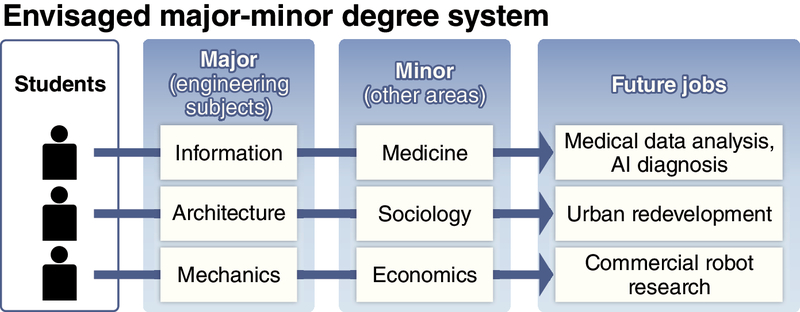
The education ministry plans to push for the full-fledged introduction of a major-minor degree system that will allow engineering students at universities and graduate schools to select a secondary subject from a wide range of areas spanning the humanities and the sciences, starting from next academic year.
The Education, Culture, Sports, Science and Technology Ministry intends to revise a ministerial ordinance soon to ease regulations concerning the allotment of university faculty members.
The move is aimed at cultivating human resources who can work on developing promising technologies for use in various fields, including artificial intelligence.
In principle, engineering students focus on one major, such as information or mechanical engineering, as the current ministerial ordinance sets a required number of teaching staff for each faculty.
To enable engineering faculties to introduce minor degree courses covering different academic areas, they need to secure staff from faculties like medicine and economics. That has hampered the introduction of such a flexible degree system.
In light of this, a planned revision to the ordinance is intended to enable universities to formulate curricula flexibly by including an exception that will allow members of other faculties to double as members of engineering faculties.
The ministry envisages that students majoring in information engineering will study medicine as their minor and seek careers in medical data analysis and AI diagnosis, for example.
The major-minor system has been adopted widely at universities in the United States and Europe. In Japan, however, a limited number of schools offer such an option, with one being the Nagoya Institute of Technology.
Read more from The Japan News at https://japannews.yomiuri.co.jp/