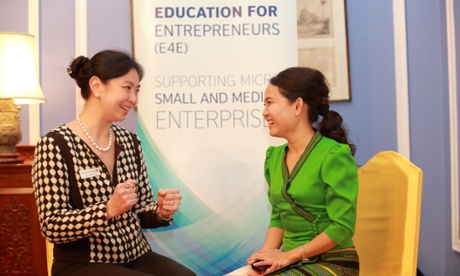
The British Council is supporting the development of the emerging social enterprise sector in Myanmar through a number of initiatives. One of these is the Education for Entrepreneurs (E4E) programme, delivered in partnership with Standard Chartered Bank.
Education for Entrepreneurs was launched in September 2014 and aims to support micro, small and medium enterprises (MSMEs) by providing training to enhance their financial literacy and business development. It offers all participants capacity building to help them grow and, at a second stage, takes the most socially impactful of these businesses through a more in-depth consultancy programme to help them enhance their impact.
As recruitment began for the second year of the programme, we asked Tina Singhsacha, chief representative from Standard Chartered bank in Myanmar, about the aims of the programme and the bank’s commitment to helping micro and small social businesses.
Why did you launch this programme and what do you hope to achieve?
Towards the end of 2014, we launched a series of community investment initiatives aimed at addressing pressing social concerns. These initiatives seek to enhance the country’s capacity for social development and employment through the delivery of targeted education and health programmes. The first programme was Goal, which provides financial education and life skills training for girls. Education for Entrepreneurs is our second programme which aims to help enhance the financial and business knowledge of business leaders so that they will be better equipped to manage the growth of their enterprises. We partnered with the British Council to deliver the E4E training sessions to 300 companies from Mandalay, Mawlyamyine, Taunggyi and Monywa in the first year.
Why focus on MSMEs?
In many developing economies, micro-, small-, and medium-sized enterprises contribute up to 90% of the gross domestic product and are the largest employers. They are the backbone of the economy.
What challenges do they face?
The financial health of these MSMEs can be threatened by a lack of access to financial services and knowledge of risk-management, insurance and credit processes. When MSMEs have limited access to finance and education, society suffers as economic and social opportunities are restricted.
To ensure micro and small businesses drive economic growth, we must support them through financing and education. Their lack of financial education is a barrier to financial inclusion and the potential success of small businesses. Without a healthy and thriving MSME sector, it would be much more difficult for the economy to maintain its sustainable growth moment.
How does E4E help small business maximise their social impact?
By providing access to financial services education we can boost job creation, raise incomes and reduce financial vulnerability. It is a core part of our long-term commitment to the country and our ongoing effort to help Myanmar strengthen its capacity for social development and employment.
These financial education programmes can help build a foundation for sustainable growth in our markets by helping to develop the capacity of the MSME sector across the country.
Why is Standard Chartered supporting this programme?
E4E is a core part of Standard Chartered’s global community investment strategy. Through E4E the bank aims to educate 5000 MSMEs across Asia, Africa and the Middle East by the end of 2018. This is part of an expanded global commitment that was announced at the Clinton Global Initiative last year. The launch of the E4E programme in Myanmar will play a pivotal part in ensuring we meet that target.
Financial education and inclusion are important issues for Standard Chartered. It is in our interest to ensure that people have high financial education so that they will use financial services actively and responsibly which will minimise gaps between the extension of access and actual usage. Moreover, financial education is a crucial building block of economic citizenship and a means to protect clients and promote stability in the retail financial system.
Financial education is not new to the bank or to our colleagues in the markets. We deliver a wide range of successful financial education initiatives, from SME training to teaching adolescent girls through our Goal programme. As bankers and experts in our field, we are uniquely positioned to share our skills and time to help improve access to finance.
What benefit does this provide for Myanmar?
We remain committed to partnering with Myanmar on its capacity building efforts, and to working with the government and other stakeholders to collectively pursue the development of Myanmar’s financial services sector and the broader community through our community investment projects. We have deep roots in Myanmar and we hope that E4E will grow to become a catalyst that will help local businesses to grow and flourish. In its second year, the programme will support 300 more businesses in Myanmar.
Watch a video about E4E and find more info about the British Council’s social enterprise programme in Myanmar here.
Content on this page is paid for and provided by the British Council, sponsor of the international social enterprise hub