FedEx, Allstate Sugar, Tostitos, Konica Minolta, Gaylord Hotels, Bell Helicopter and on and on, all the way down to the San Diego County Credit Union. To the uninitiated the names read like random selections from the Yellow Pages but to some people the link between them all is obvious.
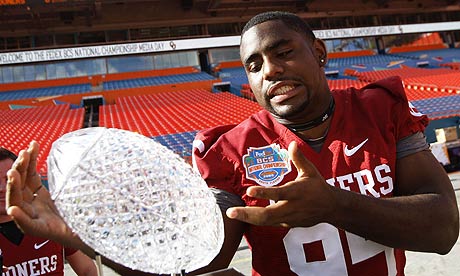
If you are one of those people in the know, then you are probably American and you will almost certainly be aware that tonight sees the climax of the US college football season in Miami, where the University of Florida will play the University of Oklahoma in the Bowl Championship Series (BCS) National Championship game, televised by Rupert Murdoch's Fox Network, sponsored by FedEx.
Over the last 18 days there have been 33 such bowl games, pitting college teams from across the country against each other – all of them televised live, all of them sponsored by one of the aforementioned corporations, all of them avidly followed by those people for whom college sport is a religion.
When it comes to American socio-cultural mysteries the popularity of college sport is right up there with the popularity of Martha Stewart. We – by which I mean anyone who is not American – cannot understand it. Sure, the Boat Race might make a vaguely intriguing diversion in London on a cold spring morning but the idea of watching students play sport is bizarre, unless you happen to be related to one of the players. For one thing, the standard is poor. For another, Arsenal kick off at three o'clock.
Americans do not think like that, partly because they are not emotionally invested in club structures to the extent that we are. They have professional teams and leagues, and supporters are enthusiastic, but the spread of professional sport in the US is geographically narrow, confined in the main to the biggest urban centres. Vast swaths of the country – particularly the southern states – have no rooting interest. It is here that college sport really is elevated to the status of religion. It is a cultural thing.
But it is also a commercial thing. Stanley Eitzen, in his brilliant study of US college sports, Fair and Foul, points out that popularity of college sport was localised until the 1970s, until television embraced some of the bigger institutions, such as the University of Notre Dame.
Since then interest in college sport has increased exponentially. So, too, has the financial commitment of sponsors and television companies. For instance, Notre Dame currently receives $9m (£6m) from the NBC network for broadcast rights to its eight home football games – a lot of money, you might think, but loose change when measured against the investment of ESPN, the world's most profitable broadcast network, which last month announced it had agreed to pay $125m (£83m) a year for the rights to broadcast the five most prestigious college bowl games.
"With the new source of funds, university athletics departments became quasi-separate entities,'' writes Eitzen. "What was once a student-run activity has been transformed and now students have no voice in athletics policies. In the process college sport changed from an activity primarily for the participant to full-time commercial entertainment with large monetary payouts."
Where there is money there is greed and where there is greed there is bad behaviour. In order to secure a share of the money, colleges need to be successful on the field of play and in order to be successful they need to recruit the best athletes coming out of American high schools. Needless to say, this commercial imperative has in many cases swamped the primary purpose of any educational institution, which is to identify the most academically promising undergraduates, nurture them when they enrol and then send them out into the world equipped to make a contribution.
But when it comes to athletes, says Eitzen, such grand missions are abandoned. He writes about a college which recruited a student with an IQ of 86, simply because he was a terrific basketball player. Indeed, the story of college recruitment is the story of underhand behaviour, illegal payments and an attitude towards educational standards that might generously be described as "loose".
Last week the New York Times carried a fascinating piece about the recruitment of Jamarkus McFarland, an 18-year-old high school football player from Texas who was targeted by some of the country's top college teams. At the University of Texas he was taken to a party hosted by fans during an official recruitment visit to the campus. "Alcohol was all you can drink, money was not an option,'' he wrote afterwards. "Girls were acting wild by taking off their tops and pulling down their pants. Girls were also romancing each other. Some guys loved every minute of the freakiness some girls demonstrated. I have never attended a party of this magnitude." In the end he signed on the dotted line with Oklahoma.
As it so happens, McFarland is academically gifted but if he had been a dunce the chances are he would still have found a college willing to accept him because of his athletic abilities. College football players are six times more likely to receive special treatment – admitted despite not having achieved the required academic standard – than normal students, according to one study.
There is a small band of academics who have long railed against this obvious abuse of the system. "Athletes are the only students recruited for entertainment purposes and the only students who get grants not based on their educational aptitude but on their talent and potential as entertainers,'' says Professor Murray Sperber, one of the most prominent critics. "If colleges searched for and gave grants to up-and-coming rock stars so that they could entertain the university community and earn money for the school through concerts and tours, the educational authorities and public would call it a perversion of academic values."
Sperber makes an excellent point, not that anyone will pay attention to it on this night of all nights, when a nation will come to a stop for the BCS National Championship Game, sponsored by FedEx.