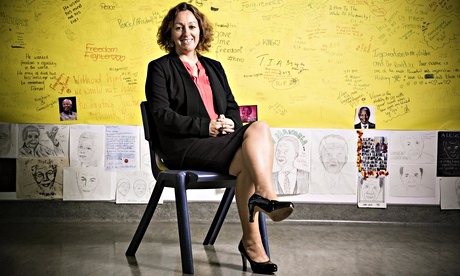
It’s the end of the school day at Frederick Bremer school in Walthamstow, east London. The students are wandering out into the damp of the early evening rush hour, talking and laughing.
English teacher Mr Bispham is buzzing: three students from the autism unit have just come and told him how much they are enjoying English. Headteacher Ms Smith is prowling the corridors in her patent leather Dr Martens lace-ups.
The 65 cameras that watched the school are long gone and there are just two more episodes of Educating the East End still to be shown. Then the “rig”, the production team, and the nation’s eye will move on to another school.
This next school has already been identified and will be the first one outside England. Filming will begin this autumn and the show will be aired next September for the start of the school year. Producers are already for searching for the school after that.
When the production company, Twofour, set out to make the show’s pilot, researchers approached almost every good or outstanding school in the country. Just two said yes. Now the “Educating …” brand is so successful that schools – and their pupils – lobby to be filmed.
And with good reason. The series has shed an enormously positive light on once-benighted comprehensive education and made stars of teachers and teenagers. Jonny Mitchell, of Thornhill community academy, which featured in Educating Yorkshire, is now the most famous headteacher in the country (and has been flooded with offers of marriage). One of his pupils, Ryan, memorable for his passion to become prime minister, has been starring in a film this summer.
At Frederick Bremer, a mixed, multicultural school with 900 pupils, the impact of the series is just beginning to filter through. At this week’s open evening for prospective students, numbers were double what they were last year. They’re hopeful too that in common with Thornhill and Passmores Academy, of Educating Essex fame, there will be a spike in job applications.
There are more immediate benefits too. “I feel the students look at me differently. They have a lot more respect and understanding of what I do,” says headteacher Jenny Smith. “It’s done lots for staff confidence. It’s shown how difficult teaching is. It’s broken through the stereotypes and it has shown that teaching is an incredibly complex job.”
It has also given people like her a voice, and she hopes Westminster is listening. “One of the things I find very frustrating is that people with a lot of influence and power have very strong views about education but not from a point of information. It’s based on what went on in their own childhood. The voices of educators are missing from the debate.
“Teachers are just not listened to. There are no mechanisms for consultation with people who are actually in the profession. What we need now more than anything is pause for time and reflection.
“We’ve been through an unprecedented period of change. Educational policy gets changed at the whim of a government. It’s too important to be changed so quickly and radically. These are young people’s lives we are dealing with.
“Teachers have been blamed for the downfall of everything in modern society. Actually as the programme shows, we do a very, very good job under very testing circumstances.
“It’s unfortunate it takes something like a television programme to change what people feel about teachers and education.”
Joe Bispham, whose travails trying to teach his year 9 class Much Ado About Nothing were the subject of the first episode, is one of the stand-out stars among staff. He studied politics at Bristol, and comes from a background of public service. Both his parents are police officers: his mother is an inspector, and his father, now retired, worked in the murder squad.
“I had ambitions to be a researcher in Westminster, to be a Spad (special adviser). I thought that was the path to making the biggest difference I possibly could.”
So he volunteered for the Labour party – he’s a fully paid-up member – stuffing envelopes and delivering leaflets for Tooting MP Sadiq Khan, now in the shadow cabinet. He worked for Liberal Democrat Susan Kramer for two years until she lost her Richmond Park seat to Zac Goldsmith. (“She really cared, she was so genuine and really passionate about making a difference.”)
Then he worked for Bethnal Green MP Rushanara Ali, before applying for a job in the office of a high-profile member of the Labour party. There he had an epiphany. “I decided I had been in this world [of politics] long enough. The self-serving nature of it had become apparent to me and I didn’t want to be part of it any more.”
It was 2011, he went home and watched an episode of Educating Essex and decided to become a teacher. He signed up with the TeachFirst scheme and the rest is television history. So the series is now inspiring the people who will become the stars of future series.
Probably the best compliment of all to the staff at Frederick Bremer, and teachers in general, comes from Rashidah, elected as head girl in the third programme in the series and thinking about her future. “Two people have come up to me this week and said, ‘You know Rashidah, you’d be a really good teacher’.
“I was like, no way! But yeah, perhaps I’ll become a teacher!”
• Educating the East End is on Channel 4 on Thursday 16 October at 9pm