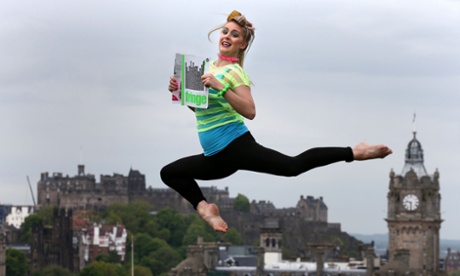
Cricket star Freddie Flintoff, actor Ricky Tomlinson, Sowetan musicians, comedian Daniel Kitson and inventive circus artists Circa are among the highlights at the largest ever Edinburgh festival fringe.
Flintoff is a fringe debutante, offering unscripted insights on his career and sport, while Kitson’s Polyphony features a script “so ambitious, so demanding” that the performer has pre-recorded his play for a cast of 20.
Tomlinson will present a no-holds-barred critique of his 1973 jailing for strike action in Guilty My Arse, Australian company Circa bring their latest show Close-up to Underbelly, and After Freedom, New Rhythms of Soweto takes the audience through the ups and downs of youth life in the township.
The record-breaking 2015 fringe programme contains details of more than 50,000 performances, with 3,300 productions due to take place in venues that include a double-decker bus, a tenement flat and a curry bar.
Familiar names such as Jo Brand, Al Murray and Phil Jupitus can be found in the comedy programme, which dominates the festival by making up 34% of the shows, but festival organisers said climate change, gender and sexuality, and father and child relationships had emerged as key themes from the shows on offer.
Poetry slam champion Ben Norris will investigate masculinity viahis one man show on love, loss and the search for a father in the Hitchhiker’s Guide to the Family and comedian Jimmy McGhie will confront his early childhood humiliations and “the sins of the father”. In The Gospel According to Jesus, Queen of Heaven, trans playwright Jo Clifford will share bread, drink wine and reimagine a transgender Jesus.
Organisers said this summer’s event has confirmed its status as the world’s largest arts festival by presenting shows at 313 venues across the city, with performers due to arrive in the city from nearly 50 countries including Taiwan, Hong Kong, Australia and Mexico.
The surge of circus at the fringe is reflected in a new complex of circus tents on the Meadows, hosting animal-free circus and physical theatre. The venues will put on “the most technically ambitious circus performances on a scale the fringe has never seen before”.
Elsewhere, the search for new venues has taken shows to the Clifton Hall public school, while a 15th century countryside church at Crichton will host medieval plainsong.
Kath Mainland, chief executive of the fringe, admitted she was increasingly reluctant to focus on the event’s routinely record-setting statistics each year as they detracted from the event’s diversity, creativity and art.
But the 50,459 events scheduled for the festival’s 25-day run – a 3.8% increase on last year – underlined the event’s strength and vitality.
Broadly speaking, the fringe has doubled in size every decade since it began nearly 70 years ago, said Mainland. “It shows that it flourishes, it is in good health … it’s a great place to show your work to a live, risk-taking audience, without waiting for an invitation.”
The official launch of the full fringe programme on Thursday put tickets on sale for a final batch of 600 shows, largely by smaller companies, whose performances had not yet become public.
The expansion of the fringe has significantly increased competition between production companies, and increased pressure for ticket sales to be opened far earlier in the year, to allow visitors to plan Edinburgh visits well in advance.
Mainland confirmed that the year on year expansion of the programme raised challenges for the Fringe to ensure audiences could navigate the 450-page long programme comfortably.
“The thing which is brilliant about the fringe is the element of discovery, the fact that you don’t know what’s in it, and it’s our job to make that as undaunting as possible for an audience,” she said.
It also raised constant challenges for the city and the fringe to find new venues. Asked whether there was a physical capacity limit for the relatively small city, Mainland said: “I guess logic would tell you that there must be, but experience would tell you that there isn’t.”
But she added: “[I] think actually that venue landscape also appeals to the audience and is special about the fringe … venues just permeate through the whole city. The venues are sometimes as exciting as discovering the shows.”
After a controversy last year when two Israeli-government funded shows were cancelled after pro-Palestinian protests and artist-led demands for a cultural boycott, Mainland insisted that the fringe was completely open to all.
“We’re an open access festival where anybody who wants to come with a show can come,” she said. “I think it’s our job to do more to make sure that anybody who wants to perform here can, but we’ve to be aware of the physical constraints and the decision they took last year was not taken lightly.”