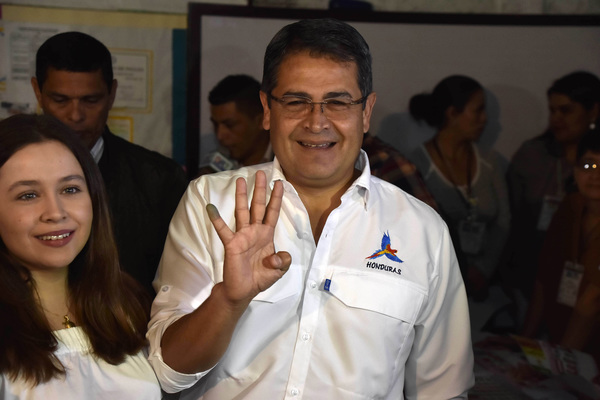
MEXICO CITY _ At first it appeared that charismatic television star Salvador Nasralla had pulled off a stunning victory in his campaign to replace Honduran President Juan Orlando Hernandez.
With 58 percent of the votes counted in Sunday's election, Nasralla was beating Hernandez by 5 percentage points, or 93,975 votes.
That was Monday morning.
On Tuesday, after more than 24 hours of unexplained silence from the electoral court that counts ballots, new vote tallies were released that showed a sudden and sharp shift in favor of the president. Nasralla's lead had shrunk to 48,388 votes.
On Wednesday, that lead dwindled to 24,282 votes, then to 16,679.
By evening, with 81 percent of ballots counted, it was 40.
To some Hondurans, the dramatic shift was evidence that the election was being stolen. The electoral court has said it would release the final results Wednesday night, but there was a sense of inevitability that Hernandez would be declared the winner.
Whatever the outcome, Honduras appeared to be edging toward political crisis. Both Hernandez and Nasralla have declared victory, and on Wednesday, supporters of both took to the streets.
The election tribunal is appointed by Congress, which is controlled by Hernandez's National Party. Hernandez also controls the army _ which is charged with transporting ballots _ as well as all election appeals processes.
Backers of Nasralla and his Alliance Against Dictatorship say members of the tribunal manipulated results in favor of Hernandez, which the tribunal denies. Leaders of the coalition, along with representatives of a political party whose candidate was in third place, say vote tallies provided to the parties at each polling place after the vote show Nasralla is the clear victor.
Representatives of the National Party say their analysis of those tallies shows Hernandez winning.
Outside of the tribunal's headquarters in the capital, Tegucigalpa, on Wednesday, supporters of Nasralla waved red flags and burned banners bearing the face of the president, whose supporters staged a counter-protest.
"The only one that can defend these votes is the Honduran people," Nasralla told reporters, urging his backers across the country to descend on the capital.
The contested election has sparked fears of violence and has drawn calls for greater transparency from around the globe.
The European Parliament, the Organization of American States and the local evangelical and Catholic churches have all urged calm.
A coalition of U.S.-based faith, labor and immigrant-rights groups signed a letter calling on the U.S. government and the Organization of American States "to insist upon full transparency in the vote count and a review of the electoral process to ensure that the elections were free and fair and represent the will of the Honduran people."
The coalition also urged Honduran authorities to respect the rights of citizens to "exercise their right to freedom of association and peaceful protest."
Rosemary Joyce, an anthropology professor at University of California at Berkeley who has spent three decades studying Honduras, said one fear is that Hernandez could call in the army to suppress protesters supporting Nasralla.
"He could militarize," Joyce said. "He's a pure authoritarian."
Joyce said it was unclear whether election officials had actually tampered with the vote. After Nasralla's strong showing in the initial results, it appeared election officials had shifted to counting votes in the districts likely to favor Hernandez, she said, which could explain his improved showing.
Elections in Honduras are frequently fraught with problems, she said. In the past, election officials have declared winners before all of the votes have actually been counted, instead predicting who will win based on early returns.
The 2013 presidential election that brought Hernandez to power was plagued with allegations of fraud, vote-buying and other irregularities.
This month's election was steeped in controversy even before voters went to the polls.
It dates back to 2009, when Hernandez backed a military coup against former President Manuel Zelaya in part because Zelaya had proposed running for a second term, which at the time was barred by the constitution.
After Hernandez was elected president in 2013, several Supreme Court judges appointed by Congress voted to overturn the constitutional ban on term limits, and Hernandez announced his campaign for re-election.
Hernandez is liked by U.S. officials for his cooperation in efforts to reduce northward migration and violence in Honduras, where the homicide rate _ among the highest in the world _ has fallen in recent years. But he and his party have been dogged by allegations of corruption and ties to criminal groups. Many believe Hernandez could be prosecuted for allegedly being involved in the diversion of public funds to his election campaign.
Nasralla, a 64-year-old sportscaster with no prior political experience, is an ally of Zeyala. He ran a populist campaign, pledging to lower taxes and fight corruption.