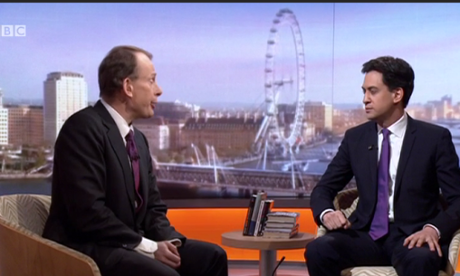
Ed Miliband's Marr interview - Summary
It was a “job done” interview for Ed Miliband. He was not outstanding or surprising, and he sounded mildly rant-y at one point towards the beginning, as he was going on about living standards, but overall he was fine, and he certainly punched out enough news lines.
Here are the key points. It’s a beefed-up version of the summary I filed earlier, with quotes.
- Ed Miliband said that, if David Cameron refused to take part in the proposed televised leaders’ debate, the broadcasters should “empty chair” him, and go ahead without him. No leader should be allowed a veto, he said.
I think it is pretty disreputable that David Cameron went into the 2010 election saying that these debates were the most important thing that we could possibly have and people shouldn’t make feeble excuses to get out of them, and he is doing precisely that.
He is running scared of these debates. I want these debates to happen, I think they should happen with David Cameron or without David Cameron.
In the end that’s a matter for the broadcasters, but I don’t think any one political leader should be able to stop these debates happen, should be able to veto these debates, block these debates.
If an empty chair represents David Cameron in these debates, so be it. I think these debates need to happen. They are owned by the British people, not owned by David Cameron or anybody else. I think, frankly, the Prime Minister should stop ducking and weaving, trying to avoid these debates.
- He refused to deny saying that he wanted to “weaponise” the NHS. Pressed about this repeatedly, he said he could not recall exactly what he had said. But he was in a fight for the NHS, he said.
What I’ve said is I want to fight for the NHS. I don’t recall exactly what I said, but we are in a fight for the National Health Service, and I make absolutely no apologies for the fact that I’m really concerned about what’s happening to our National Health Service in this country.
- He challenged the government to legislate to give Ofgen the power to force energy firms to cut domestic prices when wholesale energy prices fall. Labour would force a vote on this in parliament this week, he said.
- He played down prospects of a post-election coalition with the SNP, although he did not rule out the idea entirely. Press on this, he said he was “not about deals”. But he also conceded that the phrase did not mean he was ruling them out.
- He said he was open to the idea of reducing the benefits cap, the total an out-of-work household can receive in benefits, from £26,000. He wanted a benefits cap that worked, and one option might be to vary it regionally, he said. The Conservatives want to cut it to £23,000.
- He rejected the Conservative plan to ban public sector strikes unless 40% of members are in favour.
- He said he would consider the case for giving the security services extra internet surveillance powers. In a reference to the so-called snooper’s charter, backed by the Tories but opposed by the Lib Dems, he struck an ambivalent note, saying that he would not rule out giving the security services more powers, but that oversight was important too.
We’ve got to look at ‘Do our intelligence services have the tools they need?’, but equally ‘Do we have the proper oversight to guarantee the liberties of free citizens?’, because after all one of the things we want to protect most of all here is our freedoms.
We should defend our freedoms and also make sure the security services have what’s necessary to make sure that we counter that threat and defend that freedom.
-
He said Tuesday’s vote on the charter for budget responsibility was “a gimmick”.
That’s all from me for today.
Thanks for the comments.
In his Observer column today Andrew Rawnsley explains why he thinks the idea of empty chairing David Cameron in the television debates will come to nothing.
As things stand, I think the chances of TV election debates happening are somewhere between zilch and nada. Could anything change that? Some suggest that the broadcasters should call David Cameron’s bluff and threaten to stage debates without him – “empty chair” him in the jargon. Labour and the Lib Dems hope this will happen. Number 10 is assuming that the BBC wouldn’t have the nerve, the other broadcasters will follow its lead, and holding a debate without Mr Cameron might anyway be a breach of the laws about election coverage.
Andrew says that George Osborne, Lynton Crosby and Craig Oliver are all firmly opposed to Cameron taking part. In his Mail on Sunday column, James Forsyth offers this explanation why.
[Crosby and Osborne] also fear that expectations are so low for Miliband that, in the words of one Tory, ‘if he doesn’t trip over his shoelaces, he wins’.
Energy UK has put out a response to Ed Miliband (see ), saying energy firms are passing on price cuts. Here is the release in full.
Energy companies are passing on falls in wholesale costs Lawrence Slade, chief executive of Energy UK said today. In response to Opposition claims that Ofgem, the energy watchdog, needed extra powers to force cuts on companies, he said: “No new powers are needed. Energy suppliers are already passing on price cuts to customers. With over 25 suppliers in the market competitive pressure is forcing down prices every week. When people shop around they can easily find deals that are over a hundred pounds cheaper than this time last year and line with with falls in the wholesale energy price part of energy bills.”
Slade pointed out that prices were a commercial matter for individual companies who often buy many months ahead so price falls take time to feed through. Wholesale prices make up under half of average energy bills.
Labour has now issued a press notice on his call for the government to legislate to give Ofgen the power to force energy firms to cut prices when wholesale prices fall. The party will force a vote on this on Wednesday, when it gets to choose an opposition day motion.
Here’s an extract from Ed Miliband’s statement in his news release.
The next government is committed to making to big changes in our energy market: freezing energy prices until 2017 so that bills can fall but not rise, resetting the market and bringing in a tough new regulator to stop the rip-offs in the future.
But now George Osborne, who used to warn such measures were impossible, is claiming he understands that the energy market is broken. So next week, we’ll give him, David Cameron and Nick Clegg the chance to help all those families they have been ripped off by the energy companies under this government.
They have been making noises about energy bills. Now they can put their money where their mouth is because, if we work across party lines, we can bring in new powers for the regulator to cut bills and force energy firms to pass on savings to consumers.
And here is a statement from the party with data about how price cuts are not being passed on to customers.
Ofgem estimates that the supply margins of the Big Six have doubled in the last twelve months, increasing from 4% (£49) in 2013 to 8% (£105) today. This is only an estimate, as the companies will not publish their financial reports until next summer, but is further evidence that when wholesale energy costs rise the prices customers pay go up and when those costs fall customers energy bills do not fall to keep track.
Ed Miliband’s call for the broadcasters to “empty chair” David Cameron in the election debates has gone down will in Labour circles.
This is from LabourList’s Mark Ferguson.
Miliband says that no leader should have a “veto” on the debates and that they belong to the people not the politicians. Very good #Marr
— Mark Ferguson (@Markfergusonuk) January 11, 2015
And this is from Alastair Campbell.
Empty chair rather a good metaphor for @david_cameron #marr @Ed_Miliband
— Alastair Campbell (@campbellclaret) January 11, 2015
I suppose it would save Campbell having to bother with the debate rehearsals. (See 9.22am.)
Here is some comment on the interview from journalists and commentators.
From Sky’s Faisal Islam
both Miliband and Farage now saying in public PM should be empty chaired in GE TV debates. The DPM too? Ultimately down to bbc/sky/itv/c4
— Faisal Islam (@faisalislam) January 11, 2015
From Matthew Goodwin, the academic and Ukip specialist
Miliband strong & right on debates. They are for the people. Confirms he wd join while Cameron "empty chaired". Will broadcasters do it?
— Matthew Goodwin (@GoodwinMJ) January 11, 2015
From the BBC’s Nick Robinson
If anyone doubted @Ed_Miliband spoke of "weaponising" NHS I think he cleared that up on Marr just now - repeatedly didn't deny or disown it
— Nick Robinson (@bbcnickrobinson) January 11, 2015
Here is some Tory reaction to Ed Miliband’s interview.
From the Tory Treasury Twitter account.
Fiscal Charter requires £30bn of fiscal consolidation. There is no other number
— Tory Treasury (@ToryTreasury) January 11, 2015
Fiscal Charter clears the STRUCTURAL deficit by 2017-18. Only spending cuts or tax rises can do that. Growth is irrelevant. What's Labs mix?
— Tory Treasury (@ToryTreasury) January 11, 2015
Ed Miliband proposed "a 50:50 balance between taxation and spending to reduce the deficit." http://t.co/XCk5hXsNTG
— Tory Treasury (@ToryTreasury) January 11, 2015
From David Gauke, a Treasury minister
So Miliband (1) wants to 'weaponise' the NHS and (2) will vote for a fiscal charter he doesn't support. Extraordinarily cynical.
— David Gauke (@DavidGauke) January 11, 2015
.@tnewtondunn Vote Miliband get Miliband + Salmond. Grim prospect.
— David Gauke (@DavidGauke) January 11, 2015
Obvious to anyone watching #marr that Miliband has talked about 'weaponising' the NHS.
— David Gauke (@DavidGauke) January 11, 2015
Other Tory MP have also been attacking Miliband over the weaponising quasi-admission.
(This first came up at PMQs on Wednesday. As I explained in a post at the time, I felt David Cameron’s outrage at the prospect of Miliband having talked about weaponising the NHS was disingenuous, not least because George Osborne was the man who introduced the idea of weaponising policy to British political debate.)
Updated
Ed Miliband's interview - Snap summary
UPDATE AT 11.20AM: I’ve now beefed up the snap summary that was here earlier and posted it here, at 11.20am.
Updated
We’re not getting the usual chat on the sofa with the paper reviewers at the end.
I’ll post a snap summary shortly.
Q: Should Cameron be empty-chaired if he refused to take part in election debates?
Cameron says they should take place with him or without him.
Q: So you would take part if he were empty-chaired?
Yes, says Miliband. These debates belong to the people. Political leaders should not have a veto.
The main part of the interview is over.
Q: Would you do a deal with the SNP?
Miliband says he is not about deals.
Q: You might not get a majority.
I don’t accept that, he says. He will put a plan to the British people. He wants a majority government to make that happen.
Q: So would you rule out a deal with Alex Salmond or Nicola Sturgeon.
Miliband says he is not about deals.
Q: But you might not get a majority government.
I don’t accept that, says Miliband.
Q: When you say you’re not about deals, does that mean you won’t do one? Or you won’t talk about them?
Miliband says that is not his focus at the moment.
Q: Do you accept there is any merit in having a threshold before workers can go on strike in the public sector?
Miliband says he does not support this. This is a game. Most MPs would not be elected if this threshold applied, he says. The solution is better industrial relations.
Q: So you are happy for a small number of people to disrupt the Tube.
No, says Miliband. He is not happy about that.
But this idea just shows the Conservatives’ confrontational attitude.
Q: Frank Field last week suggested taking the NHS out of politics and putting up national insurance to pay for improving it. Do you support that?
Miliband says that would be a tax rise for ordinary people. He does not support that.
Q: When Jim Murphy says he wants mansion tax money to on paying for nurses in Scotland, do you support that?
Miliband says the mansion tax would fund the NHS. And we are a united country, so it is right that money goes to Scotland.
Q: Did you use the word weaponise about the NHS?
Miliband says he is in a fight for the NHS.
Q: Did you use the word weaponise?
Miliband says he cannot remember exactly what he said.
Q: The prime minister called it cynical. Do you disown it?
Miliband says this is not about the words we use. We are in a fight for the NHS. This is about having an NHS that works for people.
Q: Is this what an Ed Miliband government would be like. It would spend less, but regulate more.
Miliband says it is important to have the right level of regulation.
He says he is proposing a new living standards index.
Q: There is a row about this. Experts say the current measures work, and that changing the inflation measure could harm the poor.
Miliband says we need a proper measure of living standards.
Q: You proposed an energy bill cut. But the oil price is falling, making this unnecessary.
Miliband says there are two parts to his plan: a freeze on bills until 2017; and giving the regulator the power to force firms to cut prices when wholesale prices falls.
He says Labour is going to call for a vote on this in parliament.
We have a “zombie” parliament, he says. Parliament has the time to act on this. Labour is going to push for a vote on this this week.
Q: What proportion of savings would come from cuts and what proportion from tax rises? You used to say 50:50.
Miliband says you cannot pluck a figure out of the year.
You have to address the cost of living too, he says, and run the economy in a different way.
Q: Will you cut welfare bills?
We have announced plans for that, says Miliband. We would take winter fuel payments from wealthy pensioners.
Q: That’s a tiny saving.
Miliband says the best way to cut welfare bills is to raise the minimum wage.
Q: But you’re not giving us any ideas of where the huge cuts would come from.
Miliband says this government said, if it changed the rules, the housing benefit bill would fall. But it is going up.
That shows why tackling the cost of living is so important.
Q: Would you being the benefits cap down?
Miliband says he is in favour of an overall welfare cap.
Q: So would you cut the benefits cap from £26,000?
Miliband says he is open to that.
But we need to get a cap that works. Housing costs vary from area to area, he says.
Q: You will vote for the charter for budget responsibility. That means cuts of £30bn.
Miliband says the vote is a “gimmick”. Labour’s plan is very different to George Osborne,
Labour would balance the budget as soon as possible in the next parliament.
Q: That means fiscal tightening of £30bn.
Miliband says he does not accept that. He agrees that there would would have to be cuts in departments where spending is not protected. But it is also important to increase revenues coming into the government, from greater economic activity. And this is where Labour is different. Osborne has not made this happen.
He says Osborne wants to cut public spending to 1930s level.
Q: So you don’t accept the £30bn figure.
Miliband says most Labour leaders go into elections saying they would raise spending. He is going into the election saying he would cut spending in most departments.
Q: What about giving the security services more powers to keep people under surveillance?
Miliband says the security services need the right tools. But it is also important to ensure proper oversight of them.
Q: Would you be open to the possibility of more powers for the security services?
Miliband says he would take a considered look at this.
Ed Miliband's interview
Andrew Marr starts by asking about the events in France.
Ed Miliband says we’ve got to do three things. First, we need strong communities at home. Second, we have to be vigilant, and fund our security services. And, third, we need to engage abroad.
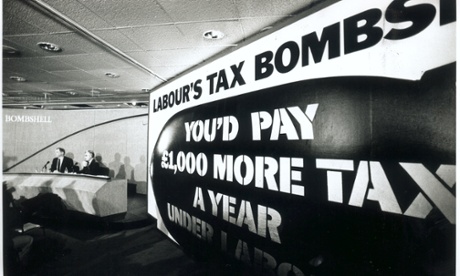
It has already widely been said that David Cameron seems to be modelling his re-election campaign on the one the Conservatives ran in 1992 (when he was a young aide in Central Office) and today we’ve seen fresh evidence of that. In his Sunday Times interview (see 8.43am), George Osborne has resurrected the tax bombshell attack that worked so well for John Major.
But the Sunday Times focused on Osborne revelation that the Conservatives will propose inheritance tax cuts.
I have taken steps to help with inheritance, making sure that people can pass on their pension to their children. People can pass on their ISAs. David Cameron has made it clear, as have I, that we believe inheritance tax is a tax that should be paid by the rich and we will set out our further approach closer to the election.
On the Andrew Marr show a Mail on Sunday story saying that Alastair Campbell has been asked to play David Cameron in Ed Miliband’s debate rehearsals has come up. Marr says he would pay good money to see the tapes.
Here’s an extract.
Campbell has been asked to impersonate Cameron and show Miliband how to expose the Prime Minister’s weaknesses. ‘No one gets under Cameron’s skin more than Alastair,’ said a Labour insider. ‘He has been goading toffs all his life.’
As Toby Helm reports in the Observer, Ed Miliband’s call for a new measure of national economic performance is reminiscent of David Cameron’s call, when he was opposition leader, for the Office for National Statistics to measure happiness, or well-being.
The ONS does now publish this data, but it is an initiative that Cameron has quietly forgotten about, and you are very unlikely to hear him boast about this as one of his great success. Why? Because the ONS statisticians released they could not fully explain what caused changes in people’s happiness. And the exercise has produced some peculiar conclusions. For example, Northern Ireland emerges as one of the happiest places in the UK, even though, looking at its economy, security situation or political culture, most policymakers would conclude that it is not exactly a model for the rest of the UK to follow.
Miliband's letter to the UK Statistics Authority about a national living standards index
There is something archetypically Ed Miliband about his plan for a national living standards index. Only someone who taught a course in social justice at Havard would conclude that what the UK really needs is a new economics metric. Which is not, of course, to say it’s a bad idea.
The Labour party has released the text of Miliband’s letter to Sir Andrew Dilnot, chair of the UK Statistics Authority, asking him to consider the idea. Here it is.
Dear Sir Andrew,
I am writing to ask you to consider introducing a new measure of UK living standards.
As you know, there are a range of issues with the way that we currently measure living standards, which mean that the information available to policy makers is not giving a full and up-to-date picture of the living standards of families across the country.
Of particular concern is:
· Current measures of wages miss out on the earnings of the self-employed, who make up an increasing proportion of the labour force.
· As the review of consumer price indices by Paul Johnson that you published this week concluded that “there is an unhelpful proliferation of price indices in the UK at present” and no clear agreement on how best to measure the impact of prices at different levels of the income distribution.
· Several of the existing measures of incomes are significantly lagged, with the most recent family resources survey showing data from 2012/13. Moreover, the measure of incomes published in the national accounts included the incomes of, for example, sports clubs and religious institutions.
Policy makers too often fail to understand and respond to changes in living standards and so we now need a better measure. My view is that key criteria used when developing this should include:
· Timely: a new indicator should be produced at least quarterly, based on data not older than six months. This should allow for discussion on the progress of living standards to reflect what people are actually experiencing.
· Comprehensive: a new indicator should reflect people’s real experience of the economy, including the impact of wages, prices and taxes and benefits on their incomes.
· Meaningful: a new indicator should show the experience of people across the range of the income distribution, and pick up how changes in wages or prices vary for those at the top, middle and bottom.
A future Labour government would use this indicator as the key measure by which we would expect our success to be measured, and I would ask the OBR to forecast this alongside measures of GDP.
We would be grateful if you could consider this issue, and the prospects for a new indicator, swiftly so that future governments can be fully held to account.
Yours sincerely
Ed Miliband
Ed Miliband, the Labour leader, is doing his big start-of-year interview on the Andrew Marr show this morning. I’ll be covering it live, and bringing you reaction and analysis.
Two stories in the papers are bound to come up.
The Labour leader will say on Sunday that the new LSI measure – which will be accorded equal status to gross domestic product (GDP) figures – will help to ensure that economic policy is geared to the everyday needs of families rather than to meeting growth targets on graphs.
Under the plan, the independent Office for Budget Responsibility would be expected to monitor standards of living and issue forecasts in the same way it does for GDP.
In a letter to Sir Andrew Dilnot, chairman of the UK Statistics Authority, Miliband has asked for preparations to be made for the new index ahead of the general election on 7 May. Miliband told Dilnot: “Policymakers too often fail to understand and respond to changes in living standards, and so we now need a better measure.”
He added: “A future Labour government would use this indicator as the key measure by which we would expect our success to be measured.”
-
George Osborne, the chancellor, has accused Labour of planning a “tax bombshell”, which would lead to a 3p increase in income tax or a 3% rise in national insurance. In an interview in the Sunday Times (paywall), Osborne also ruled out a rise in VAT if the Conservatives won the election and promised to cut inheritance tax.
Balls, the shadow chancellor, has said Labour will vote for the [charter for budget responsibility on Tuesday] but has not spelt out how it would find the savings. Miliband has previously said he favours a 50-50 mix of cuts and tax rises.
Osborne said: “If you take that approach, half of the £30bn would be £15bn in tax. That is the equivalent of 3p on income tax to hit working families or 3% on the jobs tax. Ed Miliband and Ed Balls are trying to pull off a grand deceit. They are trying to get away without saying what their real plans are.”
Osborne last night wrote to Miliband, calling on him to come clean. “Voters at the general election deserve to know how the Labour party would deliver the £30bn of consolidation,” he wrote. “Large tax increases would be catastrophic for our economy and for family budgets.”
I will be posting more from the papers before the interview starts. The Marr show begins at 9am, but the Miliband interview won’t get going until about 9.30am. It will run until 10am. It will then post reaction, a summary and analysis before wrapping up at about 11am.
If you want to follow me on Twitter, I’m on @AndrewSparrow.