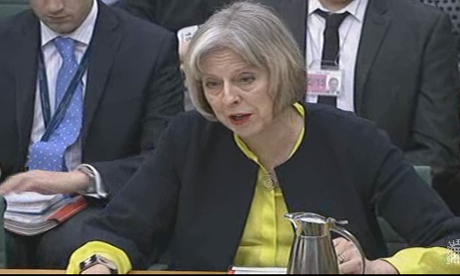
Afternoon summary
-
Theresa May has told the Commons home affairs committee that she wants the child abuse inquiry to have the power to compel witnesses to give evidence to it. She said:
The overwhelming message I’m getting from those that I have been meeting, survivors and survivors’ representatives that I’ve been meeting, is that it’s important to make sure that we do get this right. I’m very clear that the inquiry should have the powers of a statutory inquiry.
- She did not back calls for a judge-led inquiry into allegations that British intelligence officials colluded with torture. The intelligence and security committee, which is conducting its own inquiry, was the appropriate body for this, she said.
- She rejected a suggestion from Sir Bernard Hogan-Howe, the Metropolitan police commissioner, that police forces should merge. Number 10 also rejected the idea.
- Labour has said the publication of the government’s charter for budget responsibility shows that George Osborne has abandoned his demand for the government to balance its books completely by 2018-19. The charter only says the current budget should be balanced by then. The Tories say their policy is not the same as coalition policy.
That’s all from me for today.
Thanks for the comments.
Keith Vaz concludes by asking May what her legacy would like to be when she leave the Home Office.
May says she once told Home Office officials, when they asked her this question, that she would like the Home Office to stop being the story. She has got more work to do on this, she say.
Vaz says the committee will take evidence from her once more before the election.
And that’s it.
May says she does not think juveniles with mental health problems should be held in police cells.
Keith Vaz goes next.
Q: What do you think of Sir Bernard Hogan-Howe’s call in the Guardian for police forces to merge?
May says she thinks there is scope for police forces to share services more.
But she has always thought that police forces can retain their local identities too.
Labour’s Ian Austin goes next.
Q: What have you done to identify the murderer mentioned in John Vine’s report who was given citizenship? Has his citizenship been revoked?
May says she will write to the committee about this.
Keith Vaz says the Home Office has already issued a press notice about this. The man’s citizenship has been suspended, he says.
Paul Flynn goes next.
Q: Isn’t it true that the country is not full up? And some parts of the country are bearing more of a burden than others?
May says it is true that some parts of the country are taking more asylum seekers than others.
May says immigration has been good for the UK. But she wants to see more controls, she says.
Q: Will you publish the Operation Nexus report that John Vine wrote, that has been with you since June?
May says this report, and others, will be published at a suitable time.
Q: Why have you held on to this for so long?
May says it will be published.
Q: Were you surprised by the report showing how poor the checks were on people applying for UK citizenship?
May says some of the questionable decisions took place under the old asylum legacy programme.
Q: Do officials know that we don’t want murderers to get citizenship?
May says the rules have been tightened.
Vaz turns to immigration.
May says the government has not been able to control immigration from the EU.
Keith Vaz goes next.
Q: Are you going to outlaw so-called “designer vagina” operations, cosmetic genital surgery? Some are performed on women aged 18 to 24.
May says she will write to the committee about this.
Theresa May says current 1970 cut off date for child sex abuse inquiry is being reconsidered under possible redrawning of terms of reference
— Alan Travis (@alantravis40) December 15, 2014
Michael Ellis goes next.
Q: What do you think of the proposed Michael Mansfied inquiry into child abuse?
May says she hopes that any evidence it produces will be passed on to the official inquiry.
Q: Should the official inquiry have the power to compel people to give evidence?
May says she is satisfied, having spoken to survivors, that this should be an inquiry that has the powers of compulsion.
Q: Can you arrange that now?
May says she is not sure how this will be made to happen. There are various options.
Tim Loughton, the Conservative former children’s minister, is asking the questions now.
Q: Wouldn’t it have been better to have spoken to survivors’ groups earlier?
May says she has spoken to them now.
Q: What have you learnt from talking to them?
May says she has a better understanding of the enormity of the issue.
Keith Vaz, the committee chairs, switches the subject to the child abuse inquiry.
Q: Isn’t there a danger the amount of time spent appointing a chair could damage the standing of the inquiry?
May says she wants to get this right.
She wants to ensure the inquiry has the powers of a statutory inquiry.
Q: So you accept now it should be statutory inquiry?
May says it should have the power to force people to give evidence.
That could be achieved by waiting for the new chair to ask for statutory powers.
Or it could be achieved by setting up a new inquiry.
Or there could be a royal commission model, she says, but that would be more problematic.
- May says she wants the child abuse inquiry to have the powers of a statutory inquiry.
Updated
Ian Austin, a Labour MP, says we should not get swept away by these “mad conspiracy theories”. This is a partial report, produced by one side in the US. And it has produced no evidence that British officials or politicians are complicit in torture. Other senior figures in the US have said the interrogations did produce useful information, including stopping attacks on Canary Wharf and helping the US find Osama bin Laden.
When you strip away the conspiracy theories, and the point-scoring, and attempts by “liberal, hand-wringing journalists” to undermine are safety, aren’t those the facts, Austin asks.
May says the report did not show any UK complicity in torture.
She says there has been a debate in the US about whether the information uncovered by the CIA’s interrogation techniques produced useful intelligence.
Labour’s Paul Flynn goes next.
Q: The publication of the Chilcott inquiry is four years late. We still don’t know why we went into Helmland. Shouldn’t we get away from this policy of cover up?
May says she is not responsible for the Chilcott inquiry.
Q: No one in government seems to accept responsibility for the Chilcott inquiry. Doesn’t this delay degrade our reputation?
May says you cannot have an inquiry that is independent, and then complain that ministers are not taking responsibility for it.
Q: The government’s guidance to the intelligence services suggests interrogations can go ahead if there is a moderate risk of ill-treatment.
May says that is Huppert’s interpretation of the guidance, not hers.
Julian Huppert, the Lib Dem MP, goes next.
Q: Originally the prime minister said a judge-led inquiry would be right. Why has the government changed its stance?
May says circumstances change.
She says the intelligence and security committee is independent. It is not swayed by party politics.
Q: Do you think Tony Blair and Jack Straw should give evidence about what they did to a committee of parliament?
May says ministers must be responsible to parliament for the decisions they took.
But she says this can be a “heavy responsibility”.
Q: While you have been home secretary, has the government settled any cases with people suing the government over torture?
May says some cases were settled at the time the Gibson inquiry was set up. She does not think any of those involved torture. But she agrees to write to the committee with confirmation.
Michael Ellis, a Conservative, is asking questions now.
Q: Do you accept intelligence officials would be repulsed by torture?
May says that is right.
From her experience, she thinks they would not want to think that the work they were doing was tainted by torture.
Q: So if MI5 were responsible for redacting material from the Feinstein report, would you be happy for that material to appear in the public domain?
May says she would expect M15 to cooperate with the intelligence and security committtee investigation.
Q: Have you read the whole of the senate intelligence committee report?
No, says May. Officials are looking at it.
Q: Can you confirm that the government did not ask for any redactions in the report?
May says that she did not ask for any redactions.
She says it was wrongly reported that she met the committee some time ago. She has only met Senator Feinstein once, in September. They spoke about other things.
Q: So the government did not ask for redactions?
May says the government had the opportunity to ensure that there was nothing in the report that damaged national security.
She says she personally did not ask for redactions.
Q: Can you say you have not seen any evidence of British intelligence officials being complicit in torture?
May says the government set out new guidance on this when it came in. The intelligences services do an excellent job. Intelligence officials would not want to be tainted by torture. We all believe it is wrong, she says.
Q: So you have seen no evidence that British agents were involved in torture in any way?
May says she has not seen any evidence on this.
Q: Lord West says British agents may have been in the same building when torture took place.
May says she cannot speak for the last Labour government.
Q: Do you think there should be a judge-led inquiry into this?
May says in the US a senate committee did an inquiry.
The equivalent committee here is the intelligence and security committee. It will be carrying out an inquiry. And the intelligence agencies will cooperate.
Keith Vaz says his committee is also interested in this. It will be asking Senator Feinstein to come to the UK next year to speak to it about this, along with a ranking Republican.
- May does not back call for a judge-led inquiry into torture allegations.
Theresa May is giving evidence now.
She says she was “surprised” Norman Baker resigned from the Home Office. He was an “assiduous” minister, she says.
This will be a general session, covering a range of Home Office issues.
According to the home affairs committee, these are some of the topics coming up.
- The Independent Panel Inquiry into Child Sexual Abuse;
- immigration issues, including the Committee’s findings from its recent visit to the migrant camps at Calais;
- counter-terrorism, including British fighters in Syria, the Counter-Terrorism and Security Bill and the CIA’s detention and interrogation programme; and
- recent developments in policing.
Theresa May questioned by Commons home affairs committee
Theresa May is about to give evidence to the Commons home affairs committee.
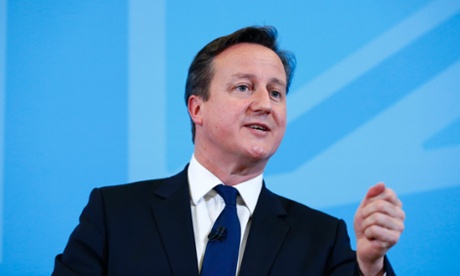
David Cameron's speech - Summary and analysis
David Cameron is not a man for understatement. According to the prime minister, Labour’s plans add up to “total and utter chaos”.
That’s the key message in his economy speech. It is not available on the web, yet, and so here are the key points, with some snap analysis. Cameron has given many good speeches in the past, but this wasn’t one of them. To me, it was hyperbolic and rather shallow.
-
Cameron said Britain could not built a future on a mountain of “unsustainable” debt.
It’s happening because this government has a long-term economic plan we are seeing through.
At the heart of that plan is sound public finances and reducing the deficit.
It’s simple: you can’t build a better future on a mountain of unsustainable debt.
Sound finances are the foundation of everything.
(The key word here is “unsustainable”. But there is no agreement on how high debt can rise as a proportion of GDP before it becomes unsustainable.)
-
He said the government had “cut the deficit in half”.
This has provoked this, from the Spectator’s Fraser Nelson.
How on earth can David Cameron claim to have halved the deficit? Real story attached... pic.twitter.com/oCKMa3LX7Z
— Fraser Nelson (@FraserNelson) December 15, 2014
-
Cameron said the charter for budget responsibility would call for the structural current budget to be in surplus by 2016-17. (See 2.55pm.)
Labour says this amounts to a retreat by the government.
Tory stunt backfires: Cameron speech attacks Labour’s target to get current budget into surplus then puts same target to vote in new Charter
— Alex Belardinelli (@abelardinelli) December 15, 2014
-
Cameron said Labour’s policies would bring “total and utter chaos”. The choice at the election would be between “competence and chaos”.
So today, I want to explain very clearly what each of those consequences are and why they add up to a simple choice: between competence and chaos.
Later he explained why he thought “total and utter chaos” was appropriate.
The chaos of a country that is racking up debts, that is unprepared for the future and totally beholden to global economic forces.
(As election hyperbole goes, it does not get much stronger than this. Doubtless some people will agree with Cameron, but there is a danger that using such apocalyptic language damages the credibility of his argument.)
-
He said Labour’s over-spending caused the financial crisis.
Let’s remember how our country got into this mess.
It’s because during good times, we didn’t put money aside for a rainy day.
At the height of the so-called boom years, far from running a surplus, Britain was running the biggest structural deficit in the G7.
Then, in 2008, when the economic storms hit, we were completely exposed.
We were plunged into a deep recession, with all the suffering and sacrifice that brings.
Our deficit spiralled out of control.
It became clear how dangerously beyond our means we had been living.
(This stretches the truth beyond breaking point. There is a perfectly reasonable argument to be had about the wisdom of Labour’s structural deficit, but Cameron knows perfectly well that it was not the prime cause of the crash.)
-
Cameron said that Miliband’s declaration that he was only focusing on getting the current budget into surplus, and that he would exempt the capital spending budget from this, meant that Labour would never stop borrowing. As a result, over 21 years, Labour could add £500bn to the national debt, he said.
Ed Miliband would never clear the overall, headline budget deficit.
He would run a budget deficit – permanently adding to debt – indefinitely. Every year. Forever.
The independent experts at the Institute for Fiscal Studies have put it best: ‘under a Labour government ... you’d have much more borrowing, and therefore government debt.’
They say that Labour’s borrowing rules would allow them to borrow £28 billion more a year.
The Treasury too have done some analysis on the equivalent of Labour’s policy.
It shows that, compared to our plans, the national debt would be almost £500 billion bigger in 21 years’ time.
Nearly £30,000 more debt for every taxpaying household in Britain.
That is a great, black, ominous cloud on the horizon – and if a real economic storm hit again, the fall-out would be felt by families up and down this country.
-
He said Labour would also impose higher taxes. Taxes would have to go up because Labour was not committed to the Tories’ spending reductions, he said.
So when they say, as they do, that they don’t support our spending reductions, that they want to spend more, we all know what that means: higher taxes.
(Cameron did not make it clear how this argument fitted with his claim that Labour would also borrow more to finance spending.)
-
He said public services would suffer under Labour because Labour would have to borrow more.
Just think about the interest alone that we are paying to foreign creditors, and what that money could be spent on.
Each day the interest bill is £130 million: that is equivalent to around 1,300 doctors’ salaries for a year.
Each month it is £4 billion: over 90,000 nurses.
Each year it is £48 billion: enough to build over 100 new hospitals.
I say let’s get that deficit and debt interest down – so we can stop sending money off to bond holders in the Gulf or China and start spending it here in Britain, to make life better for people.
- He said further savings could come from welfare.
-
He said that he was not trying to build “utopia” and that his government had simple aims.
Simple things: a decent job, more money at the end of the month, good schools for our children, the chance to own a home, peace of mind in our old age.
It’s not a utopia we’re building.
Just a Britain that everyone is proud to call home.
Updated
David Cameron has delivered his speech on the economy. It did not receive any live TV coverage, but I’ve got a copy, and I will post a summary shortly.
In it he says the government will be publishing its charter of budget responsibility this afternoon.
Today, the government is publishing a new Charter for Budget Responsibility.
This will enshrine our commitment to get debt falling as a share of our national output by 2016-17...
... and to get the structural current budget into balance the following year.
Labour is expected to be able to support this.
Expect Labour to vote for charter of budget responsibility in new year even though sets new date 17-18 by which struct deficit in balance.
— Patrick Wintour (@patrickwintour) December 15, 2014
Lunchtime summary
-
Labour leaders have distanced themselves from a party briefing note acknowledging that immigration is not a top vote-winning issue for the party. The document, called Campaigning against Ukip, does not tell activists to ignore immigration, but it says that some Ukip supporters will never be won over and that Labour’s best chance of converting people back from Ukip lies in raising the salience of other issues, like the NHS. (See 10.46am.) Ed Miliband said the document was not very well worded. Speaking at a Q&A in Great Yarmouth, he said:
I think what matters about our party and where we stand is what I’m saying on this stage, the pledge we are making, rather than some not very well drafted language, out of context, in a briefing document. I don’t think anyone is in any doubt where Labour stands on this. Over four years since the last general election I’ve changed our approach.
On the World at One Yvette Cooper, the shadow home secretary, went further, saying the document was “wrong” in so far as it said Labour should not talk about immigration.
I’m afraid the document is wrong on this. And it does not reflect what we are actually doing as well. Because what Ed is talking about today is making immigration the second pledge that we are setting out for our manifesto.
Cooper’s line is much stronger than the line Rachel Reeves adopted this morning, when she just argued that comments in the document had been taken out of context. (See 9.23am.)
(Anyone who reads the whole document will notice that it is actually one of the most sensible strategy papers to come out of Labour HQ for ages. So why is the party leadership disowning it? Because they are hyper-sensitive to the charge, unfair though it is, that they are ignoring immigration concerns. There’s a touch of Emily Thornberry about all this.)
- Miliband has confirmed that employers who exploit immigrants by offering them lower wages and worse conditions than British residents could be jailed under a Labour government. He made the announcement at an event in Great Yarmouth. At the end of last week Labour said Miliband would make a “major speech” on the subject, but this did not materialise and today’s was very short, and billed as the party as “opening remarks” before a Q&A.
Updated
Miliband moves on to some closing remarks.
He says he will be doing more events like this.
He is in politics to change things. He does not accept that politics does not matter, he says.
Ideas matter. Ideas create movements. And movements change countries.
The big question over the next two decades will by how you can ensure that the system works for everyone, he says.
He says he really believes that he can change this country.
As someone once said, the country is run by those who turn up. Make it happen, he says.
(His peroration was the most passionate part of the whole event, and probably the best too.)
Miliband is now taking two questions from the media.
Q: Why is Labour telling campaigners, when immigration comes up on the door step, to move the conversation on to something else?
Miliband says he has been talking about immigration today. It will be on Labour’s pledge card.
Q: Could that document have been better phrased?
Miliband says what matters is what he has said today, not the “not very well drafted” language in a briefing document.
It is also peculiar that Ed Miliband is ignoring questions from journalists.
. @steve_hawkes Press pack at back have had hands up for last 45 mins.
— Ben Riley-Smith (@benrileysmith) December 15, 2014
Concentrating on questions from local people may appear laudable, but it’s a very foolish media management strategy, particularly if reporters have spent two and a half hours on a train to attend your event.
(Hacks are simple folk. Keep them happy, and they are more likely to write nice things about you. That’s the first rule of PR.)
Updated
Miliband is in Great Yarmouth, where Ukip support is high, but, if the plan was for him to expose himself to public anger about immigration at this Q&A, it has not worked. Most of the questions have been on other topics.
Audience v sympathetic to Ed Miliband in Gt Yarmouth, a Ukip-friendly, Tory-held marginal. He claims guests from cross-section of electorate
— Rowena Mason (@rowenamason) December 15, 2014
Here’s the Labour press notice about Ed Miliband’s immigration announcement, with the full text of what they describe as his “opening remarks”. They are not calling it a speech.
The note includes a section explaining how a German law has provided the inspiration for Labour’s proposed anti-exploitation legislation. (Bold text from Labour.)
Labour’s proposal for a new law against exploitation has been heavily influenced by the example of Germany, where similar legislation exists.
In Germany, section 233 of the Criminal Code states: “Whosoever exploits another person’s predicament or helplessness arising from being in a foreign country to subject them to slavery, servitude or bonded labour, or makes him work for him or a third person under working conditions that are in clear discrepancy to those of other workers performing the same or a similar activity, shall be liable to imprisonment from six months to ten years. Whoever subjects a person under twenty-one years of age to slavery, servitude or bonded labour or makes him work as mentioned in the 1st sentence above shall incur the same penalty”
The German definition is significant since it applies two aspects that reflect (a) the fact that migrants might be especially vulnerable to abuse by employers; and (b) that work exploitation can be detected by comparison with the working conditions of others doing the same work. The German law is also not restricted only to trafficked people, illegal migrants or regular migrants – but is specific to being in a ‘foreign country’.
Labour is proposing to extend these principles into UK legislation – by incorporating undercutting into our new criminal offence of exploitation.
This would not stop firms from hiring from other EU countries under freedom of movement provisions. But it would mean that abusing those provisions by exploiting migrant labour would be subject to prosecuting, where there is evidence that some abuse of power had occurred and that migrants were employed on significantly different terms to local workers.
A man in the audience says his wife has to spend 35 hours a week doing job searches or face the loss of her benefits. It is impossible, he says, because the same jobs keep coming up day after day. And, given the amount she gets in return for the number of hours she is expected to put in, she is effectively receiving less than the minimum wage.
Miliband thanks him for sharing his story.
Back at the Miliband Q&A, Miliband is still taking questions from non-journalists.
Q: What can Labour do to improve the security of tenants?
This is a key issue, Miliband says. It illustrates how the current system is not working for ordinary people.
Labour would introduce more controls on the private rented sector, he says. Three-year tenancies should be the norm.
But it is also important to build more homes, he says. In the Lyons review, Labour published a very detailed plan for this.
Miliband has been taking questions for almost half an hour now, but he still has not yet taken any questions from journalists.
Miliband now fielding a Q from 'Craig with the Christmas jumper'. Still no Qs from poor old journos
— Matt Foster (@mlpfoster) December 15, 2014
Q: Labour will have no control over the NHS if the TTIP (transatlantic trade and investment partnership) goes through? Will Labour tackle these deals?
Labour will act on this, Miliband says.
It would protect the NHS from TTIP. Clive Efford, a Labour MP, recently introduced a backbench bill on this. Miliband can give his absolute assurance on this. Labour would not allow NHS privatisation through the front door, or through the back door either.
Q: A friend of mine, Natalie Engel, faces having her husband deported because she does not earn enough money. What would Labour do about cases like this?
Miliband says he does now know the details of this case. He will speak to the questioner afterwards.
He clearly hasn’t read Zoe Williams’ column today.
Updated
Q: Would you increase the minimum wage for under 18-year-olds?
Miliband says Labour would raise the minimum wage for young people. He wants the adult one to go up to £8 an hour, and he would like the youth rate to go up too. It is at a “pretty low level” now, he says.
Q: Would you increase national insurance, or raise taxes, to raise funds for the NHS?
Miliband says Labour made a different choice. It will raise money for the NHS from the mansion tax, for a crackdown on tax avoidance and by raising money from tobacco companies.
Q: Why do you think young people are apathetic about politics?
Miliband says young people are apathetic when they think politics won’t make a difference. His job is to show people that it can make a difference. And he wants to mobilise young people, because the best people to persuade young people to vote are other young people.
Partly it is about trust, he says. George Osborne abolished the educational maintenance allowance with one line in a speech, without consultation.
Q: What’s Labour’s view on English votes for English laws?
Miliband says Sadiq Khan and Hilary Benn set out Labour’s position on this at the end of last week. But constitutional change has to be done properly. There should be a constitutional convention, he says.
Updated
Miliband says it is right that migrants should not be able to come to the UK and claim benefits from day one.
Miliband says he agrees with Andy Burnham that the NHS should be the preferred provider for health services.
Miliband says Labour brought private sector into NHS "on the margins", says Coalition reforms "completely different"
— Matt Foster (@mlpfoster) December 15, 2014
Updated
Ed Miliband is attracting some criticism because his immigration speech was very short.
This is from Sky’s Faisal Islam.
v v short speech by Miliband on immigration less than ten minutes...
— Faisal Islam (@faisalislam) December 15, 2014
And this is from the Institute of Directors’ Christian May.
I went to get a coffee just before Miliband's big immigration speech, and by the time I got back to my desk he'd finished.
— Christian May (@ChristianJMay) December 15, 2014
Labour announces its election pledge on immigration
Here is the wording of the Labour pledge on immigration.
JUST ANNOUNCED: our plans to control immigration fairly. pic.twitter.com/dJLylwvlNG
— The Labour Party (@UKLabour) December 15, 2014
Updated
Ed Miliband asked how local areas can plan for impact of immigration on schools, NHS etc. He says it "does matter", v important problem
— Rowena Mason (@rowenamason) December 15, 2014
Miliband's Q&A
Miliband is now taking questions.
Q: Will you be in the Commons to vote against the proposed cut to fire service pensions?
Miliband says it will depend if he can get back from Great Yarmouth in time. Labour has triggered this vote. The government’s plans are motivated by dogma, he says.
Q: What are you going to do about zero-hours contracts?
Miliband says Labour would ensure that people on zero-hours contracts, who are working regular hours, can get a proper contract?
Miliband confirms that Labour would make undercutting the wages of workers by exploiting migrants an offence.
Today, I am announcing that the next Labour government will go further still: making it a criminal offence to undercut pay or conditions by exploiting migrant workers.
We are serving notice on employers who bring workers here under duress or on false terms and pay them significantly lower wages, with worse terms and conditions.
This new criminal offence will provide protection to everyone. It will help ensure that, when immigrants work here, they do not face exploitation themselves and rogue employers are stopped from undercutting the terms and conditions of everyone else.
And he says that promising to control immigration in this way will be Labour’s second election pledge.
Miliband says people want immigration to be controlled.
People want there to be control of immigration. That means being tough on illegal immigration, with proper entry and exit checks. But control doesn’t stop at the border, it is also about fair rules when people get here.
And he says Labour has already proposed moves to introduce “fair rules”.
Fair rules means that entitlement to benefits needs to be earned. That is why we have already published proposals to prevent people coming here claiming benefit for at least two years. Fair rules means people integrating into communities and learning English.
But it isn’t just the benefits system that needs to be fair. It is the workplace too. We know that so many workplaces are so far from being fair today. And that is especially true in many workplaces with a large number of employees who have come from overseas.
We have all heard the most truly shocking stories of people having their wages stolen, and having to live in the most appalling conditions, exploited because they come here from abroad.
These practices have an effect on local workers too. Because when people can be exploited for low wages or endangered at work, it drags the whole system down, undercutting the pay and conditions of people here.
We have a plan to change this. We will increase the fines for firms paying below the National Minimum Wage. We will close down loopholes in agency worker laws that allow firms to undercut directly employed staff. We will ban recruitment agencies from hiring only from abroad.
Ed Miliband's immigration speech
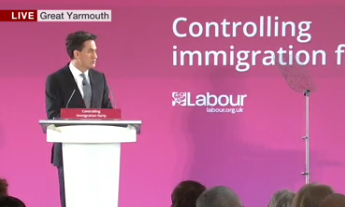
Ed Miliband is delivering his immigration speech now.
It is not being shown on BBC News or Sky, but the BBC are showing a live feed on their website.
He says he wants to hear what people say in the Q&A session, but that he is going to start with some remarks.
He begins with his own background.
I am the son of parents who came here as refugees.
I am proud that Britain enabled them to build a home and family.
And I am proud of the contribution that immigrants – of all origins, races, and faiths - have made to our country.
But when people worry about the real impact immigration has had, we will respond to those concerns not dismiss them. That is why I have changed Labour’s approach since 2010.
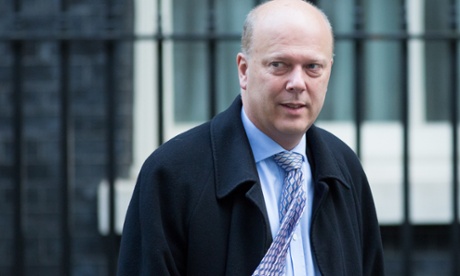
Grayling loses court of appeal case over legal aid in immigration cases
Chris Grayling, the justice secretary, has lost a case at the court of appeal over granting legal aid in immigration cases.
This is from the Press Association.
Government guidance in relation to granting legal aid for immigration cases has been declared “unlawful” by leading judges.
Earlier this year the High Court in London ruled that the guidance issued by Lord Chancellor Chris Grayling was “unlawful and too restrictive”.
A judge in London said the guidance “sets too high a threshold” and “produces unfairness” by denying publicly-funded legal advice to applicants in “exceptional cases”.
The government appealed against that ruling to the Court of Appeal.
Today Master of the Rolls Lord Dyson, who heard the appeal with Lord Justice Richards and Lord Justice Sullivan following the decision of Mr Justice Collins in the High Court, announced that the guidance was “unlawful”.
Quashing refusals of civil legal aid in six cases, Mr Justice Collins said in June that it was “a fundamental principle that anyone in the UK is subject to its laws and is entitled to their protection”.
He said: “Thus there must be a fair and effective hearing available and the guidance, as the facts of some of the cases I have dealt with show, produces unfairness.”
The judge quashed refusals by the director of legal aid casework, relying on the Lord Chancellor’s guidance, to grant legal aid to six claimants.
All the cases concern the availability of legal aid in immigration cases under Section 10 of the Legal Aid, Sentencing and Punishment of Offenders Act 2012 (Laspo), which deals with exceptional funding applications.
Mr Justice Collins said the cases involved EU nationals appealing against decisions that they should be deported following criminal convictions, an alleged victim of trafficking from Nigeria, and other cases involving the right to enter and remain in the UK.
He indicated that in some of the six cases legal aid should have been granted, but said all of them must be reconsidered in the light of the ruling.
He said: “I have decided that the guidance in certain respects is indeed unlawful in that it is too restrictive and in other respects not in accordance with the law.”
The government’s flagship Laspo legislation was introduced to reform the legal aid system in order to cut the legal aid bill by 350 million a year by 2015.
The Act made wide-ranging changes to the provision and scope of legal aid, including for immigration cases, and most of the reforms came into force on April 1 2013.
Updated
Labour’s next election pledge is “controlling immigration fairly”, to judge by the slogan on display at the venue where Ed Miliband is speaking.
People now being turned away and the room is full and ready for Ed Miliband in Great Yarmouth. pic.twitter.com/Jqk4yuTl0D
— Annabelle Dickson (@NewsAnnabelle) December 15, 2014
Whisper it quietly (esp on the doorstep) Labour's next Manifesto pledge "Controlling Immigration Fairly" ...
— steve hawkes (@steve_hawkes) December 15, 2014
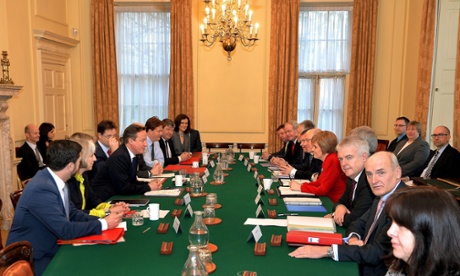
Here’s a picture from the start of today’s joint ministerial committee meeting at Downing Street.
Nicola Sturgeon, Scotland’s first minister, gets the prime slot opposite David Cameron.
According to the overnight briefing, Cameron was planning to tell his Scottish, Welsh and Northern Ireland counterparts that it was time to move on from the debate about devolution. This is from the Press Association earlier.
David Cameron will tell the leaders of Scotland, Wales and Northern Ireland that it is time to concentrate on best using the powers they have rather than debating what more could be devolved.
The prime minister hopes to focus a session of the Joint Ministerial Committee on UK-wide issues - including a briefing from security and intelligence services about the threat posed by Islamic State-inspired terrorism.
“It is now time we reached a point where the big debate is about how the powers are used, not about what they should be,” he said ahead of the annual meeting at Downing Street.
The Downing Street gathering is the first face-to-face meeting between the prime minister and Nicola Sturgeon since she became Scotland’s first minister and will be followed by direct talks between the two.
“It is now time we reached a point where the big debate is about how the powers are used, not about what they should be.” Given that the Smith Commission has published its report, you can see why Cameron might be saying this. Still, it sounds a bit premature.
And here are some of the more interesting tweets I’ve seen about the Labour “Campaigning against Ukip” document.
From the Guardian’s Rafael Behr
So Telegraph splash is that Lab is advising candidates they won't change Ukippers' minds by banging on about immigration ... (1/2)
— Rafael Behr (@rafaelbehr) December 15, 2014
Haven't the Tories already very thoroughly proved the wisdom of this counsel. Taken in context, seems pretty sensible.
— Rafael Behr (@rafaelbehr) December 15, 2014
From Huffington Post’s Mehdi Hasan
Another Monday morning of collective right-wing-press-meets-craven-Labour hysteria over immigration and the party's 'anti-Ukip strategy'.
— Mehdi Hasan (@mehdirhasan) December 15, 2014
Apparently it's wrong to try & 'move conversation' on from immigration with Ukip irreconcilables on the doorstep. Talking NHS is bad (!). Ok
— Mehdi Hasan (@mehdirhasan) December 15, 2014
The more everyone talks about immigration, the more Ukip benefit as the issue is thrust/kept centre stage. Voters think 'Ukip have a point'.
— Mehdi Hasan (@mehdirhasan) December 15, 2014
From Damian McBride, Gordon Brown’s former spin doctor
I hope Labour's media team roll up a copy of that 33-page document and beat their ‘strategic’ colleagues savagely around the head with it.
— Damian McBride (@DPMcBride) December 15, 2014
“Don’t send *whack* daft *whack* documents *whack* like this *whack* all round *whack* the country *whack* you total *whack* twats *whack*”
— Damian McBride (@DPMcBride) December 15, 2014
From Rob Ford, co-author of Revolt on the Right, the acclaimed book about Ukip
Lab doc doesn't say don't talk abt imm. Says address imm directly but don't turn conversation into bidding war over imm. Sensible.
— Rob Ford (Britain) (@robfordmancs) December 15, 2014
Media treatment of leaked Lab doc about imm shows why nuanced discussion of issue impossible: 99% of thoughtful doc is ignored
— Rob Ford (Britain) (@robfordmancs) December 15, 2014
From Matthew Goodwin, Ford’s co-author
1/2 Labour 'anti-Ukip' doc all about short-term doorstep strategy but will not resolve long-term loss of blue-collar voters who since 2001..
— Matthew Goodwin (@GoodwinMJ) December 15, 2014
2/2 have been drifting away from Lab due to intense concern over EU & imm. Lab will need to engage on these issues to stall long-term losses
— Matthew Goodwin (@GoodwinMJ) December 15, 2014
From Philip Cowley, a politics professor
Note all the academic references in the leaked Labour document: Pattie, Johnston, Fisher, Cutts, Fieldhouse, John: http://t.co/zLGzSRU1sV
— Philip Cowley (@philipjcowley) December 15, 2014
Updated
Labour's "Campaigning against Ukip" document - Summary
The Labour party’s “Campaigning against Ukip” document (pdf) is well worth a read. Although it is capable of being caricatured as containing a “don’t mention immigration” message, it is actually much more intelligent and sophisticated than that and it shows that (at last?) Labour has actually developed a plausible strategy to counter Ukip.
It is a practical guide designed to help people engaged in door-to-door campaigning in areas where Ukip is a threat. Here are some of the key points.
-
It says that Ukip supporters aren’t all the same and that Labour campaigners need to differentiate between those Ukip supporters who might back Labour and those who have no chance of doing so.
As former Conservative supporters are estimated to make up almost half of UKIP supporters, this makes it clear regarding UKIP supporters as a homogeneous group is a mistake. For that reason, it is important to carefully target sub-groups within UKIP’s base of support, as many UKIP-leaning electors report they have little (or no) chance of ever considering voting Labour. We should therefore use the limited time before the General Election to concentrate our efforts and resources on the electors we are most likely to be able to persuade to vote Labour.
Polling for ComRes in October 20143 suggested that, while 16% of self-identified Labour supporters would consider voting for UKIP in the 2015 General Election, 1 in 10 current UKIP supporters would consider voting for the Labour Party. This highlights that there are votes that can be won (and lost) in the fight against UKIP. Our goal is to identify and target these electors with our key persuasion messages to win their support.
The biggest single group of UKIP supporters, former Tories, are likely to be attracted to UKIP due their anti-EU rhetoric and right-wing policies which overlap with the Conservative Party’s right-wing policy agenda. As such, these electors are unlikely to be easily won over by the Labour Party in the 2015 General Election.
-
It says that Labour campaigners should try to raise the salience of issues other than immigration, where Labour policies are more popular.
As a political party, we are more effective at changing what is discussed and debated (the salience of the issues), as opposed to changing what may be long-held and entrenched opinions of each party or views on which party has the best policies on each issue. For example, in autumn 2013 we saw a sharp rise in the salience of energy prices in the wake of Ed’s policy announcement at Annual Conference and the integrated campaigns we ran in the weeks and months that followed. More recently, we have seen a substantial increase in the salience of the NHS.
Following from this, when we embark on policy messaging around immigration, which is not an area where Labour has the strongest lead over other parties, we should ensure that this messaging is always done in conjunction with other policy areas. The purpose of this is to raise the salience of those issues in which Labour has a much clearer lead and stands to benefit more from their prominence with the electorate. This is especially true when messaging comes from the local candidate and local party, where the magnitude of this effect may be greatest.
-
It says voters often link immigration with issues on which Labour is stronger.
The Labour Party has commissioned polling by Greenberg Quinlan Rosner Research (GQRR) to test the top issues among different groups of electors. Table 4 shows that Older Traditionalists, who are more likely to vote for UKIP, are also most likely to select immigration as one of the two most important issues for them. This concern for immigration is often framed around other issues (such as local housing, healthcare or other services) where the Labour Party tends to be rated more highly. This is closely followed by the NHS, which is also considered a key issue for the majority of Older Traditionalist electors.
-
It says that campaigners should listen to voters concerns about immigration, but also move the conversation on to other issues.
While it is clear that UKIP’s campaign is largely concentrated on the issue of immigration, we cannot and should not fight the UKIP threat simply on their terms, not least because we will not win a bidding war on the issue. Although immigration is an important issue for many electors, and is often mentioned on the doorstep, it is often used as a means to express other concerns. Many of these issues, including healthcare, housing, and the delivery of other local services, are among the strongest policy areas for the Labour Party.
Volunteers and activists must understand and acknowledge electors’ concerns about immigration on the doorstep, which will mean hearing opinions that may not gel with their own. In these cases, it’s important to remember that first phase of re-establishing trust is to listen and understand. Keep in mind too that there may well be some voters who, with the best will in the world, we are unlikely to bring back from UKIP. It’s nonetheless essential that we leave them with a positive impression of the Labour Party, to avoid cementing them in their views and thus their voting patterns. Our focus must instead be moving the conversation on to issues where we have clear policy which tackles the problems people are worried about, whether they express those concerns through the prism of immigration or not. In summary, campaigners should acknowledge concerns and contextualise the problem as something that Labour has a clear plan to improve.
-
It says raising immigration with voters pro-actively can be counter-productive.
Immigration is a complex issue, on which the Labour Party has a series of policies designed to address legitimate concerns. Once explained and the context surrounding the issue made clear, our policies tend to be accepted as common sense. However, writing to electors proactively (i.e.: without evidence the elector is concerned about it) about immigration risks undermining the broad coalition of support we need to return to government, for the following reasons:
as a general rule, a higher salience for the issue does not translate into electoral advantage for us; and
we do not have much data collected in many UKIP target areas. Even with the best models we can develop, this means we will inevitably be hitting some people for whom it is unhelpful to raise the salience of immigration as an issue.
- But it says that Labour campaigners should “face the issue of immigration directly” with Ukip supporters.
Our advice [when dealing with people planning to vote Ukip] is therefore we should:
(a) listen carefully to electors’ concerns on immigration on the doorstep and engage with their views before moving the conversation on to how Labour would tackle the issues they have raised (whether they be housing, education, the NHS, etc.). We should acknowledge electors’ concerns and contextualise the problem as something that Labour has a clear plan to improve;
(b) focus our messaging on our key policies that will have improve the lives of electors ... ; and
(c) face the issue of immigration directly with identified UKIP supporters. With electors who have already indicated that they intend to vote for UKIP, we should set out our immigration policy clearly and explain how it resolves the issues people raise while forming part of our wider package of changes to how Britain works to make Britain fairer and more prosperous for everyone.
-
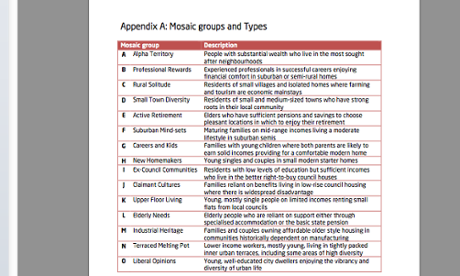
It uses the Mosaic system - a form of classifying people according to social type, which is more detailed than conventional class analysis - to explain who is mostly likely to vote Ukip.
Our current understanding suggests that UKIP’s support is strongest among the following Mosaic groups:
L – “Elderly Needs” (26%) Elderly people who are reliant on support either through specialised accommodation or the basic state pensio
E – “Active Retirement” (22%) Elders who have sufficient pensions and savings to choose pleasant locations in which to enjoy their retirement
M – “Industrial Heritage” (20%) Families and couples owning affordable older style housing in communities historically dependent on manufacturing
D – “Small Town Diversity” (19%) Residents of small and medium-sized towns who have strong roots in their local community
-
And it identifies which Mosaic groups are most likely to be Ukip-Labour switchers.
However, it is not enough to merely identify those Mosaic groups where UKIP support is most widespread because many UKIP supporters have little or no chance of ever voting Labour. Instead, we should target electors who share similar characteristics to UKIP supporters, but fall into our categorisation of UKIP-Labour switchers based on our polling data. This group is defined as
a) voted Labour in 2010 and intend to vote UKIP now;
b) intend to vote UKIP now but state that they have a good chance of voting Labour, and a fair or no chance of voting Tory;
c) intend to vote UKIP now but state that they have a fair chance of voting Labour, and no chance of voting Tory; or
d) intend to vote Labour but report a good chance of voting UKIP.
As figure 6 shows, the biggest group of such electors is within Mosaic group J, followed by Mosaic groups I and L.
Mosaic group J is “Claimant Cultures - families reliant on benefits in low-rise council housing where there is widespread disadvantage”. Mosaic group I is “Ex Council Communities - residents with low levels of education but sufficent incomes who live in the better right-to-buy council houses.” And Mosaic group L is “Elderly Needs - elderly people who are reliant on support either through specialised accommodation or the basic state pension.
-
It says that strong campaigning on the ground can beat Ukip.
Lessons can be learnt from the European election campaign. In particular, strong campaigning on the ground can help to win back and secure the support of disaffected electors who may be sympathetic to UKIP’s positioning as a party of protest and discontent. Past Labour Party campaigns against protest parties (including against the BNP in Barking and against the Liberal Democrats in constituencies ranging from Chesterfield to Islington South) have shown that work on the doorstep, combining clear messaging and targeting within constituencies will help to combat this threat on the ground.
-
It says door-to-door campaign makes a difference generally.
Pattie and Johnston sum up the research on campaign effects in the UK bluntly: “Other things being equal, the more parties campaign locally, the more votes they gain and the fewer votes go to their rivals” ...
Of the relatively few studies that have attempted to quantify the effect of local campaigns, a change in intensity of the Labour Party’s local campaign from no campaigning to the average ‘campaign intensity’ was associated with an increase in our vote share of more than 5 percentage points, even when taking other local political factors in account. Of particular relevance to this election, there is evidence that the benefits gained from campaigning are even larger for opposition parties than they are for incumbents.
Updated
The Institute for Fiscal Studies has today published a short paper analysing the impact of the benefits cap (which limits benefits to out-of-work families to £500 per week). The Department for Work and Pensions has put put a news release, based on DWP research, saying that the benefit cap is providing a clear incentive to work. The IFS accepts that it has encouraged some people to find work, but says the impact is relatively marginal.
Here’s an excerpt.
The cap, which works by reducing housing benefit awards, was set at £500 per week (except for childless single people, for whom it is £350), and those receiving Working Tax Credit and some claiming disability benefits are exempt. These choices mean that the cap does not affect many people and that the overall fiscal consequences are small. About 27,000 families (less than 1% of working-age families receiving housing benefit) were being capped once the policy was fully rolled out in late 2013, with their benefit income reduced by a total of about £100 million per year. Essentially all the families who receive enough benefit income for the cap to be binding have a large number of children or high rents (and often both) ....
What the quantitative analysis does tell us is that the large majority of affected claimants responded neither by moving into work nor by moving house.
Here’s more from what Rachel Reeves, the shadow work and pensions secretary, was saying about the Labour “’don’t mention immigration” document. (I’m paraphrasing the Telegraph’s headline spin on it.)
At the weekend I was talking to local councillors in my constituency about what stories we were going to put in our next leaflet. And on national stories, one of the four things I said we should be talking about was immigration, especially how it interacts with the benefits system ...
Ed is in Great Yarmouth today, one of [our] key seats, making our second election pledge, which is on immigration. So this is clearly something that Labour is talking about, is talking to voters about, and it’s our second pledge after the pledge on the deficit last week.
I’ve taken the quotes from PoliticsHome.
The Telegraph exclusive is here and the Labour document it is reporting his here (pdf).
I’ll post some highlights from it shortly.
My colleague Patrick Wintour says it is not telling Labour candidates to avoid the topic completely.
Lab. doc says "face issue of immigration directly with UKIP supporters, set out our immig policy clearly & explain how it resolves issues"
— Patrick Wintour (@patrickwintour) December 15, 2014
How comfortable is Labour talking about immigration?
Not that uncomfortable, because Ed Miliband is going to give a major speech on the subject today, in Great Yarmouth. He will says that employers who exploit immigrants by offering them lower wages and worse conditions than British residents could be jailed under a Labour government.
But the fact that Miliband feels the need to talk about immigration does not mean that the party sees this as a vote-winner. The Telegraph today reveals that, in a private strategy document, Labour candidates are urged to focus on “moving the conversation on” when voters raise the topic on the doorstep.
Labour MPs have been secretly ordered not to campaign on immigration because doing so could cost them the next election, the Daily Telegraph can reveal.
A private strategy document circulated by Labour HQ and seen by this newspaper warns that the bigger immigration becomes as a campaign issue the more votes the party will lose.
MPs are told to focus on “moving the conversation on” if voters express concerns about border controls to topics Labour is stronger on such as healthcare or housing.
They are also urged not to send leaflets on immigration to all voters because it could be “unhelpful” and “risks undermining the broad coalition of support we need to return to government”.
Rachel Reeves, the shadow work and pension secretary, told the Today programme that the Telegraph had taken comments in the document out of context. I will report more from her interview, and what the Telegraph says, shortly, as well as covering Miliband’s speech, and the reaction to it, in detail.
We’ve also got a major speech from David Cameron later. I will be covering that in detail too.
THE TIMES: Black cloud of Labour will wreck economy, PM warns #tomorrowspaperstoday #bbcpapers pic.twitter.com/fvCg4HngSf
— Neil Henderson (@hendopolis) December 14, 2014
Although I will be focusing on the Miliband and Cameron speeches, there is lots of other politics around too that I will be picking up along the way. Here’s the agenda for the day.
9am: David Cameron hosts a meeting of the joint ministerial committee, involving Nicola Sturgeon, the first minister of Scotland, Carwyn Jones, the first minister of Wales, and Peter Robinson and Martin McGuinness, the first minister and deputy first minister of Northern Ireland.
11.45am: Nick Clegg holds his monthly press conference.
12pm: Ed Miliband gives a speech on immigration. As Rowena Mason reports, he will says that employers who exploit immigrants by offering them lower wages and worse conditions than British residents could be jailed under a Labour government.
2pm: David Cameron gives a speech on the economy.
2.20pm: Nicola Sturgeon meets Leanne Wood, the Plaid Cymru leader, and Natalie Bennett, the Green party leader, in Westminster to discuss uniting to fight austerity.
3.30pm: MPs begin a debate on a Labour motion to block the government’s plans to cut firefighters’ pensions.
4.30pm: Theresa May, the home secretary, gives evidence to the Commons home affairs committee.
As usual, I will be also covering all the breaking political news from Westminster, as well as bringing you the most interesting political comment and analysis from the web and from Twitter. I will post a summary at lunchtime and another in the afternoon.
If you want to follow me on Twitter, I’m on @AndrewSparrow.
Updated