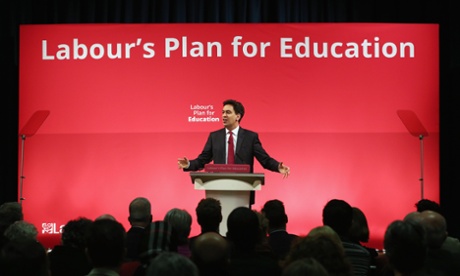
Ed Miliband’s education policy launch was surprisingly low-key. The Labour leader ended by stepping on his own message, by going off on a tangent on a political tiff over tax evasion, to the delight of Westminster but the despair of anyone wanting to focus on education.
The policy speech would otherwise have been significant enough. He trained most of his fire on the former education secretary Michael Gove, and didn’t bother mentioning by name his replacement, Nicky Morgan. Some of Miliband’s policy announcements were pre-digested, including putting a hard cap on infant class sizes, a small change that promises to be a headache for local authorities and primary school admissions administrators, although that will depend on the details.
The meat, though, was Miliband’s announcement that a Labour government would commit to increasing the education budget in line with inflation – a pledge that encompassed nurseries, Sure Start and provision for 16- to 18-year-olds that the Conservatives had left exposed.
But Labour’s policy was less generous than some had hoped. Rather than protect per-pupil funding in real terms, the inflation-proofing was provided for the total education spend – meaning that the big rises in pupil numbers coming down the biological pipeline will eat up much of the inflationary increase.
In contrast, the Tories last week had pledged to freeze at 2010 levels the funding per pupil from reception entry at age four or five to the end of GCSEs at 16. Nursery funding would not be inside the Tory ring fence, nor would sixth forms and further education colleges at the other end of the age scale.
With the numbers of 17- and 18-year-olds in the population remaining flat for a few more years, sixth-form colleges would face shrinking funding under the Tory plans, just at the point where teenagers are compelled by law to stay in education of training until the age of 18.
Overall, Labour’s pledge is an improvement on the Conservative offer, especially at the nursery and 16-18 levels. For the ages in between, Labour’s position is slightly more generous than the Conservatives, perhaps by one percentage point or so, but that depends on the rate of inflation. And even 1% can be a large number when it is added to a £50bn annual education budget. As the US senator is supposed to have said: a billion here and a billion there and pretty soon you’re talking real money.
For schools, the Tory offer has the benefit of clarity. And it could even be a better deal if inflation remains as low as it is now. If the cost of living stays below 2% for the next few years, the Conservative offer for schools could turn out to be more generous. Above 2%, Labour’s is probably better – although even then, schools will have to pay higher prices and face pressure to raise wages.
And, whereas the Conservative position degrades as inflation erodes the value of the ring-fenced per-pupil payment with the passing of time, Labour’s takes its biggest hit in 2017-18, when the increase in school intake peaks.
The Tories were eager to make their case. “Last week, Tristram Hunt promised that Labour would do better than the Conservatives. Today, after their back-of-an-envelope calculations, we can see it’s no such thing,” said one.
The rest of Miliband’s speech was a little too heaving on preparing pupils for the 21st-century economy – a point Bill Clinton was making in the 1990s. Now that the 21st century is here, and has been for a while, it sounds old-fashioned to keep preparing for it.
Some teachers may have been crestfallen when, in the Q&A that followed, Miliband ruled out abolishing Ofsted, saying that the inspectorate “had a really important role”. But Miliband’s two themes were neatly brought together by one question: “Should there be a GCSE in tax avoidance?” Now there’s a 21st century skill involving maths. “Ah, no,” he wisely concluded.