Ed Miliband is not exactly Bourne, the dynamic, tightly coiled action hero of the movies that made Paul Greengrass’s name. He is rather closer to Tom Hanks in Captain Phillips, that other Paul Greengrass hit: the decent, shy, slightly wimpish fellow, feeling terribly alone as he commands a container ship and realises he is about to be attacked by murderous pirates. Intentionally or not, the emphasis in Paul Greengrass’s new four-minute campaign film is on Ed Miliband’s loneliness, the solitude of power and responsibility: Ed at the helm of the Labour container ship, and suddenly seeing a speedboat roaring up alongside, with David Cameron, George Osborne, Paul Dacre, Rupert Murdoch and the Barclay Brothers, all waving AK-47s.
This is a “portrait” of Ed Miliband, but not a very intimate or revealing or indeed exciting one. There are certainly no images of Miliband’s house, giving anyone the chance to mock the number of kitchens.
His wife, Justine, is glimpsed very briefly, without the children, and brother David is absent, except for a still image of his childhood in an old family snap. Shadow Cabinet colleagues are seen almost subliminally. This is all about Ed himself the public man, the party leader, shown in quasi-prime ministerial situations: working (all alone) near a table that could be the Cabinet table, or giving an interview to an unseen interlocutor in a garden that might almost be the No 10 garden. He is seen in that context speaking to someone just to the left of camera, and then in complete profile. He speaks in that sing-song faintly nasal voice, but happily without the mockney-estuary moments that Russell Brand tempted him into.
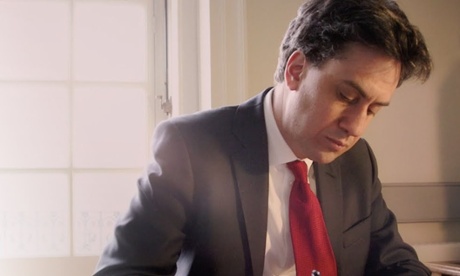
There is an extreme closeup at the very beginning, with Ed considering a document, those dark, opaque eyes drinking in its contents: the shot is there to establish his industry and seriousness, and actually Greengrass uses quite a lot of closeups, generally of Ed in profile, looking away, lost in thought, perhaps influenced a little by Aaron Shikler’s portrait of John F Kennedy, arms folded, looking down.
There is a long sequence showing his parents, focusing on his dad, Ralph, and his wartime service in the Royal Navy – the subject on which Ed won his skirmish with the Daily Mail – and in a later “interview” scene, Ed will boldly and explicitly talk about standing up to Rupert Murdoch. But there is not a word about Ralph’s strong left-of-centre views, or how they specifically shaped the current Labour leader. Interestingly, the old photos that Greengrass uses show that Ed is the son who really looks like Ralph.
Greengrass gives us a classic sequence, popularised by Aaron Sorkin in TV’s The West Wing: the walking-down-the-corridor shot in the Commons, flanked by advisers: it is dynamic, purposeful. He is also seen out on the stump, informally in jumper and jeans, chatting with Labour loyalists (by accident or design, there is no multi-ethnicity in the visual emphasis here, and no Scots) and he even playfully has a Tom-Cruise-red-carpet-style chat on the mobile phone to someone’s relative. He addresses a crowd of loyalists in a “workplace” situation, a moment more beloved of Conservatives, but vital to Ed.
In another Paul Greengrass film, all this would be the “ordinary life” scenario that sets the scene for a crisis – rather as in Captain Phillips, or his Northern Ireland drama, Bloody Sunday. But this is different. This film has to fulfil the scene-setting function, and convey the sense that something exciting is about to happen, and that we, the audience, the voters, can be a part of it – but also that something bad has already happened, and that what follows is a calming of the waters. Paradoxically, the film has to offer an exciting beginning and a happy ending at the same time.
The director mixes all these classic ingredients in something like a montage, or rather a trailer. Rousing if somewhat sombre chords swell on the soundtrack. It is all, portentously, leading up to something. You can almost hear the basso profundo American voice: “In a world … where Tories betray working families and strangle kittens, one man dared to stand up … This summer … put Ed Miliband into Downing Street.”
It’s a rather generic piece of journeyman work for Paul Greengrass, with few personal touches. But Labour will be perfectly happy with it.