Labour’s energy policies would destroy the certainty and stability the industry so desperately needs, Ed Davey has warned.
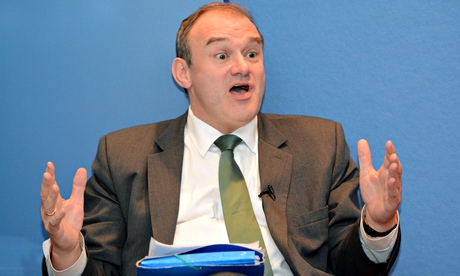
The secretary of state for energy and climate change went on the attack against Labour’s policies at the Liberal Democrat Conference in Glasgow. Speaking at a Guardian fringe meeting, he lambasted opposition plans to get rid of Ofgem, the energy regulator, and introduce an energy price freeze for consumers.
His comments came just days after Lady Verma, the Conservative parliamentary under-secretary for energy and climate change, used her own party’s conference to criticise Labour’s energy policies as “silly headlines”.
Davey said he could never agree to the two pillars of Labour’s energy agenda. But the energy secretary refused to confirm whether his opposition to these key Labour ideas was a “red line” issue for him – policies he would refuse to accept in any coalition deal with the party after the 2015 general election.
Davey said his opposition was driven by his belief they would create massive instability and uncertainty in the industry at a time when investors were crying out for certainty. There are already many sources of uncertainty in the energy sector, he said, including political instability ahead of a general election and the possibility of a referendum on Britain’s European membership, and questions over the long-term wholesale prices of gas and oil.
“We need and crave – and quite rightly crave – stability and certainty, but there are all these factors that work against it,” Davey said. “When some politicians play fast and loose with this, it undermines the public consensus we are trying to achieve.”
His comments were echoed by Janine Freeman, head of UK and EU public affairs for the National Grid. “We obviously need to have policy stability,” she stressed.
Davey was particularly scathing of Labour’s plans to scrap Ofgem and replace it with a tougher regulator. “Labour created Ofgem, Ed Miliband reformed Ofgem and now they want to abolish Ofgem – you couldn’t make it up. If you are an investor and you see the regulator being torn up, you will not invest,” he said.
By contrast, Davey said Labour should be proud of Ofgem and claimed the party had “got themselves into a really silly position” on the matter. He was equally dismissive of Labour leader Ed Miliband’s promise to freeze energy prices, saying this would create major problems for investors.
Davey also used the debate to say he was very enthusiastic about the potential for growing tidal energy and reiterated his support for nuclear, stating that it was the only way to maintain a low carbon energy mix for the UK. He also insisted he was confident in the UK’s future energy supply, despite reports that Scotland’s coal-fired power station at Longannet may close.
Frank Mitchell, chief executive of Scottish Power Energy Networks, warned that the UK could face short-term problems if it began a programme of shutting down coal-fired power stations without ensuring adequate back-up supply to replace them. Mitchell said the UK needed a “soft landing” when coal-fired stations were closed.
Huub de Rooijen, head of offshore wind at the Crown Estate, said other forms of energy such as offshore wind were often penalised unfairly because of the high start-up and construction costs – but traditional energy models were proving to be more expensive in the long term. He called for lifetime costs of different energy sources to be made transparent to the public, and demanded a “level playing field” for all energy technologies.
But the Crown Estate manager was also more cautious about the possibilities of tidal energy solving some of the UK’s problems. “So far there has not been a single turbine running properly for a couple of years. It is not really deployable at the moment,” he said.
This conference fringe debate was designed and produced by the Guardian to a brief agreed by partners for the Big Energy Debate series. All content is editorially independent.
Read more from the Guardian Big Ideas at the 2014 party conferences.