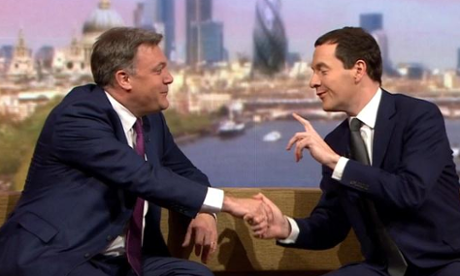
Ed Balls, the Labour shadow chancellor, may have forced his Conservative rival, George Osborne, into an election television debate with him, sealing the deal with an awkward handshake live on air.
Balls ambushed the chancellor with the suggestion when they appeared together on the BBC’s Andrew Marr Show on Sunday.
However, Osborne immediately tried to back out, saying he was sure his “very effective” deputy, the Liberal Democrat Danny Alexander, would want to come along.
Asked to agree to an encounter, Osborne said: “Well, I’m happy to meet you in a debate.” Balls replied: “We should shake on it and go for it.”
At that point, Osborne appeared to retreat, saying: “Ed, I’m not going to … We’re going to see who else wants to be part of that. I’ve got a very effective chief secretary who I think would also want to be part of that.”
Balls later also appeared unsure whether Osborne had agreed to a debate. Speaking on BBC 5 Live’s Pienaar’s Politics, he said: “He [Osborne] started shaking hands and he was agreeing to a head-to-head debate with me. By the end of the handshake it sounded like he wanted to bring along his deputy, Danny Alexander.
“It was clear and then it was unclear. I thought George Osborne was going to do what David Cameron has ducked for weeks and weeks. He started the handshake doing it – by the end, constructive ambiguity I think.”
Any two-way debate between Osborne and Balls would put Cameron in a sticky position as he has declined a one-to-one encounter with the Labour leader, Ed Miliband.
Negotiations for the leaders’ debates are continuing, with Cameron now only likely to agree to a seven-way debate including minor political parties – if anything happens at all.
Pressed on whether he got on well with Balls in private, Osborne said they were passionately ideologically opposed but that they “do get on reasonably well” without being best friends.
The two men appeared on the show in advance of this week’s budget, at which Osborne has said there will be “no giveaways, no gimmicks”.
However, it had already emerged on Sunday that Osborne would give up to 5 million pensioners the right to swap their regular retirement incomes for cash lump sums.
The highly populist move to end restrictions on the sale of annuities without incurring punitive tax penalties appears to be a move designed to woo older voters.
The chancellor said it was patronising to suggest that older people would blow their pension pots.
Osborne’s spending plans set out at the autumn statement include a projection for a surplus in the next parliament that would allow for income tax cuts for mid to higher earners.
However, the chancellor’s ambition to balance the books will require spending cuts Labour has warned will require extreme austerity on a near-impossible scale, a VAT rise or charging for the NHS.
Asked whether the Conservatives would stick to their goal of reaching a £23bn budget surplus in the next parliament, the chancellor said: “We have set out plans and we intend to fulfil our plans.”
Osborne said the budget would be based around securing a “truly national recovery” but refused to say whether it would be fiscally neutral. He is expected to raise the personal allowance further from its current level of £10,500 and potentially cut beer duty.
He added: “I can’t reveal on the Andrew Marr Show all the details of my budget but people can judge me from the approach I’ve taken in this parliament, which is to tell the country the truth about the economic problems it faces, to say that Britain’s got to pay its way in the world, it’s got to earn a living. We do that by backing our businesses, growing our industry, supporting all parts of the country, making sure we’re using the talents of the entire population.
“And look, this country is in a fundamentally stronger situation than it was when I came on this show before the first budget I delivered in this parliament.”
He was also questioned on defence spending, and refused to commit to maintaining 2% of spending on the military in line with the Nato target. Former generals have warned that Britain’s ability to defend itself will be compromised if this is breached.
Balls said Labour’s plans meant less severe defence cuts than the Tories, but he also refused to sign up to the 2% target without a proper review after the election.