With no end in sight for the novel coronavirus pandemic, the situation surrounding the apparel industry has become ever more adverse. Is there any hope? The following is the first installment of a series looking at the tactics apparel firms are using to survive.
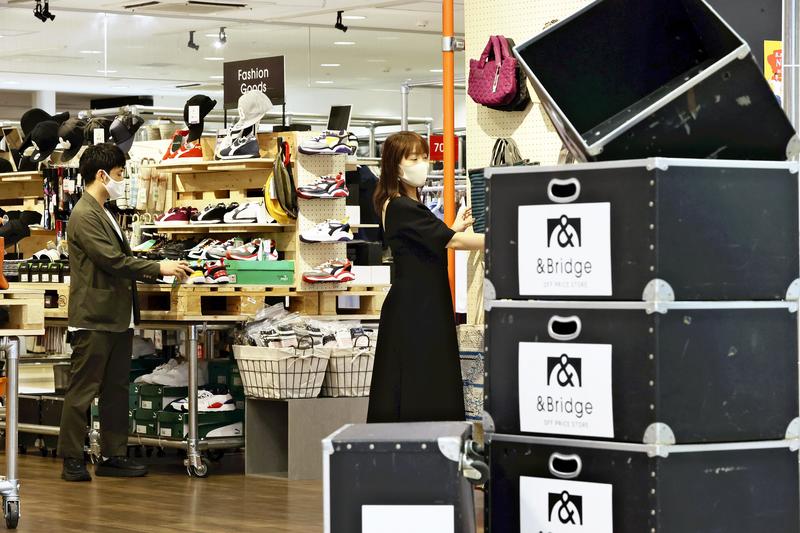
An off-price retailer that sells brand-name clothing at discount prices, called &Bridge, opened a store at a commercial facility in Asakusa, Tokyo, in late August. Offered for sale are 7,000 items of branded goods, including footwear and general merchandise. Women's clothing items, which had price tags ranging from 10,000 yen to 30,000 yen when they were offered at department stores, are being sold at 50%-70% percent discounts.
Tsuyoshi Matsushita, president of &Bridge Co., said, "Clothes and merchandise of about 150 brands, Japanese and foreign, are sold at our store. As the [conventional] sales of these branded items have become sluggish, due to the impact of the new coronavirus, there have been growing requests for us to purchase them from garment firms beset with mounting inventory."
The store in Asakusa was the third outlet opened by &Bridge, following stores opened in Saitama City, and in Sagamihara. Companies investing money in &Bridge Co. include World Co., a leading general fashion and apparel company. Matsushita candidly said: "What concerns apparel firms the most are their clothes being sold at an unknown store, thus impairing the brand value. There is also a certain feeling of trust that, 'With World Co. investing in the operator of the store, they wouldn't sell things in a fishy way, would they?'" His company plans to increase the number of its outlets to 25 by March 2023, mostly in the Kanto and Kansai regions.
Yet another destination for those unsold garments is a warehouse in Nishinari Ward, Osaka, where cardboard boxes bearing the logos of well-known brands are piled up. "It was about five years ago when inquiries about purchasing started rising," recalled Shoichi Yamamoto, president of Shoichi Co., which deals with clearance sales of clothing inventory.
His company purchases stockpiles of clothing left unsold at garment firms across the country. It accepts about 10 million items of clothing annually. Purchasing them at a rate of roughly 10% of their listed prices, his company then sells them to wholesalers at home and abroad, including in Cambodia and Malaysia. Anticipating that inquiries about merchandise purchasing will continue rising in the future, Yamamoto said his company applied for a new loan from a bank to expand its business operations.
-- Coronavirus impact
Having peaked during the economic bubble period of the late 1980s and early 1990s, the nation's apparel industry has been shrinking. It is no longer taken for granted that consumers will purchase any amount of clothing manufactured. This is due to various factors such as the low birthrate, people's penchant for low-priced goods and the diversification of values.
Last year, October's consumption tax rate hike and an unusually warm winter slowed down clothing sales. Now making matters worse is the outbreak of the new coronavirus. Department stores and large-scale commercial facilities, the major sales channels for branded clothing, were forced to temporarily close, while demand for suits and jackets has also declined, chiefly because of an increase in telework.
Onward Holdings Co.-- an apparel firm with such brands as 23ku and Kumikyoku -- saw its March-May quarterly sales this year decline 35% from the corresponding quarter last year, with sales to department stores, in particular, falling by 71%. Onward Holdings President Michinobu Yasumoto expressed a dismal outlook, saying, "From now on, as people avoid crowded places, the number of shoppers in urban areas will also decline."
-- Fleeting fashions
One reason for the protracted period of sluggish sales of branded clothes involves the structure of the apparel industry.
To respond to the shrinking domestic market and the increase in low-priced, imported products, apparel firms expanded their production abroad. Such moves were aimed at holding down the prices of their products, by placing bulk orders and utilizing mass production in foreign countries where labor costs are low. Japan's domestic clothing production, which accounted for 50% of the total until the 1990s, has now fallen to as low as about 2%.
But this has cost apparel firms some of their agility.
In the world of fashion, changes of vogue are quick. If products are made in Japan, it would take only about one or two weeks for the product planning to be done and for the goods to reach the consumers. If they are to be produced in China, it would take at least one month for the products to reach the market. If they are to be made in Vietnam or Bangladesh, it is said to take about six months or even a year for them to reach their customers.
Kensuke Kojima, a consultant who is knowledgeable about apparel industry, said: "A product for which an apparel firm places an order, in the belief that it will sell well half a year later, will end up becoming a large stock of unsold products if the firm's calculations go wrong. Over the past two decades, there were repeated examples of such developments. If a shell fired from a battleship reaches the enemy's vessel within a few seconds, it may strike the vessel. But this is the equivalent of a fired shell reaching the enemy's vessel 10 minutes later, only to miss the target."
To respond to diverse consumer tastes, apparel firms do not have the option of narrowing down the number of products they offer. As products go out of fashion fast, those not quickly sold at full price must be sold during a sale or at discounted prices. The conventional business model for the apparel industry is coming close to the limits.
Renown Inc., once a prestigious firm with over 100 years of history since its founding, collapsed in May. One former employee said: "I haven't received my severance pay yet. It seems to me that only one or two out of every 10 former employees have found new jobs." Although a decision has been made as to where D'urban, one of its leading brands, is to be transferred, it is not clear to what extent jobs can be offered to its former employees.
An apparel industry official said, "Before the coronavirus, generally firms of all sizes had funds on hand for the equivalent of about seven months. Should those funds run out, the reorganization of the industry will accelerate."
If they are to survive, only a little time is left.
Read more from The Japan News at https://japannews.yomiuri.co.jp/