PS: Here’s our news story on the Greek proposals:
Wired-up tax snoopers could be unleashed in Greece
(if you’re just joining us, there’s lots of reaction further back in this blog. GW)
And finally... Greece’s government, despite the carping, is determined to end this week on a triumphant note.
Our Athens correspondent Helena Smith has received a new “non-paper” from Syriza’s indefatigable press ministry, which declares:
“Once again the Cassandras who foresaw catastrophe for the country, and a credit crunch that would lead Greece to bankruptcy, have been disproved. The instalment [debt obligation] of €310m to the IMF went normally and was paid, while issuance of T-bills worth €1.4bn happened successfully .. the situation is absolutely manageable.”
[yes, we know, Cassandra was right, don’t shoot the messenger, eh?]
Back to the statement... and, lambasting those who had foreseen “the end of the world” on February 28 when Athens’ EU-IMF backed bailout program was due to end, the government says Greece was acting on and realizing its commitments.
At the euro group on Monday the process of working on the proposal Greece had submitted would begin, it said adding that that “will be the spark that will change the climate and the decisions of the ECB.”
And on Thursday 12, Prime Minister Alexis Tsipras will visit Paris to hold talks with Angel Gurria, the former Mexican finance minister and head of the OECD “about the reforms that will take place in Greece so that public administration can be reorganized to fight tax evasion and so that social justice is reestablished.”
And that is probably all for tonight, and indeed the week. Thanks all, and have a very good weekend. GW
Updated
Being told #Greece broadcasters having a laugh over #Varoufakis' undercover inspectors proposal.Something to do with white socks and sandals
— Loukia Gyftopoulou (@loukia_g) March 6, 2015
In other news, a lawmaker from the Neo-Nazi Golden Dawn party has been cleared of charges related to an attack on two female left-wing colleagues during a live TV talk show in 2012.
Associated Press reports:
An Athens court found this afternoon that Ilias Kassidiaris did not cause the women grievous bodily harm, as he had been charged.
TV footage of the 2012 incident showed Kassidiaris repeatedly slapping one woman and throwing a glass of water at another before running away. The attack followed an exchange of verbal abuse...
Kassidiaris was not convicted of plain assault, because that would have required a formal complaint from his victims, that was never made, AP adds.
You can see a clip of the infamous incident here.
Infamous slapper #GoldenDawn MP #IliasKasidiaris cd get off hook after court demotes charge of GBH re his assault @ 2 women MPs
— Helena Smith (@HelenaSmithGDN) March 6, 2015
Peter Spiegel, the FT’s man in Brussels, reports that Yanis Varoufakis’s letter has not impressed officials there:
...The reaction from eurozone officials to the undercover tourist plan — one said staff laughed out loud when they read the proposal — is the latest evidence of the growing gap between the Greek government and its international bailout lenders, at a time when Athens could be less than two weeks away from running out of cash completely.
“It’s quite hilarious, if it were not so tragic, that this is what a government in an industrialised country comes up with,” said one eurozone official involved in the talks.
Updated
Another complaint about the undercover tax inspector plan is that it will target small-scale tax evasion, not the wealthy that the Syriza government has vowed to rein in.
Analyst Dan Davies of Frontline Analysts tweets:
seems very weird that, after all the rhetoric about "oligarchs", the actual tax evasion proposal is targeted at cash in hand workers
— Dan Davies (@dsquareddigest) March 6, 2015
and tbh, fact that Syriza would rather clamp down on cigarette kiosks and builders than cut even on govt job ... kind of business as usual
— Dan Davies (@dsquareddigest) March 6, 2015
Of course, the seven proposals in today’s letter (online at the FT) aren’t the end of the matter. Greece must has more plans up its sleeve, as it moves towards that third bailout, or “Contract for Recovery and Growth”.
Given the scale of tax evasion worldwide, it feels wrong to knock the Greek finance ministry for proposing a clampdown.
So, if wiring up concerned members of the public and tourists is questionable, is there a better way?
Well, Greece could learn from Slovakia’s example. It roped in its civilians to help, by collecting all their sales receipts for anything over one euro, whether at a store or a restaurant.
As my colleague Jana Kasperkevic explains:
Each receipt is printed with the business’s company tax ID. Slovakian authorities want citizens to go home, look up the receipt with the tax ID, and enter it into a national database. The Slovakian finance ministry will look through the database to double-check that the businesses are correctly reporting their income – or so they say.
And citizens were offered the carrot of a free prize draw for taking part.
Can the IRS tap citizen power to police tax-evading corporations?
Greece not the first to try to recruit the masses to fight tax evasion. Slovakia did it. Could the IRS? http://t.co/3ZpbieWX11
— Jana Kasperkevic (@kasperka) March 6, 2015
Or Athens could look to Israel.
According to Bloomberg’s Stephen Mihm, the Israeli authorities tackled a deep-seated aversion to tax payments in the 1970s by imposing tougher penalties, simplifying the system, and making tax offices less confrontional and more friendly.
Mihm says:
Such subtle interventions were bolstered by a huge public-relations campaign to change the attitude toward taxes. The government introduced lessons about taxation into the secondary school system, the armed forces and other institutions; it also flooded the country with pamphlets and advertising, and offered tours of tax offices.
The government sought to convey the sense that taxation wasn’t an evil to be avoided, but the price of citizenship. It even built a museum of taxation (it so impressed U.S. officials that the Internal Revenue Service built one, too). The government commissioned a short propaganda film (“The Tsippori Affair”), which followed the travails of a man who discovers that government ceases to function when he evades taxes.
By avoiding single-minded, heavy-handed interventions (as countries such as Argentina did, unsuccessfully) Israel fixed its problem. By the 1970s, tax evasion had largely disappeared, and Israel became an adviser to other countries struggling to collect taxes from their recalcitrant citizenry.
Since it's topical again: How #Israel tackled its #tax evasion problems by @smihm http://t.co/lzM6tfhsCS via @BV #Greece
— Nick Malkoutzis (@NickMalkoutzis) March 6, 2015
Updated
Hugo Dixon of Reuters reckons we’re being too negative about the innovative scheme...
@Hugodixon a) it's unconstitutional, b) images of lynched tourists/citizens not so good for tourism in the long run!
— Liberal in Despair (@LibinDesp) March 6, 2015
Over in Athens Helena Smith has just spoken to Aliki Mouriki, a senior sociologist at the National Centre for Social Research who described the proposed reforms as resembling more of “a wish list” than a catalogue of quantifiable figure-backed proposals that euro zone creditor countries would accept.
In their current form, it was hard to conceive how the reforms would pass muster. “It’s a wish list at the moment,” she told Helena, adding:
“But on the other hand, I do think our creditors should give us some breathing space when things are so fluid and there is just no liquidity in the economy to come up, let alone commit, with statistics and figures.”
As for the idea of undercover agents acting as tax inspectors, Mouriki said:
“You can’t expect to have serious results handing over this sort of job to amateurs. It’s too serious a buziness to hand over to tourists and housewives.”
Tweet of the day!
'You may well hope to bribe or twist/ my God! a Greek-bound tourist/ but given what he's there to do/ let's pray you've no occasion to'.
— Anna H. (@drlangtry_girl) March 6, 2015
More reaction to the tax evasion proposal:
The absurdity of the proposal of undercover 'wired' non-professional tax collectors highlights the magnitude of tax evasion in #Greece
— K.G. Paschal (@KonPaschal) March 6, 2015
In all seriousness, @yanisvaroufakis why not make it mandatory for SMEs in Greece to accept credit cards? Paper trail against tax evasion
— The DC Pope (@TheDCPope) March 6, 2015
I think I've said it many times, but heck if it isn't appropriate today: you couldn't have made #Varoufakis up even if you tried!
— The Greek Analyst (@GreekAnalyst) March 6, 2015
Not everyone is against the plan, though.
Herakles Galanakopoulos, an accountant who specialises in tax issues, told the Guardian that at a time when the need for revenues had reached crisis point,the government had to think of novel ways to combat the scourge.
“Why not resort to such measures? We wouldn’t be the first.”.
“The government has to find some way of dealing with this problem - the state urgently needs revenues.”
Updated
Greek tourist chief: Can't expect tourists to spy.
The head of the Greek Tourist Confederation, SETE, has also questioned whether Greece can really expect tourists to wear secret recording equipment to catch tax evaders, as proposed in that letter to Brussels today.
Speaking to the Guardian, SETE’s chief Andreas Andreadis said the best way to beat tax evasion would be through exclusive use of credit cards and tax rebates (as proposed by two German MPs this week).
Andreas Andreadis told Athens correspondent Helena Smith that:
“You cannot ask tourists or Greeks to spy.”
“The most practical way of tackling tax evasion, which could be started as a pilot program in tourist areas, would be simply to forbid cash transactions above €100,”
“Paying by credit card would automatically force the transaction to be shown on the cash register. They will say people don’t have credit cards but that is rubbish. Another practical way would be to give tax benefits to those who collect receipts as German MPs recently proposed.”
Germans lead the league tables in arrivals in Greece - more than 2.5 million visited last year and as many are expected to descend on the country this summer.
PS: if you’re just joining us, this proposal is included in an 11-page letter apparently sent by finance minister Yanis Varoufakis, ahead of next Monday’s meeting of eurozone finance ministers.
Here’s a flavour: (see earlier post for more)
Taste of new @yanisvaroufakis letter to @J_Dijsselbloem: among proposals hiring tourists as undercover tax inspectors pic.twitter.com/EZMem3Ca0u
— Peter Spiegel (@SpiegelPeter) March 6, 2015
Updated
Government insider blasts "outlandish plan".
One well-placed government insider has told Helena Smith that “I think heads will roll after this,” [the secret tax inspector plan], adding:
“These proposals are simply outlandish.”
Roping in the support of tourists to spy on tax evaders rather stretched the definition of the word “tourist” to breaking point, another one said.
“They’re meant to be on holiday. That is the definition of a tourist.”
Greek tax inspector plan ridiculed
News of Greece’s proposal to deploy undercover tax agents has sparked widespread disbelief in Greece, reports our Helena Smith.
Of all the measures employed to crack down on the traditional sport of tax evasion in Greece, hiring wired undercover “secret agents” - including tourists - cuts the cake and has been greeted with ridicule.
For example:
Varoufakis is raising the market research mystery shopper methodology to a whole new level. Is what he proposes even legal?
— helena chari (@helena_chari) March 6, 2015
Live your myth in Greece as undercover tax inspector. Mr Yanis needs you...
— Loukas Karaoglanis (@Loukas_7) March 6, 2015
Tax inspector Clouseau disguises for sale - business opportunity #Greece
— nikos skylakakis (@nskylak) March 6, 2015
Tax Excursions in Greek islands. Find the law offender and win a trip to Santorini. #tourism #Greece
— Elena Kappa (@Elena_Kappa) March 6, 2015
#VaroufakisJoking? Greece is proposing economic reforms like the use of “students, housekeepers and tourists” as undercover tax inspectors.
— Alan Friedman (@alanfriedmanit) March 6, 2015
Updated
German tourists may leap at the chance of keeping Greece honest, while taking in some Aegean sun:
German offers tax inspectors to Greece + popularity of Greece for German tourists = pic.twitter.com/DrIZ0x1iSO
— Tom Nuttall (@tom_nuttall) March 6, 2015
The Greek government has also announced this afternoon that delayed legislation to re-open the state-run TV channel, ERT, will be presented to Athens’ parliament on Monday.
As this blog reported earlier in the week, the new leftist-led government’s plan to present reforms this week was delayed after it became clear that the cost impact of many of the changes would take days to calculate.
Helena Smith reports from Athens:
Sources close to prime minister Alexis Tsipras this afternoon confirmed that legislation to reopen ERT - shut down by the former coalition government in a controversial moves almost two year ago - would be brought before the 300-member House on Monday.
The sources attributed the delay - it was meant to be presented to parliament on Thursday - to efforts to clean up “legal and technical questions” pending from the institution’s reincarnation as NERIT and “the economic investigation” the new government had to conduct on Nerit.
They explained:
“Finding the correct solution to [those issues] is the cause of the postponement of the legal plan which will be brought before [parliament] on Monday.”
“ERT is opening, workers are returning.”
More reaction to the prospect of Greece crawling with part-time tax evasion inspectors, with hidden cameras and microphones:
Only question is how hard Germany will slap down proposals from the Greek govt like this. pic.twitter.com/sXGGRBh9YL (h/t @SpiegelPeter)
— Megan Greene (@economistmeg) March 6, 2015
Undercover tourists, wiretapping and bugs. You can't make this s*** up.
— Yannis Koutsomitis (@YanniKouts) March 6, 2015
Updated
Greece proposes an army of undercover tax inspectors
Back to Greece...and the FT has published a letter which (it says) the Greek finance minister has sent to Brussels officials ahead of Monday’s eurogroup.
The letter outlines seven reforms including improving tax collection and the public finances, and addressing Greece’s humanitarian crisis. It also suggests that talks should begin on a “possible follow-up arrangement”.
It’s billed as a contract for recovery and growth’, but it’s a third bailout really.
#grexit @yanisvaroufakis asks eurogroup for talks on 3rd bailout dubbed 'contract for recovery and growth' via @SpiegelPeter
— Ian Traynor (@traynorbrussels) March 6, 2015
Somewhat surprisingly, the letter also proposes that Greece sends an army of “non-professional inspectors”, secretly carrying audio and video recording kit, across the country to spot tax evasion.
Finance minister Yanis Varoufakis argues that this would tackle the culture of tax dodgy in Greece.
He proposes:
That large numbers of non-professional inspectors are hired on a strictly short-term, casual basis (no longer than two months, and without any prospect of being rehired) to post, after some basic trading, as customers, on behalf of the tax authorities, while ‘wired’ for sound and video.
The information they collected would carry legal weight, he argued, and could be acted on by full-time tax officers.
“The very ‘news’ that thousands of casual ‘onlookers’ are everywhere, bearing audio and video recording equipment on behalf of tax authorities, has the capacity to shift attitudes very quickly,”
The FT’s man in Brussels, Peter Spiegel, got hold of the letter and kindly uploaded it:
He’s also uploaded the letter here.
What can possibly go wrong?...
Looking for an exciting summer job? Come to Greece as an undercover Tax Inspector (you'll be wired as well). Like "The Wire". But not.
— helena chari (@helena_chari) March 6, 2015
#Greece My name is #Contract. For Recovery and Growth of the Greek Economy #Contract (not MoU) #undercover
— Efthimia Efthimiou (@EfiEfthimiou) March 6, 2015
Updated
Dominic Rushe: US economy shake off winter gloom

Here’s my colleague Dominic Rushe on today’s jobs report:
The US economy shook off the brutal winter weather in February to add 295,000 new jobs, the 12th straight month it has added over 200,000 jobs, the Bureau of Labour Statistics said Friday.
Economists had forecast employers would add 240,000 jobs last month and the unemployment rate would fall to 5.6% from January’s 5.7%. The actual figures beat predictions on both scores with the unemployment rate dropping to 5.5%.
Over the past year the US economy has added an average of 270,000 jobs each month. Hiring from November through February was the best four-month pace since the late 1990s. In January the US added 257,000 new jobs, the strongest month of growth since.
Wage growth, however, remained disappointing. Average hourly earnings rose by 3 cents in February to $24.78. Over the past 12 months, average hourly earnings have risen by 48 cents, or 2%.
The latest jobs news will add pressure for the Federal Reserve to increase interest rates, which have been close to zero since the recession began. The central bank has said repeatedly that it will be “patient” in its assessment of when rates will rise but minutes from recent meeting reveal officials are at odds over how long they should wait.
“Today’s report is entirely in step with recent trends and, with the unemployment rate now at the top end of longer run estimates, the Fed will almost surely move to drop ‘patient’ at its upcoming meeting while pushing towards raising interest rates later this year,” said Dan Greenhaus, chief strategist at broker BTIG.
Full story: US economy shrugs off winter weather to add 295,000 jobs in February

An interesting note from Jeremy Lawson, chief economist at Standard Life Investments, just landed.
He reckons the Federal Reserve has a real dilemma deciding whether to raise rates in June, or hold off until December. While some economic data favours an early hike, others suggest the Fed should be cautious.
He writes:
A dove would use the following line of reasoning. In recent months there has been a noticeable softening in the non-labour market data. Business investment indicators have softened, as have vehicle sales. That suggests that falling gasoline prices are not yet boosting economic activity. GDP growth was only just above 2% in Q4 and will probably be weaker in Q1. There is not a lot of evidence why that will pick up in Q2. Meanwhile, average hourly earnings growth is still very subdued and the near-term momentum in core PCE inflation has been very weak. With the US dollar continuing to rise on a trade weighted basis, and downside risks to global growth emanating from emerging markets increasing, inflation is unlikely to move up to its 2% target quickly enough to justify tightening policy. Indeed, a premature rate rise would damage the recovery as well as the Fed’s inflation credibility. Recent advocates for this view have been Charles Evans from the Chicago Fed and Eric Rosengren from the Boston Fed, the two most dovish members of the Committee.
A centrist would take a different tack. They would point to very strong employment growth and the firm downward trend in unemployment and labour underutilisation. Along with the still high levels of business and consumer sentiment, they would recommend looking through some of the near-term weakness in the hard data, arguing that it was likely to be mainly due to the temporary effects of bad weather, or the fact that in the short-term lower oil prices constrains investment more than it boosts other components of GDP. On the foreign front, they would be mindful of the rise in the dollar, but also observe that growth has been improving in Europe and Japan, underpinned by significant monetary easing.....
So what might Fed chair Janet Yellen do?
I think that she will find the arguments to remove the patient language compelling. I also suspect that she will be comforted by the strength of the improvement in the labour market, and will not yet be alarmed by the downside surprises to some of the key hard data in recent months. That said, she also takes the inflation side of the Fed’s mandate seriously and will not like the optics of tightening policy at a time when core PCE inflation is declining. She will recognise that the ongoing rise in the dollar means that core goods price inflation will probably weaken further. Thus, while she will want to keep a June increase on the table, she will want to see more evidence that forward looking inflation indicators are moving in the right direction before pulling the trigger. For those reasons, I see June/September (or later) as a genuine 50-50 call.
The jobs report hasn’t sparked a stock market rally.
Shares are down in New York, with the Dow Jones dropping 90 points or 0.5%.
Apple, though, has seen its shares jump by 2% following an announcement that the world’s most valuable company will join the Dow.
#Apple jumps as company set to Join the iconic Dow Jones Industrial Average http://t.co/nR0mEZGJJl pic.twitter.com/3IKrhhc8Ch
— Holger Zschaepitz (@Schuldensuehner) March 6, 2015
As the jobs market improves, US companies may have to start hiking wages to retain talent.
James Knightley of ING explains:
The pool of available labour continues to shrink so firms are finding it increasingly difficult to hire workers with the right skill-set that are currently unemployed.
This means that turnover in the labour market will continue to rise with firms increasingly looking to hire staff that are already employed elsewhere. As a result, we suspect firms will increasingly be thinking about staff retention - we are moving from an environment where firms didn’t feel the need to offer higher pay to one where it is a growing requirement to pay more in order to keep staff.
And the resulting pressure on inflation means the Fed might hike in June, Knightley suggests.
Paul Dales, senior US economist at Capital Economics, agrees that pressure is building on the Federal Reserve.
The 295,000 increase in US payrolls in February (consensus 235,000) and the further fall in the unemployment to 5.5% illustrate that, even if wage growth is still subdued, the Fed can’t hang around before raising rates.
Could the Fed hike as soon as June?
Enrique Diaz, lead currency specialist at business finance group Ebury, reckons they will, which should help pin the euro down.
“This is quite a day for Dollar bulls. These latest figures have more than surpassed the markets’ expectations, sending the Dollar soaring by around 1% against the Euro. This is good news for Eurozone exporters.
As for the currency impact, with the ECB introducing further QE this week, it may now be difficult for the Euro to bounce back from its recent slide. More fundamentally, this may well be the green light that the Fed have been waiting for on interest rates. We should see a hike as soon as June this year, and the overnight rate should end the year at around the 1% level.”
Bad news for Brits heading across the Atlantic soon -- the pound has fallen by one and a half cents against the US dollar, to just $1.5095.
#CABLE 1.5095
— Steve Collins (@TradeDesk_Steve) March 6, 2015
Sebastien Galy of Société Générale says:
The US labour market is tightening much faster than expected but without much signs of wage growth. Irrespective of this the big repricing of the Fed’s reaction function is on the way, sooner maybe a tad faster as the Fed catches up
Updated
This chart shows how “the markets” now expect US borrowing costs to be a little higher over the next three years:
Eurodollars pricing in an extra half-rate hike from the Fed between now and Dec. 2017 following that jobs report pic.twitter.com/k74AoodWjp
— Matthew B (@boes_) March 6, 2015
This is encouraging. The underemployment rate (which measures how many Americans would like to work more hours) fell to 11% in February.
That’s a healthy drop from January’s 11.3% -- but still too high.
Decent drop in the underemployment rate last month. Down from 11.3% to 11%. Good progress. Would be great to see U6 in single digits though.
— Paul R. La Monica (@LaMonicaBuzz) March 6, 2015
The labour force participation rate (which measures how many Americans of working age are actually available for work) dipped last month to 62.8%.
That’s a bad sign, argues Dab Alpert, managing partner of New York investment bank Westwood Capital:
#BLS Just ignore the U-# unemployment rate. Labor force fell again and LFPR down yet another 10th. Wage growth flat, more low wage jobs.
— Dan Alpert (@DanielAlpert) March 6, 2015
The main job creation last month was in food services, bars, professional and business services, construction, health care, and in transportation and warehousing, says the BLS.
Other commentators are convinced that the US labor market is healing:
Six month average job growth is +293k, strongest since March 2000. If you had told me that even a year ago I would have been thrilled.
— Neil Irwin (@Neil_Irwin) March 6, 2015
Big Bada Boom job number
— James Pethokoukis (@JimPethokoukis) March 6, 2015
Boom. US unemployment rate down to 5.5%, hasn't been this low since May 2008. pic.twitter.com/LNCnDfkYkt
— Matt Phillips (@MatthewPhillips) March 6, 2015
Reaction is coming in....and some economists are disappointed that wage growth remains weak.
The meagre 0.1% increase in average hourly earnings last month means that they rose by just 2.0% year-on-year.
That means worker are still not experiencing the recovery in their wallets and purses.
Once again, headline jobs data looks great, details lacklustre--low wage growth, lower labor force participation. Summary: meh.
— Megan Greene (@economistmeg) March 6, 2015
Surprising to hear bond yields jumped. The absence of wage pressure will weigh heavily on the Fed.
— Justin Wolfers (@JustinWolfers) March 6, 2015
Updated
Money is flowing out of US government debt, pushing up the yield (or interest rate) on Treasury bills.
That’s another sign that investors are expecting the Federal Reserve to start to tighten monetary policy this year, perhaps as early as the summer?
The BLS has revised down January and December’s data, to show that 18,000 fewer jobs were created than expected.
But even so, last month’s strong report isn’t a blip. America has posted decent jobs growth in three of the last four months:
295,000 jobs created in February -- strong growth in three of the last four months http://t.co/SOIMhjlBwA pic.twitter.com/ASSon3rrGD
— MarketWatch Economy (@MKTWeconomics) March 6, 2015
Dollar surges
The jobs report is fuelling predictions that the Federal Reserve will start to raise interest rates this year.
The dollar is surging on the back of the jobs report, driving the euro down to a new 11 and a half-year low.
One euro is worth just $1.0877, the lowest since autumn 2003.
Euro drops below $1.09 pic.twitter.com/TMRi2D5Wga
— Bloomberg Markets (@markets) March 6, 2015
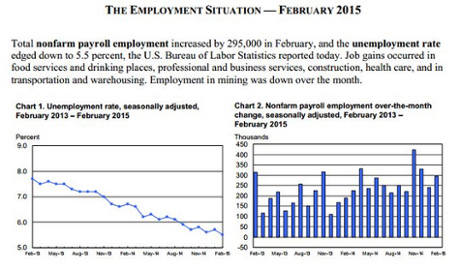
Here’s the official details:
But wage growth is weak
However... average earnings are a little disappointing.
Earnings rose by just 0.1% last month, weaker than the 0.2% rise that was forecast.
At 5.5%, the US unemployment rate is now at its lowest in over six years.
US jobs report beats forecasts
The results are in!
The US economy economy created 295,000 new jobs last month, a rather stronger reading than expected.
The unemployment rate has fallen too, to 5.5% -- from 5.7% last month.
Lots more detail and reaction to come....
worth waiting for.
— Katie Martin (@katie_martin_FX) March 6, 2015
The Bureau of Labor Statistics website has crashed...
Here we go....
NO MORE BETS
— Nicola Duke (@NicTrades) March 6, 2015
The Wall Street Journal has some good charts showing how America’s employment market added jobs steadily over the last year...
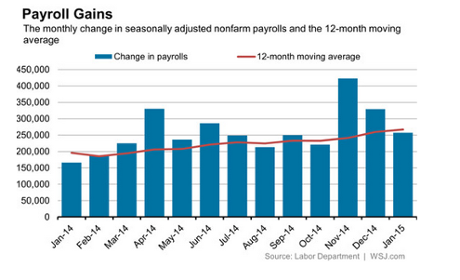
...although wage growth has been elusive:
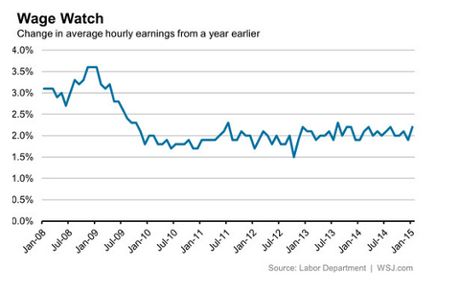
More in the WSJ’s preview: Five Things to Watch in February’s Jobs Report
The jobs report should be published on the Department of Labor’s website, and also on the Bureau of Labor Statistics site.
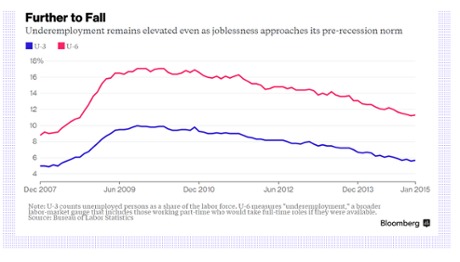
US policymakers will also be scrutinising today’s jobs report for signs that ‘labour market slack’ is being used up.
How do you tell that? By measuring how many people aren’t working as much as they’d like.
The so-called U-6 or “underemployment” rate edged up to 11.3 percent in January — still a blemish for the economy if you consider that the measure averaged 8.8 percent in the four years leading up to the last recession. This gauge includes workers such as those in part-time roles who would take full-time gigs.
Against the unemployment rate with which we are all familiar, called the U-3 rate, you can see why policy makers are eager for evidence that underemployment is receding more quickly:
Preamble: US jobs report
Over to a snowy Washington now, for the final economic news of the week – the US Jobs Report.
Happy Jobs Day everyone!
— Joseph Weisenthal (@TheStalwart) March 6, 2015
The Non-Farm Payroll for February will be released in 30 minutes time, giving a new insight into the health of the world’s largest economy.
It will show how many new jobs were created last month and – arguably more importantly - whether Americans were paid more.
Here are the economist predictions (from city broker Abshire-Smith’s preview)
1) an increase of 240,000 new jobs compared to January’s 257,000. With the economy rebounding
2) A fall in the unemployment rate to 5.6% from 5.7%,
3) a small rise in average hourly earnings (+0.25).
US Employment Report for February: http://t.co/KdES2h5SwU via @abshiresmith #NFP #NFPGuesses
— Joe Bond (@Joe_Trading) March 6, 2015
The report is due at 1.30pm GMT, or 8.30am EST.
However, because of the bad weather in America, it could be slightly delayed.
The Labor Department has said it will make every effort to put the data on its website at 8:30 a.m. or shortly afterwards......

Lunchtime summary: QE drive euro down
A very quick recap:
The euro has hit its lowest level against the US dollar in over 11 years, and hit a seven year low against the pound, ahead of the launch of the eurozone’s QE package on Monday. Here are the key charts
Eurozone government bond yields also fell to fresh record lows, following yesterday’s confirmation that the European Central Bank will launch its €1trn asset-purchase scheme next week.
QE also drove the Japanese stock market to a new 15-year high today, although European markets are more subdued.
Greece prime minister has claimed that the ECB still has a rope around Greece’s neck.
Alexis Tsipras’s government has also denied falling out with Commission chief Jean-Claude Juncker; the pair are still planning to meet soon to discuss Greece’s humanitarian crisis.
Yanis Varoufakis’s habit of shooting from the lip is a godsend to the media, but it hasn’t helped Athens build relationships in Brussels.
That’s one of the lessons that the Open Europe thinktank has drawn from the new Syriza government’s early weeks.
OE director Mats Persson reckons Britain’s Conservative party should should take note:
Mind your language: Greek Finance Minister Yanis Varoufakis may be fun, but his controversial running commentary – “fiscal waterboarding”, “bankrupt country” etc – has meant the new Greek government has used up a lot of political capital with EU partners for zero diplomatic benefit. The Tories are slowly learning this lesson (for example by not singling out individual countries when discussing immigration).
Don’t negotiate via the media: Syriza – like Number 10 up until recently – has a tendency to write the headline first, and the content later. I can think of no example when this has actually worked in terms of winning concessions in Europe. First get a sensible policy that squares your democratic mandate and its negotiability in Europe (admittedly a hard thing to pull off) , then go to the media
Here’s the full list: Eight lessons for David Cameron from Syriza

Reuters has now filed a story on Tsipras’s interview with Der Spiegel:
Greek Prime Minister Alexis Tsipras wants to issue short-term debt such as Treasury bills to plug his government’s financing gap and warned in a German magazine that if the European Central Bank objected, it would be assuming a grave responsibility.
“Then it will be back to the thriller we saw before Feb. 20,” he told Der Spiegel, referring to the date Greece agreed a four-month bailout extension with its euro zone partners.
“The ECB has still got a rope round our neck,” Tsipras said, according to excerpts of the interview released on Friday.
The leftist prime minister said he did not want Greece to leave the euro “because I love Europe” and said he had asked all his cabinet ministers - not just his combative finance minister Yanis Varoufakis - for “fewer words and more deeds”. <end>
Personally, I’d be delighted with more words and deeds from Varoufakis.
Updated
Hat-tip to Jeremy Cook of World First for this chart, showing how much the euro has weakened since the ECB imposed negative interest rates on commercial banks nine months ago:
Performance of the euro since ECB introduced negative deposit rates in June '14 pic.twitter.com/fEjMvgX52W
— World First (@World_First) March 6, 2015
“Less talk, more action”.
That’s the Greek prime minister’s message to his ministers, including the never knowingly underquoted finance minister Yanis Varoufakis.
Alexis Tsipras made the comments to German news magazine Spiegel. Reuters has just snapped the key points, including another denial that Greece could leave the eurozone.
- BERLIN-GREEK PM TSIPRAS TELLS GERMAN MAGAZINE HE WANTS TO ISSUE SHORT-TERM DEBT TO COVER FINANCING DEFICIT
- TSIPRAS TELLS SPIEGEL MAGAZINE THAT IF ECB DOESN’T AGREE TO THIS, THEY ARE ASSUMING GREAT RESPONSIBILITY
- TSIPRAS SAYS RULES OUT GREEK EXIT FROM EURO “BECAUSE I LOVE EUROPE”
- TSIPRAS SAYS HAS ASKED GREEK MINISTERS FOR FEWER WORDS, MORE ACTION, INCLUDING FIN MIN VAROUFAKIS
- TSIPRAS SAYS ECB STILL HAS “ROPE ROUND OUR NECK”
Varoufakis, meanwhile, continues to wow the media, appearing on the front cover of Esquire magazine (€13.80 (!) at all good Greek newsagents)
But still SO GOOD RT @_BenWright_: This is getting ridiculous... pic.twitter.com/LJSkix7P1s
— Emily Purser (@EmilyPurserSky) March 6, 2015
Brussels is also denying there is a rift with Athens:
*EU SAYS JUNCKER AND TSIPRAS IN CONSTANT TELEPHONE CONTACT
— Dealingroom (@Dealingroom_EN) March 6, 2015
Correction! Monday night’s eurogroup meeting might not be a marathon after all:
Just realised this tweet left out v key word: "It will NOT be a super duper long #Eurogroup," said #EU official pic.twitter.com/8alP5h4IlI
— Peter Spiegel (@SpiegelPeter) March 6, 2015
Greek government denies Juncker snub

Over in Athens, prime ministerial aides have denied that European Commission chief Jean-Claude Juncker has rejected a request to speak with Alexis Tsipras [as Suddeutsche Zeitung claims today].
Helena Smith, our correspondent in Athens, says put on the defensive officials have just issued another tersely worded statement.
She writes:
Prime Minister Alexis Tsipras’ aides were adamant: the Greek leader had neither made a request for a meeting with the European Commission chief before Monday’s Euro group, nor was there any let-up in communication between the two men.
A statement issued by Tsipras’ office in the last half hour declared:
“No meeting with Mr Juncker was requested before Monday’s Eurogroup. The prime minister speaks with Mr Juncker regularly. Their last contact was yesterday, Thursday, during which they agreed to meet before the Summit meeting.”
They admitted, however, that talks were underway to discuss how European Union funds could be used to finance the leftist-led government’s plans to alleviate both joblessness and the humanitarian crisis, the by-products of six years of recession and austerity.
“At their meeting, which will take place in the coming days, they will discuss how Greece can productively make use of European funds to combat the humanitarian crisis and unemployment.”
Insiders in the governing Syriza party are also firmly denying that the government will have an “issue” paying public salaries or pensions this month.
Updated

So, Greece has sent a new letter to Brussels with details of its reform plans, but it didn’t arrive in time for Wednesday’s working group (where officials do the hard graft ahead of Monday’s eurogroup meeting)
The new @yanisvaroufakis letter to @J_Dijsselbloem not received until after € working group meeting, so not prepped for #Eurogroup.
— Peter Spiegel (@SpiegelPeter) March 6, 2015
Updated
Eurostat has just confirmed that the eurozone economy grew by 0.3% in the last three months of 2014, in line with the initial estimate.
Encouragingly, consumer spending, business investment and trade all added to GDP growth, while government spending was flat.
again. The wider EU grew by 0.4%, with the fastest growth in Estonia and Sweden (both +1.1%). Germany grew by 0.7%, while France only managed 0.1% and Italy stagnated
Four countries contracted: Cyprus (-0.7%), Greece (-0.4%), Austria and Finland (both -0.2%).
Over in Brussels, an official is briefing the press now ahead of Monday’s eurogroup meeting. The FT’s Peter Spiegel is tweeting the key points: <updated>
Time for everyone's favourite monthly @twitter event: the pre-#Eurogroup background briefing. #Greece
— Peter Spiegel (@SpiegelPeter) March 6, 2015
Institutions to update #Eurogroup on "technical preparations to resume discussions" w/#Greece. In English: nowhere near deal on fast cash
— Peter Spiegel (@SpiegelPeter) March 6, 2015
#EU official confirms #Eurogroup has received new letter from @yanisvaroufakis with reform proposals for Monday's #Eurogroup. #Greece
— Peter Spiegel (@SpiegelPeter) March 6, 2015
Updated
The meeting between Greece’s prime minister and its central bank governor is over.
Bank chief Yannis Stournaras spoke to the media afterwards, and said that it is “very important” that Monday night’s eurogroup meeting is a success. He also pledged that Greek bank deposits are safe [yesterday, the ECB extended another €500m of emergency liquidity support to the sector]
Στουρνάρας: «Δεν υπάρχει πρόβλημα με τις καταθέσεις» http://t.co/jxjQmTkkTh pic.twitter.com/1Nvr1uMvA7
— ASTRATV THLEORASI (@astratelevision) March 6, 2015
After meeting w #Tsipras BoG gov Stournaras says banks safe&capitalised but v important for Monday's #Eurogroup to be successful #Greece
— Loukia Gyftopoulou (@loukia_g) March 6, 2015
Back in Britain, the public’s inflation expectations have hit a 13-year low.
Citizens expect prices to rise by 1.9% over the next year, the lowest since late 2001, a new Bank of England survey found. [reminder, UK inflation is currently just 0.3%]
And just 36% expect interest rates to rise in the next year, down from 37% in the previous survey in November.
Weak euro: the key charts
These charts underline how the euro has weakened against other major currencies in recent weeks, hitting new lows this morning.
#Euro drops to fresh 7yr low vs Sterling. Traded as low as GBP0.7213. pic.twitter.com/nWH14on1eZ
— Holger Zschaepitz (@Schuldensuehner) March 6, 2015
#Euro slips to fresh 11yr Low. Acc to Citi there’s no obvious reason other than continuation of well-accepted trend. pic.twitter.com/WJwPvYpOIf
— Holger Zschaepitz (@Schuldensuehner) March 6, 2015
QE sends euro sliding against dollar and pound
The euro has just weakened to a new eleven and a half-year low against the US dollar.
Foreign exchange traders drove the single currency down to its lowest level since September 2003, as they prepare for the European Central Bank to unleash its trillion-euro bond-buying programme on Monday.
The euro has fallen 0.5% this morning against the US dollar, to hit $1.0974.
It’s also hit a new seven year low against sterling. One pound is now worth €1.385, which I think is the most since December 2007.
The prospect of Eurozone QE has weakened the euro steadily this year, even though the ECB hasn’t actually bought anything yet.
Trade-weighted € has dropped by far more in the first 10 weeks of this year than it did in all of 2014. pic.twitter.com/ZEc8fFyA5s
— Mike Bird (@Birdyword) March 6, 2015
As explained earlier, the ECB is planning to buy €60bn of assets -- including government debt -- each month until September 2016.
Many of those bonds will be bought from banks outside the eurozone. That will effectively weaken the euro, as those foreign banks will be handed euros which they may then exchange for local currency, or US dollars, to buy new assets.
Chris Weston of IG explains:
With the ECB buying more bonds than are being issued, this is a huge negative for the euro.
All roads at present lead to a weaker euro and an outperforming equity market.
And as flagged up earlier, some eurozone bond yields are hitting record lows today -- meaning prices are at all-time highs.
Reuters: Greece repays IMF loan
Newsflash from Reuters: Greece has met a loan repayment to the International Monetary Fund this morning.
-
GREECE PAYS FIRST INSTALLMENT OF 310 MLN EUROS DUE FRIDAY AS PART OF IMF MARCH LOAN REPAYMENT-GOVT SOURCE
That’s the first of four debt demands this month:
A busy month of IMF repayments for #Greece. http://t.co/myfWnj7kWf …via @charlesforelle pic.twitter.com/jq7GTlELUT
— lastoftheboyscout (@nr_zero) March 2, 2015
Greece is unlikely to trigger a systemic crisis if it defaults on its debt and leave the eurozone, rating agency Fitch says today.
In a new report, Fitch warns that the threat of Grexit hasn’t abated, despite the four-month bailout extension agreed last month.
The uncompromising stance taken by both sides at times before the agreement highlights the possibility of a future policy mistake. “Grexit” is not our base case, but will remain a risk as more detailed negotiations take place, and as the Greek government tries to maintain domestic support for the deal it secures.
But, unlike in 2012, the eurozone is better equipped to cope.
The eurozone has developed mechanisms to prevent a run on a sovereign leading to a sovereign default, and to alleviate sovereign-to-sovereign contagion, and concerns about other eurozone sovereigns’ creditworthiness are less pronounced than in 2012. A chain reaction from Grexit to the ultimate breakup of the bloc is therefore unlikely...
More here: ‘Grexit’ Remains Possible, But Systemic Crisis Unlikely
Suddeutsche: Juncker refuses to speak with Tsipras
German newspaper Suddeutsche Zeitung claims that European Commission chief Jean-Claude Juncker has rejected a request to speak with Greek prime minister Alexis Tsipras today.
According to Suddeutsche, Tsipras hoped to discuss Greece’s funding problems with Junker; but the EC president wants to wait until Monday’s eurogroup meeting.
This follows reports that Athens will struggle to meet public sector salary demands.
We’ll see if we can get more details on this.
In the meantime, here’s the story: Tsipras bittet Juncker um Hilfe
A cash-strapped #Tsipras made emergency call to @JunckerEU to meet today but the latter refused (Suddeutsche Zeitung) http://t.co/iiBKl7lVSp
— Maxime Sbaihi (@MxSba) March 6, 2015
And here’s MNI newswire’s take:
Greece now unable to pay public sector employees, Tsipras makes emergency call to Juncker https://t.co/Jm7OcD4Ios
— MineForNothing (@minefornothing) March 6, 2015

In the City, shares in holiday firm Thomas Cook have jumped by 16% after it announced a tie-up with a Chinese investor.
Fosun International has taken a 5% stake in the venerable UK travel maker (founded back in 1841), and hopes to expand that to 10%.
The deal should help develop China’s burgeoning holiday sector, as the growing middle classes look to travel abroad.
Full story: Thomas Cook stake sold to China conglomerate
Spain’s factory sector also performed well in January, posting a 0.4% rise in output.
Economists had expected a 0.3% decline - perhaps the weak euro is providing eurozone firms a much-needed boost.
Germany’s industrial heartland began 2015 quite strongly, new data shows, as its economic recovery continued to pick up.
German industrial production rose by 0.6% in January, ahead of forecasts. December’s figure was revised sharply higher too, to +1.0%.
German IP much stronger than expected (+0.6% MoM in January) once the revision to December (from +0.1% to 1.0% MoM) is taken into account.
— Frederik Ducrozet (@fwred) March 6, 2015
#Germany's Industrial Production Increases for Fifth Month as Momentum Builds http://t.co/BptlHJjs3Y /via @business
— Yannis Koutsomitis (@YanniKouts) March 6, 2015
Eurozone bond yields hit record lows
The QE effect is also pushing up the value of debt issued by Spain, Portugal and Italy to record highs.
This is pushing down the yield (interest rate) on all three country’s debts to new lows, as investors anticipate the arrival of the ECB’s stimulus programme.
Peripheral Bond yields make fresh Euro-Era lows ahead of ECB QE. 10yr Portugal ylds at 1.7%, Spain 1.24%, Italy 1.26% pic.twitter.com/irTJs0m5Yx
— Holger Zschaepitz (@Schuldensuehner) March 6, 2015
Importantly, the ECB said yesterday it would buy debt even if was trading at a slight negative yield -- ie, more than its face value.
That will help Mario Draghi to pump money into the banking sector (as he’ll have a wider selection of bonds to buy).
IG’s Chris Weston explains:
The fact the bank is prepared to buy bonds with yields as low as negative 20 basis points increases its scope (or the actual ability) to buy €60 billion a month in assets, especially as 32% of all outstanding bonds have a negative yield now.
Updated
Nikkei hits 15-year high
The news that the eurozone is, finally, joining the quantitative easing party has helped to drive shares in Japan to a 15-year high.
The Nikkei jumped 1.2% or 291 points to 18,971, the best closing level since April 2000.
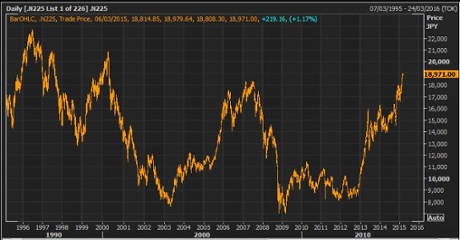
That follows a rally in Europe yesterday, after Mario Draghi announced that the ECB’s bond-buying programme will start on March 09, and also predicted stronger growth this year.
Ian Williams of Peel Hunt explains that Draghi’s upbeat mood is helping to drive shares higher.
The ECB announcement did not contain anything that should have surprised investors, but with the mood still extremely equity friendly, it triggered another rally for Eurozone indices.
The Nikkei has now risen for four weeks running; pushed up by expectations that central banks will maintain their loose monetary policy for some time.
Traders say today’s rally was also due to the yen dropping against the US dollar; America’s currency is strengthening ahead of this afternoon’s unemployment report.
Updated
The Agenda: US unemployment report and ECB reaction
Good morning, and welcome to our rolling coverage of world economy, the financial markets, the eurozone and business.
America’s labour market recovery puts Europe to shame. And we’ll get another reminder of that today, with the latest Non-Farm Payroll report (at 1.30pm GMT).
February’s NFP is expected to show that US employers hired around 240,000 new staff last month. That could pull the unemployment rate down to 5.6%, from 5.7% -- or or around half of the eurozone’s 11.2%.
If the wage data is strong, it could reignite talk of a US interest rate hike.
We’ll also be monitoring reaction to yesterday’s European Central Bank meeting, where Mario Draghi confirmed that QE will begin on Monday.
The euro has hit a new 12-year low overnight, briefly dipping below the $1.1 mark. Is parity with the dollar coming?
And Greece’s debt woes haven’t gone away; Athens should be working on firm proposals for next Monday’s eurogroup meeting.
The Greek prime minister, Alexis Tsipras, is due to meet with central bank governor Yannis Stournaras shortly:
#Greece PM Tsipras to meet w BoG Stournaras in abt an hour, in order to be informed re the yesterday's ECB meeting (via @capitalgr )
— Efthimia Efthimiou (@EfiEfthimiou) March 6, 2015
I’ll be tracking all the main events through the day.....