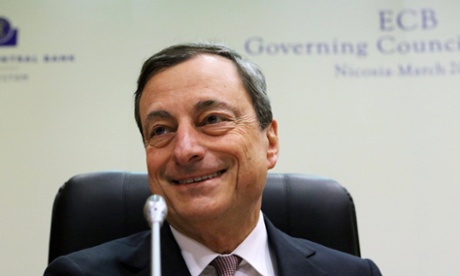
Listening to Mario Draghi, the European Central Bank’s canny Italian president, at Thursday’s press conference in Cyprus, you could be excused for thinking he’s already fixed the eurozone.
Growth forecasts up; deflation scare over; interest rates falling, helping to unblock lending to the real economy.
All he needs now, he suggested, is for eurozone governments to carry out their part of the bargain, and press ahead with the “structural reforms” so beloved of the ECB (and Brussels).
There are two reasons for the ECB’s optimism: firstly, for the moment, Mario Draghi is basking in what Mervyn King once called the Maradona theory of central banking.
Even before the ECB has pressed the button and started buying up government bonds, which it will start to do on Monday, markets have already moved in just the way central bankers hope for when they decide to take the drastic measure of launching quantitative easing.
The euro has fallen sharply on foreign exchanges; bond yields have declined; and as Draghi was keen to point out, interest rates have started to shift downwards even in what policymakers call the “real economy” — ie. the one beyond the financial markets. “We’ve seen a decline, if not a steep fall, in the lending rates across the euro area,” as he put it.
Draghi had carefully and deliberately built up expectations over more than six months of what the ECB would be forced to do if economic and financial conditions failed to improve; and markets have positioned themselves accordingly — like the defenders dodging out of Maradona’s way in Mexico in the 1986 World Cup, allowing the Argentine player to run straight up the pitch towards the goal.
King’s now rather dated sporting metaphor was meant to illustrate the fact that central bankers could sometimes achieve everything they wanted without shifting monetary policy at all.
Despite Draghi’s new-found bullishness about the economic outlook, though, he well knows that markets would punish him if he didn’t press ahead with the planned programme of QE: so the ECB and member-country governments will start buying €60bn a month of bonds on Monday, and keep going until they’re convinced the risk of deflation is a distant memory.
Secondly, recent data have pointed to the fact that some of the benefits of much lower oil prices are starting to make themselves felt.
Retail sales across the eurozone were surprisingly strong in January, expanding by 1.1% on the month, suggesting consumers are feeling the benefits of lower petrol and utility prices - which in economic terms, act very much like a tax cut, putting more cash in people’s pockets.
In the business sector, while the UK is fretting about the impact of the halving of oil prices on the North Sea fields, many eurozone economies are experiencing it mainly as a welcome cut in energy costs — which is coming at the same time as a depreciation in the currency, making exports more competitive.
Some firms may also have delayed decision-making while they waited to see whether Greece would plunge out of the eurozone, reigniting the financial crisis, after the radical left-wing Syriza government swept to power in Athens.
There are at least two risks to Draghi’s rosy view. The most obvious, underlined by the flurry of questions about Greece at Thursday’s press conference, is that the Greek crisis is not yet over, and could erupt back into life, causing financial market chaos - if eurozone members are less than happy with Syriza’s promised reforms, for example.
The second risk is more subtle. Past evidence suggests the major benefit of QE often comes at its early stages, when the so-called “announcement effect” is strongest.
The powerful message QE sends, that the central bank is determined to get to grips with an economic crisis, can boost confidence and unlock spending — but that tends to wane after a while.
And confidence will be crucial to determining whether there are so-called “second-round effects” from falling oil prices.
If price declines are perceived as widespread and long-lasting, rather than a temporary fillip, consumers may delay spending, companies may start to cut prices, and adjust wages downwards accordingly — and deflation can become entrenched.
Draghi believes the ECB’s determined approach has been critical in avoiding these so-called “second round effects”. For now, what evidence there is suggests he’s right; but only time will tell.