The Election Commission members are hosts and controversial participants in a vital meeting on Wednesday. The full seven-member EC is to meet with political parties on rules, methods and procedures of the just-stirring campaign and election day events. But the EC will be in the hot seat. Some of its early rules on electioneering have given the impression of favouritism.
In theory, the EC will lay down the rules for campaigning, voting and tabulating the results of an election that might be held on Feb 24. In fact, the meeting is more likely to become a debate -- and it should. The seven-man, military-approved EC has become a hot issue.

Going into the meeting, all of the major parties but one has either criticised or directly challenged early EC rulings. The one party that has remained silent and thus appeared supportive of the rules is the Palang Pracharath Party. The PPRP, whose top executives are government ministers, is the political arm of a movement to continue the rule of the military regime and its head, Prime Minister Prayut Chan-o-cha.
That only the PPRP appears to accept every EC ruling presents a major problem. It is unacceptable that any independent body appear to favour the government and its backers. That goes double for the EC. The only acceptable election, to the country and to all of Thailand's foreign friends, is one that is clearly free and fair. The EC is off to a bad start and must get back on the track of neutrality, beginning Wednesday.
There are many issues in dispute. First is the EC decision that could fairly be called the "Thaksin Rule". Out of the blue, without consultation and without justification, the EC decreed that no election material can carry a photo of anyone but the specific candidate, his or her party leader, or the party's nominee for prime minister. This is an obvious rule aimed at Pheu Thai and allied parties, who are barred from displaying photos of fugitive former premiers Thaksin and Yingluck Shinawatra. But it will hurt others much more. The Democrats, as an early example, are barred from using photos of their founder, or even of the much-admired ex-prime minister Chuan Leekpai.
The PPRP is not hurt by this. Nor is the regime-supporting party harmed by a previous proposal that ballots -- for the first time ever -- cannot carry logos, names or national numbers identifying parties. The EC announced instant support for this rule the day after it was "mentioned" by Prime Minister Prayut. On Monday, it decided to take a step back by allowing ballots to carry logos and names of the parties. But it will still exclude party numbers from them.
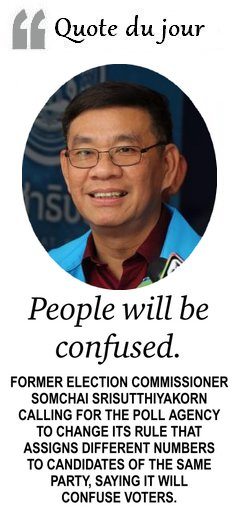
Party numbers are in dispute. For some inscrutable reason, the EC has indicated that numbers for candidates will be issued for each constituency. There is no apparent reason to scrap the long tradition that each competing political party has its own number throughout the country. The EC should also revert to past practice on this rule. If not, it is certain to be charged with favouritism for helping the new PPRP, which is struggling for national recognition.
The EC is on stronger but still shaky ground on other issues. It will sponsor debates among party leaders. But it has ruled that only top-echelon party leaders can participate. The commission is missing a brilliant opportunity to organise debates at the constituency level, among people's candidates. Allowing only the leaders or prime minister-candidates to debate is a huge favour for the current regime.
The EC should surely know that its reputation, and the reputation of each of its member is on the line. The public has waited very patiently for a general election. Any sign that the EC is acting in concert with the regime will certainly be magnified, and will subject the entire election to suspicion. Wednesday's meeting is the time for the EC to get back on the track of full fairness.