Summary
We’re going to wrap our coverage of the Ebola cases in the US, Africa and Europe today with a summary of the major developments.
- President Barack Obama said the US must respond much more aggressively to prepare at home and confront the outbreak abroad. He said that while risks are low he had ordered the CDC to prepare special teams for rapid response. The White House said “there are likely to be more cases,” and acknowledged “shortcomings” of hospital response in Texas.
- A second health worker contracted Ebola after having treated a man who died from the virus there. Amber Vinson and will be airlifted to Emory hospital in Atlanta, near the Centers for Disease Control.
- Vinson flew just a day before reporting a fever and testing positive. The CDC is trying to reach all 132 people who were on board Frontier Airlines flight 1143, which flew from Cleveland to Dallas-Fort Worth on 13 October.
- The death toll neared 4,500 people since the outbreak began in west Africa, the WHO said, adding that the estimated death rate is now 70% and it’s likely that many deaths go unreported.
- Staff at Presbyterian Hospital allege chaotic scenes and poor safety protocols in dealing with infected patients. The CDC admitted it should have responded faster, and nurses threatened to picket over poor preparations.
- First-hand accounts and UN agencies describe increasingly awful situations in west African nations, with the crisis affecting other areas, for example families’ ability to heal themselves.
Updated
A short note before our final summary to close the blog: the AP reports that a second, smaller Ebola outbreak broke out in the Democratic republic of Congo, killing at least 49 people since July.
A new WHO study shows the virus has a different source in nature than the massive epidemic raging now in the western part of the continent.
The outbreak that began in July in the Democratic Republic of Congo is similar to earlier ones in that central African region, genetic testing of viruses shows. At least 69 people, including eight health workers, are believed to have been infected, and 49 have died.
Health experts think the initial cases in each outbreak got it from eating or handling Ebola-infected animals, then spread it person-to-person. The exact source in nature has not been proved but the leading suspect is a certain type of fruit bat.
The virus is different from the Zaire strain causing the larger epidemic in West Africa, suggesting that a separate source in nature seeded each outbreak.
“The bottom line to the American public is that the dangers of contracting Ebola … is very low. But we are taking this very seriously. … We have to look toward the future, and if we are not responding in an international and effective way, and if we do not … have the training and [preparation] in the United States, then we could have future problems.”
“In the meantime I want everyone thinking about and praying about the [workers] who have gotten sick … we are going to be doing everything to make sure they are properly cared for.”
With that the speech concludes.
Updated
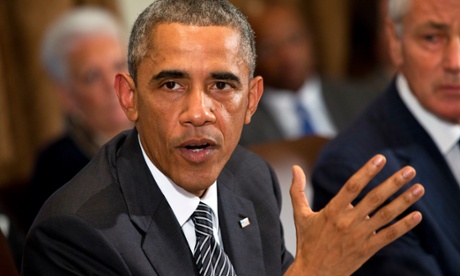
“We understand that many people are scared, and we’re going to make sure that we’re on the ground 24/7 to provide support and assurance that they need to get through this particular challenge.”
“Finally we’re also going to continue to examine our screening at airports … whether patients need treatment at specialized hospitals that those teams are in place … and that we continue to provide the public with information.”
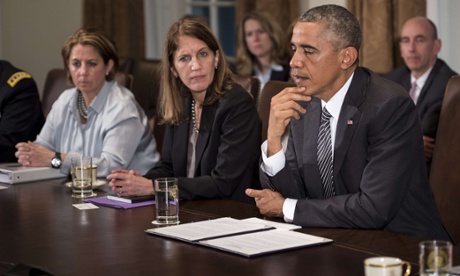
“I’ll end with this point: we are going to have to make sure that we do not lose sight of the international response to what is taking place … I am absolutely confident that we can prevent a serious outbreak in the United States.
“But it becomes more difficult to do so if this epidemic of Ebola rages out of control. If it does it will spread globally in an age of frequent travel and the kind of constant interactions people have across borders.”
“So it is very important for us to understand that the investment we make in dealing with this problem is an investment in our public health. It is not simply charity. … It is probably the single most important thing we can do to prevent [an outbreak in America] is to confront a raging epidemic in Africa.”
He adds that he spoke with prime ministers and is coordinating efforts on an international level.
Updated
Obama adds, in line with the CDC and White House press secretary, that contact tracing is underway in “aggressive fashion” to determine who has come into contact with anyone who has tested positive.
He takes himself “as an example” that treatments work: “I have shook hands with, hugged, and even kissed, not the doctors but some of the nurses.”
Obama stresses that “the likelihood of widespread ebola outbreaks in this country are very, very low” if protocols are followed assiduously.
“We are reviewing every step since Mr Duncan was brought into the hospital, to understand what went wrong. We are now communicating all these various lessons to hospitals, clinics, first responders around the country, and obviously given all the attention that this has received, we’re going to make sure … all this information is constant, updated, and always under revision.”
“We’re going to be working with [health officials], agencies, the governor of Texas that in the event of [future cases, people] will receive proper treatment.”
“It’s not like the flu, it is not airborne. The only way you can transmit is through the bodily fluids of someone who is showing symptoms.”
“What I’ve directed the CDC to do is to have a first response team, a Swat team, to be on the ground as soon as possible, so that they are on the ground, at the hospital, to … make sure that what needs to be done is done.”
“That the key thing to understand about this disease is that these protocols work. We know that because they’ve been used for decades now … including in the treatments that worked in Emory and Nebraska. But we have to make sure that certain hospitals that do not have that experience are walking through that.”
Updated
Obama: US must be much more aggressive in response
President Obama is delivering remarks on the crisis
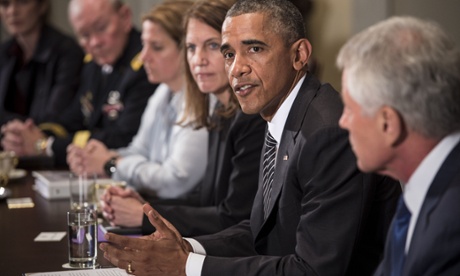
“What we’ve been doing here today is reviewing exactly what is happening in Dallas, and to ensure that something like this does not repeat.”
Updated
A man from Sierra Leone says British landlords have refused him accommodation because of Ebola fears, my colleague Robert Booth reports from London.
A radio presenter from Sierra Leone who had been broadcasting a myth-busting show about Ebola in his home country was refused accommodation when he arrived to study at the University of East Anglia this month because landlords feared he may have brought the killer virus with him.
“It’s very unreasonable,” Amara Bangura told the BBC. “And if you think everybody coming from Sierra Leone is affected, then that’s just completely unfair.”
One of the landlords reportedly told him in a refusal letter: “Under normal circumstance[s] your profile would be a great profile to be one of our lodgers.
“However, given that the world is about to probably experience an Ebola epidemic, we have decided not to accept anyone that has been anywhere near the outbreak within the last two months, or is likely to visit those areas in the near future.”
lodgings told the Guardian last week: “You have to deal with the issues of myth, you have to deal with the issues of religion, you have to answer questions about prevention and how to stay safe”.
You can read the full piece here.
Barack Obama declared Ebola “a threat to international security” in a video conference with European leaders earlier today, Dan Roberts (@robertsdan), the Guardian’s Washington bureau chief, reports.
Speaking with leaders in the UK, France, Germany and Italy shortly after the case was confirmed on Wednesday, the US president said they all urgently needed to marshal extra finances and personnel to “bend the curve of the epidemic” in west Africa.
The White House released a readout of the call.
Criticism of the hospital failures and CDC protocols have already spurred Republicans in Congress, with the House of Representatives holding a hearing tomorrow on the Texas infections.
Republican Tim Murphy, chairman of the oversight and investigations subcommittee, said “so far traveler self-reported screening procedures and hospital infection control measures have been demonstrated failures” in a statement issued ahead of Thursday’s testimony from CDC director Thomas Frieden.
Updated
A bit of brighter news about the dog of Nina Pham, an Ebola patient in Dallas. The pup is “looking good and happy” at a decommissioned naval air base while his owner is treated, city officials say.
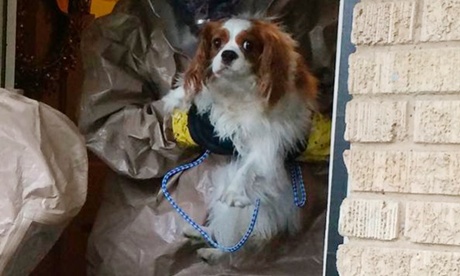
Bentley has been given comfortable bedding, toys and room to run around at the former residence of the executive officer at the decommissioned Hensley Field, city spokeswoman Sana Syed said.
The dog, like humans who may have come into contact with Pham, will be monitored for 21 days, and officials have so far shown no will to follow the path of Spanish authorities, who euthanized a dog belonging to a nursing assistant with Ebola. Authorities, a decision that caused an uproar.
The CDC says there have been no reports of pets spreading Ebola to people or other animals.
My colleagues have gathered more details about Bentley here.
Updated
Accounts from west Africa tell of fear, panic and hunger, as men and women in Sierra Leone send their stories sent to the Guardian.
John F Sillah tells of the last unaffected region in Sierra Leone: “Two suspected Ebola cases have been reported in Fagoya, a village in the Nieni chiefdom of the Koinadugu District. This village allegedly became affected through a man who had travelled there from Kono. Many people in Kabala are now very worried. The District was the only previously unaffected region in Sierra Leone.”
Hunger and poverty are compounding the pressures of Ebola, according to Moses Kortu, who says “Ebola has destroyed the community.”
In this part of the country, students are not able to listen to the radio; most of them don’t own radios. This is farming time, parents are looking for food- how will they tell their children to listen when there is no food at home. Generally, children in this community are not benefiting from lessons via the radio.
The issue of hunger is still a real concern in Koindu; there is no food at home. Banks are only open Monday, Wednesday and Friday from 9am-1pm which is causing problems – people need their money. Ebola has destroyed the community.
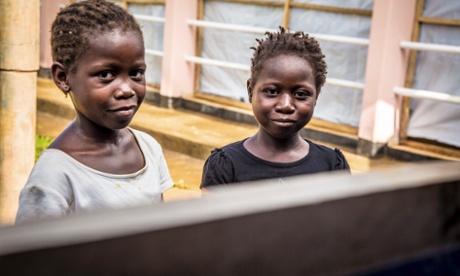
Mariama Jalloh describes “panic in Koinadugu”, Sierra Leone: “There is panic in Koinadugu right now due to two persons suspected of Ebola. They are from Nieni chiefdom but according to the information I have gathered, these two people came from Kono … and now the district has decided that no one should travel in and out of the Nieni chiefdom until the results come out.”
If you have a story to share you can send it to Guardian Witness here.
A British nurse who survived Ebola is heading back to Sierra Leone to rejoin the frontline of health workers, my colleague Lisa O’Carroll (@lisaocarroll) reports.
Will Pooley confirmed his plans as he spoke to potential volunteers at the department of health on Wednesday. “There is still a lot of work to do out there and I am in the same or better position than when I chose to go out before,” he said.
“It does not seem likely that I will contract it again but it will still be the same question in my mind as it was the first times. It was an easy decision at that time and it is the same now.
Of his friends and family who have already seen the trauma he went through after contracting the illness, he said: “They are always going to be worried. They are very supportive.
“I know my mum and dad are worried but they support me because they know this is something I have to do. My potential immunity is very reassuring for them, or at least it should be, and I will be returning in a more organised fashion than when I was out there originally.”
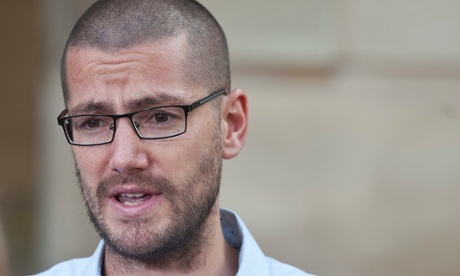
Pooley said he has made a “100% recovery”. “My exposure, as with everyone’s exposure, was an accident. It is something that everyone will be thinking about – all the volunteers who are here tonight but it is about vigilance really and being cautious. You must never let any complacency creep in.”
Updated
An ambitious plan to contain and push back the epidemic in west Africa in two months is guiding UN policy, explains the Guardian’s health editor Sarah Boseley (@sarahboseley).
The 70/70/60 plan aims to isolate, treat and care for 70% of Ebola patients and safely bury 70% of the dead within 60 days. At a briefing on Tuesday, Dr Bruce Aylward, WHO Assistant Director-General, said that by the start of December, they expected up to 10,000 cases a week, a tenfold increase. If they could meet the targets, he said, they might be able to “bend the curve” and try to get the numbers to fall.
“I worry that we risk making their challenge worse. We are not at common purpose, and we must get to common purpose very, very quickly,” he said.
“There is no question the strategies work. The question is how much carnage and human misery there will be between now and then, and that depends on if we get to common purpose - 70/70/60.”
The WHO also committed to getting 600 people in 45 districts across the three countries in 60 days “to find the cases, ensure the programmes are safe, and ensure we have the evidence we need to get this finished.”
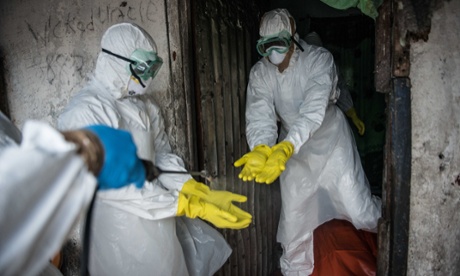
Sarah also reports that health officials called for substantial and immediate financial help. Dr David Nabarro, the UN Secretary General’s special envoy on Ebola, said: “This is in a moment where there must be no postponement of financing decisions and no postponement of action because we haven’t agreed on things. As everybody has said so far, the time is the key variable.”
Updated
An American being treated for Ebola at Emory says he is recovering, Reuters reports.
The patient, who has not been identified, was working in Sierra Leone when he tested positive for the disease and was evacuated to the United States on a private chartered flight.
“I want to share the news that I am recovering from this disease, and that I anticipate being discharged very soon, free from the Ebola virus and able to return safely to my family and to my community,” the patient said.
“I want the public to know that although Ebola is a serious, complex disease, it is possible to recover and return to a healthy life,” the patient said.
The patient, being treated since 9 September, has said he wants to keep his identity secret for now.
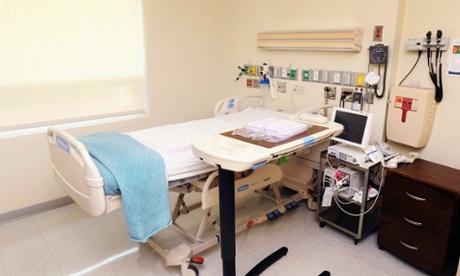
The international effort to contain and stop the virus has brought nine Ebola patients to Europe, three of whom to Germany – but some medical organizations say Germany should do more, my colleague Philip Oltermann reports.
A working group at Leopoldina, the German national academy of sciences, on Wednesday called for Germany to accelerate its effort to develop experimental vaccines and medicines for clinical application.
“Germany already has very good expertise in this field, particularly with the research going on,” said Leopoldina president Jörg Hacker.
Hacker argues that the discovery and development of vaccines should not be solely driven by the market economy, and he told the Guardian that recent progress in the field of Aids research had shown that governments could drive progress via public-private partnerships or medical foundations.
But he said the cost of treating patients with Ebola is “extremely high”, amounting to around €10,000 plus additional medicine costs. Moreover, patients’ own health insurers (including the UN) have covered the expenses so far, rather than Germany.
Summary
Here’s a summary of today’s key events so far:
- A second health worker has contracted Ebola after having treated a man who died from the virus there. She has been named as Amber Vinson and will be airlifted to Emory hospital in Atlanta, near the Centers for Disease Control.
- Vinson flew just a day before reporting a fever and testing positive, though crew members say she showed no symptoms during the flight. The CDC is trying to reach all 132 people who were on board Frontier Airlines flight 1143, which flew from Cleveland to Dallas-Fort Worth on 13 October.
- The White House said “there are likely to be more cases,” and said that the safety breaches that led to infections in Texas were “unacceptable”, but resisted the idea of an “Ebola tsar”. President Barack Obama will speaker after an emergency meeting, and also spoke by video conference with EU leaders.
- Nearly 4,500 people have died from the virus since the outbreak began in west Africa, the WHO said in a statement, adding that the estimated death rate is now 70% and it’s likely that many deaths go unreported.
- Staff at Presbyterian Hospital allege chaotic scenes and poor safety protocols in dealing with infected patients. A nurses union says the hospital let hazardous waste “pile to the ceiling”, and threatened to picket over poor preparations.
- UN agencies describe increasingly awful situations in west African nations, with the crisis affecting other areas, for example families’ ability to heal themselves.
Updated
National Nurses United, the union and professional organization for US healthcare workers, just held a conference call for thousands of nurses to discuss Ebola.
Vox’s Sarah Kliff tweets what may be the biggest news from the call:
Wow: in a conference call happening now, nurse’s biggest union says they’re considering hospital pickets if preparation doesn’t improve.
— Sarah Kliff (@sarahkliff) October 15, 2014
Dallas local news meanwhile has yet another allegation from nurses about the lack of protocol at Texas Presbyterian Hospital.
Dallas hospital nurses DID NOT wear protective personal equipment for several days, until diagnosis confirmed. http://t.co/24oSPbWiFU
— Dove (@abenadove) October 15, 2014
“There’s a multi-layered screening protocol in place,” Earnest says, to prevent Ebola-positive people from boarding flights to the US.
He says controls abroad and by border patrol officers in the US are part of a system to stop the virus from entering the country (again).
Earnest directs reporters to the CDC for leadership on how to handle the crisis:
“It’s the CDC’s responsibility to communicate with hospitals and healthcare professionals about the proper protocols … there’s also a protocol the CDC has in place for [treating] patients with Ebola. The CDC is reviewing those protocols. And we are concerned about making sure that the CDC is offering clear guidance about what those protocols should be.”
But he refuses to say that Texas Presbyterian Hospital in Dallas did anything wrong: “There was, uh, something unacceptable occurred.”
And shortly after that the briefing is over, and Earnest leaves to attend the president’s meeting.
White House: more cases are 'likely'
“There are likely to be more cases of Ebola,” Earnest says, before adopting the future tense, rather than the conditional:
“When those cases present themselves, [the president wants to ensure] that our [workers] will be able to [handle it] and to ensure the safety of the greater public.”
The next question hits on the problem of leadership: “So there’s not one person in charge…? Besides the president.”
Earnest strenuously clarifies that Lisa Monaco is coordinating activities of agencies, who are themselves determining those activities, and that she’s not involved with ground operations, per se.
Updated
Asked about preventing people who’ve contacted Ebola patients from getting on commercial flights, Earnest says that the CDC bears most of that responsibility.
Pressed about the powers necessary to keep Ebola off airplanes, Earnest repeats his earlier comment about setting up protocols; he doesn’t say anything about the administration’s ability to enforce any rules.
“The president is concerned that healthcare professionals are getting clear guidance from the Centers for Disease Control … he wants them to be cognizant that there could be other Ebola patients across the country, about how to handle [one such patient] should they present themselves … the president is convening this meeting to make sure the response is commensurate.”
He then reminds the press pool about the American healthcare workers who contracted the virus in Africa and recovered upon return to the US, without incident or further infections – “at other healthcare facilities”.
Updated
“The stakes are high,” Earnest says, after something of a dodge to a question about Obama’s video conference with EU leaders and UK prime minister David Cameron.
Earnest says the president urged EU leaders to make a bigger commitment in west Africa, but that he won’t remark about their conversation before a readout comes from the White House later today.
Earnest gets asked about fear and the failings of healthcare workers protocol: “Everyone on that plane is now being contacted – that creates at least a low level of alarm … do you understand how that could create [fear]?”
“We have a modern medical infrastructure in place – that again has not been flawless … people should take solace in the fact that we know exactly how Ebola is transmitted. … This is a deadly graphic disease.”
He hits his talking points again: the investigation to determine how healthcare workers were infected; tracing contacts of the infected; adapting better, more secure protocols; and treatment of those patients.
Earnest says a travel ban from west African countries is “not on the table”.
“The only way for us to stop this outbreak … is to stop this outbreak at the source. So we are mobilizing significant resources … to the region,” referring to the US military work in west Africa to support medical work and infrastructure.
“This is a deadly, terrible disease and it is wreacking havoc in west Africa … it is genuinely tragic. At the same time because of the way that virus is transmitted, because of [the quality of medical serices] in this country,” that risk is extremely low, he says.
Earnest goes to pains to differentiate the situation in west Africa from the US infections in Dallas.
“[Dallas] is wholly different than the situation we see in west Africa, where we see people in the same household passing the virus from one to another … or burial practices, where individuals are contracting the virus [from handling] corpses.”
A reporter interrogates him a bit about how it was possible that Presbyterian hospital’s conditions allowed for workers to contract the virus, and about the government’s response.
“Dr Frieden [the CDC director] has said that it’s unacceptable that even one healthcare worker has been exposed to this virus while providing treatment to this patient. That is an indiciation that there were shortcomings. … This under investigation, and that investigation will now expand to this second healthcare worker.”
“What you are seeing from the federal government is the kind of tenacious response that reflects changing circumstances. Dr Frieden indicated that he would send a whole team of experts earlier this week after [seeing] that they should’ve been there sooner – what you’re seeing in Texas is [a changing response to reflect that].”
Updated
Earnest is cagey about the idea of an “Ebola tsar” – he says that Monaco is in charge of coordinating agencies in the US but that, because the situation is “dynamic”, the organization of powers could change.
Asked about how the second patient boarded a commercial flight, Earnest launches into a talk about protocols, saying that the CDC and administration is working on “advice to medical professionals across the country about the protocols to ensure that healthcare workers remain safe”.
Earnest says that “contract tracing of the two workers that have contracted the virus” has begun, explaining that authorities are “tracing the contacts that these individuals have had after they got sick”.
He emphasizes that “risks are low”, andasked whether an Ebola epidemic is still “very unlikely” in the United States, he says “it is true, it’s guided by the science, that’s what our experts say. … The only way an individual can get Ebola is by coming into close contact with the fluids of an individual that is showing the symptoms of Ebola.”
“How the transmission of [the healthcare workers with infected fluids] occurred remains under investigation.”
White House press secretary Josh Earnest is talking to reporters, and dives right into questions. He says that the president is convening a meeting at 3.30pm ET and will deliver remarks afterward.
From the pool: “Can you give us any more details on the meeting?”
He’ll be meeting with “members of his team who are responsible for responding to the Ebola situation … he wants to make sure that all the needed resources of the federal government are being deployed.”
He say that the White House supports CDC director Tom Frieden and that part of the meeting today is to determine the division of powers and responsibilities: in Africa US forces from Department of Defense, Homeland Security, the CDC and health agencies are all involved.
He says “There are clear lines of responsibilities in place … and Lisa Monaco, secretary of the department of homeland security [is in charge] of integrating the response.”
Updated
The UN Security Council says the world has “failed” to address Ebola outbreaks and their consequences.
The council’s press statement says the virus threatens international security, and that all UN countries and organizations should “accelerate and dramatically expand the provision of resources.”
The head of the UN mission for Ebola response, Anthony Banbury, on Tuesday said that should the world fail to meet goals by 1 December, everyone will “face an entirely unprecedented situation for which we don’t have a plan.”
You can read the full statement here.
Updated
National Nurses United – the group that wrote a blistering account of Presbyterian Hospital’s lack of Ebola protocol – will host a conference call for nurses at 3pm ET, so that they can air concerns, ask questions and discuss how hospitals should confront the crisis.
The nurses call for “all hospitals to have in place the highest standard of optimal protections, including Hazmat suits, and hands-on training to protect all RNs, other hospital personnel to confront Ebola.”
“There is no standard short of optimal in protective equipment and hands-on-training that is acceptable,” said RoseAnn DeMoro, executive director, says in the statement.
A press conference is scheduled to begin shortly at the White House, and the Guardian’s Dan Roberts is reporting from Washington – where Ebola fears have drawn a very small demonstration.
A lone protestor outside White House ignores tornado warnings to stay inside but demands a ban on flights from Africa pic.twitter.com/zaS7DyYcLg
— Dan Roberts (@RobertsDan) October 15, 2014
Based on medical records, Frieden said it appears the team of 77-healthcare workers who treated Duncan had exposed skin while working in the quarantine unit during the three-day window between when he was admitted and when he was diagnosed.
Frieden said: “Were also planning for other eventualities in case we get additional cases in the coming days.”
“The first several days before the patient was diagnosed appear to be the highest risk period,” the director of the CDC has said.
My colleague Lauren Gambino (@lgamgam) has more:
The two infected nurses had ‘extensive’ contact with Thomas Eric Duncan in the days before he was diagnosed with Ebola and was extremely ill, excreting large quantities of highly-contagious body fluids.
“Our investigation increasingly suggest that the first several days before the patient was diagnosed appear to be the highest risk period,” Frieden said.
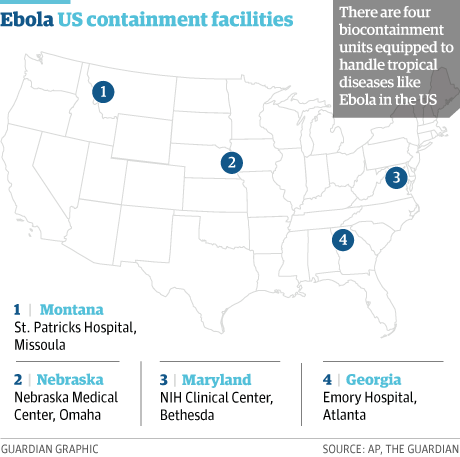
Amber Vinson, the second healthcare worker to be diagnosed with Ebola, will be transferred to a special bio-containment unit in Atlanta for care. The US has four units of the CDC’s highest calibre.
Updated
Nearly 4,500 people have died from the world’s worst Ebola outbreak, according to the WHO.
The health organization reports that 4,493 people have died as of 12 October, of of 8,997 confirmed, probable, and suspected cases of Ebola, across in seven countries. The WHO puts the death rate in the outbreak at 70%; it had previously hovered near 50%. The
“It is clear … that the situation in Guinea, Liberia and Sierra Leone is deteriorating, with widespread and persistent transmission of [Ebola],” the report notes, emphasizing that huge numbers of cases and deaths may be unreported.
.@WHO's latest #Ebola report makes it very clear that the official numbers ar far removed from reality. http://t.co/vxxkI1wqPZ
— Martin Enserink (@martinenserink) October 15, 2014
Amber Vinson is ill but “clinically stable”, according to Tom Frieden, the CDC director.
He said infected nurses had extensive contact with Thomas Eric Duncan during the most infectious stage of the virus. He also clarified the timeline, and his comments about her flight:
The patient had traveled to Ohio before it was known that the first healthcare worker was ill. At that point that patient as well as the rest of the healthcare team were undergoing self-monitoring.
The second healthcare worker reported no symptoms and no fever. However, because at that point she was in a group of individuals known to have exposure to Ebola, she should not have traveled on a commercial flight.”
Ohio’s health department is tracing whom Vinson may’ve contacted while she was in the state, and whether she may have had any symptoms before or during her flight from Cleveland back to Texas.
Vinson should never have boarded a commercial plane, Frieden says, per my colleague Lauren Gambino (@lgamgam).
He says she should not have flown after having been exposed to extremely infectious, late-stage Ebola – which she knew. He says “we will make sure others being monitored for Ebola will not be allowed to travel on a commercial flight.”
.@DrFriedenCDC today says the second nurse to be infected with #Ebola was known to have exposure to Ebola & she should not have traveled
— Julia Belluz (@juliaoftoronto) October 15, 2014
The CDC and Presbyterian Hospital are attempting to sort out secure travel and transportation for Vinson, and the Freidan’s assertion about Vinson’s misconduct raises more questions about healthcare protocols.
Updated
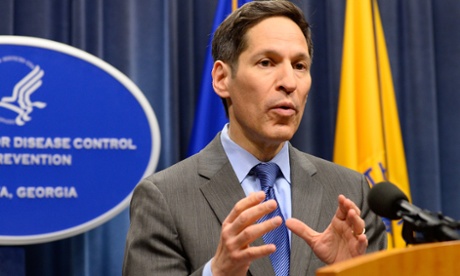
Some details from that call with Tom Frieden, director of the CDC:
Frieden says the risk to passengers on Frontier flight 1143 is “extremely low”, and that by contacting passengers and crew the CDC is using “extra margins of safety”. He says the CDC is using “extra margins of safety” by contacting passengers and crew on board Frontier flight 1143, and in dealing with the second patient.
Frieden also says hospital staff may have put on too many layers of protective gear while caring for Duncan in the early days of his treatment.
Updated
Texas Presbyterian Hospital has released a statement more or less in line with the continuing call hosted by the CDC, which my colleague Lauren Gambino (@lgamgam) should have more details on soon.
Texas Health Presbyterian Dallas is actively consulting with Emory University Hospital in Atlanta and other health officials about the possibility of transferring to Emory our second coworker being treated for Ebola.
We are sensitive to the demands being placed on our caregivers, who are working intensively to provide quality care to all patients, and we will provide new information as decisions are made.
There have been conflicting reports as to whether Amber Vinson, diagnosed most recently, or Nina Pham, the first nurse to test positive, will fly to Atlanta.
*Lauren confirms that Vinson, the second patient, will fly to Emory.
Updated
Dallas patient to be airlifted to Emory
One of the healthcare workers to contract Ebola will be transported to Emory University Hospital in Atlanta, Tom Frieden, director of the Centers for Disease Control and Prevention has told reporters.
A patient will be taken for treatment at CDC’s state-of-the-art base, where two Americans recovered from the virus earlier this year.
Updated
Summary
Here’s a summary of today’s key events so far:
- A second health worker has contracted Ebola after having treated a man who died from the virus there, officials have said. She has been named as Amber Vinson and is being treated in isolation at Texas Presbyterian Hospital. Crews have cleaned her apartment, where she reportedly lived alone.
- Vinson flew just a day before reporting a fever and testing positive, though crew members say she showed no symptoms during the flight. The CDC is trying to reach all 132 people who were on board Frontier Airlines flight 1143, which flew from Cleveland to Dallas-Fort Worth on 13 October.
- A series of reports from staff at Presbyterian Hospital allege chaotic scenes and poor safety protocols in dealing with infected patients. A nurses union says the hospital let hazardous waste “pile to the ceiling”.
- More Ebola cases were “a very real possibility, according to Dallas judge Clay Jenkins, and the city’s mayor said the situation “may get worse before it gets better, but it will get better”.
- The overwhelming majority of cases continue to be seen in west Africa, with the UN’s World Health Organisation warning that we could soon see 10,000 new cases a week.
- UN agencies describe increasingly awful situations in west African nations, with the crisis affecting other areas, for example families’ ability to heal themselves.
- President Barack Obama cancelled plans to arrange an emergency meeting at the White House. He is due to speak later this afternoon ET, and also held a video conference with EU leaders to discuss the crisis.
Updated
The second case may help determine how nurses were infected, which would allow the hospital to correct a control breach and prevent spread, the AP reports.
For example, if both health workers were involved in drawing Duncan’s blood, placing an intravenous line or suctioning mucus when Duncan was on a breathing machine, that would be recognized as a particularly high-risk activity. It also might reveal which body fluids pose the greatest risk.
Nina Pham, the first person to contract the disease as she cared for Duncan was in Duncan’s room often, from the day he was placed in intensive care until the day before he died.
The hospital now plans to limit the number of healthcare workers who care for Ebola patients so they “can become more familiar and more systematic in how they put on and take off protective equipment, and they can become more comfortable in a healthy way with providing care in the isolation unit”.
The situation in Dallas “may get worse before it gets better, but it will get better”, Mayor Mike Rawlings has said, as officials both call for calm and signal that the end is not quite in sight.
Dallas County health and human services director Zachary Thompson has told residents “don’t be surprised” to see more cases in the coming days, but has called for area residents to remain calm in an interview with local news.
“I’ve got to remind Dallas County residents: Let’s not get into the fear factor and panic,” he said. “It should be contained within the healthcare workers, and hopefully we don’t see any more cases, but don’t be surprised.”
Dallas County judge Clay Jenkins said the 48 people who had contact outside the hospital with the first patient, Thomas Eric Duncan, are still healthy and without symptoms.
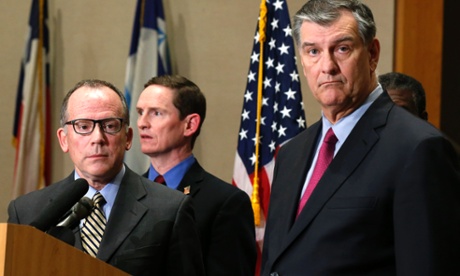
At the hospital, 76 people could have been exposed to Duncan and are being monitored for fever and other symptoms. With the addition of the 132 people on board Frontier flight 1143, more than 250 people may have come into contact with one of the three people to have tested positive for the virus in the US.
Executive president of Texas Health Resources Dr Daniel Varga said Presbyterian hospital has an isolation unit set up which can handle up to three patients. A new area has also been opened to screen patients for Ebola.
Updated
President Obama has postponed travel to campaign rallies for an emergency Ebola meeting at the White House, my colleague Dan Roberts reports.
Obama will also speak this afternoon after the meeting. Dan copies in a statement from the White House press secretary:
Late this afternoon, the president will convene a meeting at the White House of cabinet agencies coordinating the government’s response to the Ebola outbreak. There will be a pool spray at the conclusion of that meeting, where the president will deliver brief remarks. We will have more details on the participants and timing of the meeting as soon as they are available.
The second infected healthcare worker has been named as Amber Vinson by family members to local media. Dallas local news WFAA has more details from the mayor’s press conference, and has spoken with relatives:
Family members say 29-year-old nurse Amber Vinson has joined nurse Nina Pham in isolation at Texas Presbyterian Hospital. Martha Schuler, the mother of Vinson’s former stepfather, confirmed her identity Wednesday morning.
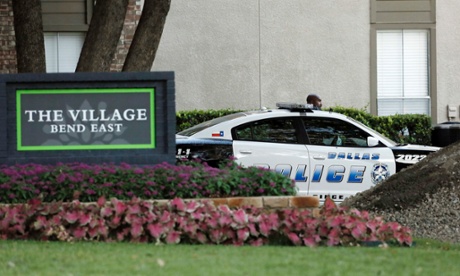
During a press conference Wednesday morning, Mayor Mike Rawlings confirmed that Vinson lives alone without pets at The Green in the Village Apartments, in the 6000 block of Village Bend near Skillman, just north of Lovers Lane.
Police were at Vinson’s apartment complex early this morning and notified people in the area. About Pham, Presbyterian Hospital said her condition had improved and that her dog is also doing well.
Updated
The CDC and Frontier Airlines have released statements about their attempt to contact passengers on flight 1143.
Both statements reiterate: “the healthcare worker exhibited no symptoms of illness while on flight 1143, according to the crew”. The CDC statement reads in part:
Because of the proximity in time between the evening flight and first report of illness the following morning, CDC is reaching out to passengers who flew on Frontier Airlines flight 1143 Cleveland to Dallas/Fort Worth 13 October.
CDC is asking all 132 passengers on Frontier Airlines flight 1143 Cleveland to Dallas/Fort Worth on October 13 (the flight route was Cleveland to Dallas Fort Worth and landed at 8.16pm CT) to call 1 800-CDC INFO (1 800 232-4636). After 1pm ET, public health professionals will begin interviewing passengers about the flight, answering their questions, and arranging follow up. Individuals who are determined to be at any potential risk will be actively monitored.
The healthcare worker exhibited no signs or symptoms of illness while on flight 1143, according to the crew.
Frontier Airlines statement follows a similar line, saying the company cleaned the aircraft as usual:
At approximately 1am MT on 15 October, Frontier was notified by the CDC that a customer traveling on Frontier Airlines flight 1143 Cleveland to Dallas/Fort Worth on 13 October has since tested positive for the Ebola virus.
The flight landed in Dallas/Fort Worth at 8.16pm local and remained overnight at the airport having completed its flying for the day at which point the aircraft received a thorough cleaning per our normal procedures which is consistent with CDC guidelines prior to returning to service the next day. It was also cleaned again in Cleveland last night. Previously the customer had traveled from Dallas Fort Worth to Cleveland on Frontier flight 1142 on 10 October.
The safety and security of our customers and employees is our primary concern. Frontier will continue to work closely with CDC and other governmental agencies to ensure proper protocols and procedures are being followed.”
Second patient was on a flight before fever
The CDC is trying to contact passengers who shared a flight with an infected health worker, Reuters snaps.
The second healthcare worker was on flight number 1143, flying 13 October from Cleveland to Dallas-Fort Worth, just before reporting a fever a day later.
The CDC says that she showed no symptoms during the flight, quoting a crew member, but asks all 132 who were on board to call a hotline: 1.800.232.4636, which can be called after 1pm ET.
Updated
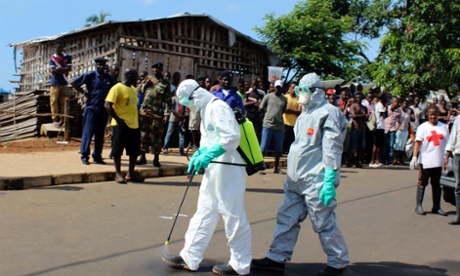
“We feel like a pariah nation,” an NGO worker in Sierra Leone tells my colleague Sam Jones, in a piece excerpted earlier in the blog.
Sierra Leone has been wracked by Ebola cases, with public services pressed for resources and officials stranded around and outside the country. There have been some 2,700 cases of the virus in the country, and nearly 900 deaths.
You can read the full piece here.
Updated
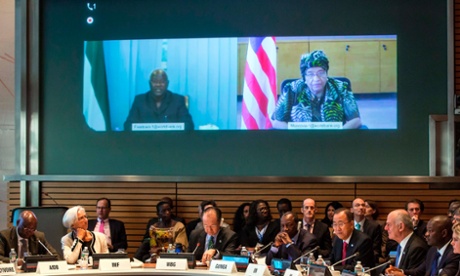
The president of Sierra Leone says containing the virus will require drastic laboratory improvements, my colleague Lisa O’Carroll (@lisaocarroll) relays.
Ernest Bai Koroma has said Ebola test results need to be turned around within four hours, and told a delegation from the Italian-run Emergency Hospital in Freetown the the country is in urgent need laboratories.
We need these facilities today as there is no time to waste.”
“If we can increase our capacity of handling over 500 samples a day, it will be helpful to handle the pressure. Forty-eight hours is not good, as some will get infected while waiting. We should maintain the four hours and work on improving it further.”
Updated
EU countries may screen airport travellers for Ebola, Reuters reports, which would follow actions by the UK and US.
The European Commission, the bloc’s executive body, says it is still weighing up the effectiveness of entry screening, given that travellers are screened on departure from the affected areas and have a low probability of developing infectious symptoms between leaving an African airport and arriving in Europe.
An EU official said one key element of entry screening could be informing arriving passengers of what to do if they later fell ill – notably telling them not to turn up without warning at hospital after developing symptoms of Ebola.
Health ministers will meet Thursday in Brussels to discuss whether the bloc ought to have more uniform screenings.
The effectiveness of screenings has been questioned by experts, as my colleague Jessica Glenza wrote about earlier this month.
CDC guidelines for protective gear could be more careful and guarded yet, according to CNN’s Sanjay Gupta.
Gupta notes that the recommended gear leaves skin exposed, that there’s no “buddy system” for healthcare workers to ensure that colleagues are careful, and that there should likely be more about cleaning your hands. He says that in Guinea, he and healthcare workers would dip their hands in buckets of bleach.
You can watch him try and critique the guidelines here; CDC guidelines are only recommendations, and not standard practice in all US hospitals.
Summary
Here’s a summary of today’s key events so far:
- Another health worker at the Dallas hospital where a man died from Ebola has contracted the virus, officials have said. The person has not been identified yet.
- A series of reports from staff at the Texas Health Presbyterian hospital allege chaotic scenes and poor safety protocols in dealing with infected patients.
- At a press conference the Dallas judge, Clay Jenkins, said more Ebola cases were “a very real possibility”.
- The overwhelming majority of cases continue to be seen in West Africa, with the UN’s World Health Organisation warning that we could soon see 10,000 new cases a week.
-
UN agencies describe increasingly awful situations in West African nations, with the crisis affecting other areas, for example families’ ability to heal themselves.
- Around 4pm UK time Barack Obama is due to hold a video conference about Ebola with David Cameron and three other EU leaders.
Updated
Sam Jones also sends these heartbreaking details from the UN’s World Food Programme about the devastating impact of the Ebola outbreak on some families:
According to John Crisci, the World Food Programme’s emergency co-ordinator in Sierra Leone, the spread of Ebola is making it harder for people to feed their families.
“The average Sierra Leonean family spends anything from 60% to 70% of their income on food and with this crisis, families in highly infected hotspots such as Kenema and Kailahun have lost one of the breadwinners in the family either to Ebola or to unemployment.”
In some areas, says Crisci, families are now spending 80-90% of their income on food and adopting what the WFP calls “severe food coping strategies”: when food becomes the predominant concern, people stop buying medicines, clothes and hygiene products.
With unemployment rising in towns and the countryside as people lose jobs in banks, hotels and restaurants, farmers stop tending their lands and plantation employees shun work that involves large groups, mothers and fathers are beginning to limit what they eat.
“Parents in some areas are now eating one meal a day to try to give two meals to their children,” says Crisci. “When both parents were working and had a steady income, they’d be having three meals a day.”
In response, the WFP is conducting a “no-regrets operation”, opting to bring in and then withdraw excess resources rather than risk failing those in need.
Dry rations of rice, beans, salt, vegetable oil and supercereals for children - supplemented by onions, stock cubes, tea and toothpaste from the Sierra Leonean government - are being delivered to families whose houses have been locked down by the military and police in the hope of halting Ebola’s spread.
“The biggest challenge in this operation is that it’s forever-evolving,” says Crisci. “The number of areas in the country that are being isolated continues to grow. We’re always moving quickly behind the target but we’re now trying to beat it.”
With the food pipeline beginning to open up and the WFP bringing in large shipments this month and next, Crisci believes it will have the capacity to respond to the needs of up to 600,000 people.
But he does not underestimate the scale of the emergency. Last week, while on an assessment mission to a village 45 miles from Freetown that had been placed in isolation, he came across a quarantined house guarded by soldiers.
“Behind them on the patio, covered with a coloured cotton sheet were two sisters, probably about two and nine years old. One was face up and one was face down. Their mother was there on the patio, keeping a distance of couple of metres. She was looking over at them and you could see that she was desperate and hopeless. Her hands were tied and she couldn’t do anything to comfort them. She kept on looking out at the road hoping that the ambulance was coming any time. We intervened heavily but unfortunately one of the little girls passed away. The other sister is in a treatment centre now in Port Loko and we hear the chances are slim.
“If it had been a kid who had broken their leg or bumped their head, we’d have thrown them in the WFP car and run to the hospital; we do it all the time. But in a case like this, we couldn’t do anything. We try to change the world, we try to assist millions of people but here there were these two children just lying there and none of us could do anything except pull every contact we had to get the ministry of health to intervene. You feel like you’re doing a big thing and then you see the two children and their mother. It broke my heart.”
My colleague Sam Jones sends this about the wider social effect of the outbreak in Sierra Leone:
Ebola’s impact on Sierra Leone goes far beyond swamped clinics and closed schools, according to Simitie Lavaly, the executive director at AdvocAid, an NGO that works with women and their children in detention in Sierra Leone.
“Very few lawyers are going to court because it’s not worth their while financially and there are not many judges because a lot of them are stranded outside the country because they went abroad for the high court summer recess. The flights were cancelled and they can’t come back.“The few magistrates who are now sitting don’t hear more than 10 cases a day because the emergency public health declarations say there should not be large gatherings. If you have more cases, you have more people. Before, they’d hear 30 cases a day. Now they’re adjourning cases and they’ve also restricted litigants: it has to be your case and you can’t come with lots of friends and witnesses to support you. Lots of the male prisoners are not in good health and some lawyers are worried about coming across them in the corridors.”
Lavaly says the situation in prisons is also becoming increasingly difficult as people’s cases are adjourned. With visits from family suspended, it is left to the NGOs to bring baby food to mothers detained with young children, and to top up the prisons’ ever-dwindling supplies of chlorine, buckets and gloves.
“We also bring in a bit of cassava for people, because a lot of time they complain that the don’t have enough food,” says Lavaly. “And God forbid, if you get Ebola, your immune system needs the food – not to mention oral rehydration solution. Even without Ebola, there are a lot of malnourished prisoners.”
While it applauds the efforts of those judges and magistrates still managing to do their jobs, AdvocAid wants the police to relieve some of the pressure by dealing with minor offences in the police station rather than clogging up the courts.
But what it most needed, argues Lavaly, is neither a fast-tracked legal process nor a judicial airdrop, but international help in bringing a swift end to the crisis.
“Many of us lived through the war,” she says. “It feels like we are back in that time again, but only it is worse. Then, we could see our enemy but now the enemy is unknown and could be a loved one or close associate. Then, the international community and relatives overseas were sympathetic to our plight and readily gave financial and moral support. Now we feel like a pariah nation, closed from the outside world and with not much sympathy for our plight as no one wants to contract Ebola from us.”
Here’s a photo of the Dallas apartment block where the second healthcare worker to contract Ebola lived. Their home is currently being decontaminated.
My colleague Ben Quinn sends this about the Sierra Leonean population in the UK:
The UK is home to one of the largest Sierra Leonean diasporas outside of Africa – some 16,972 people born in the country were living in Britain at the 2001 census – and they’re certainly getting involved in helping relatives in their homeland.
I’ve been speaking to Londoner Memuna Janneh, who grew up in Sierra Leone, about the charity she has set up to channel resources there (see the audio below).
Her Charity, Lunchbox, has already supplied thousands of meals to people living in a number of communities. Its next goal is to raise £50,000 to supply 50,000 meals to those in hospital in Sierra Leone’s western region, including patients, nurses, doctors, drivers and others.
She talks also about the strong sense of community among the Sierra Leone diaspora in the UK.
“Everybody who is on the front line should at least be able to get meal,” she said.
“The idea is that we free up the Ministry of Health and Sanitisation so that they don’t have to worry about that part of the struggle. This is a very complex situation and we are all battling to get things going.”
The campaign - Lunch Is On Me - launches this Saturday. People are going to be asked to take photographs of their lunch, make a donation to the value of their lunch, post a photograph online and perhaps nominate three other people to do the same.
You can read more about the role of Sierra Leone’s grassroots diaspora here.
Updated
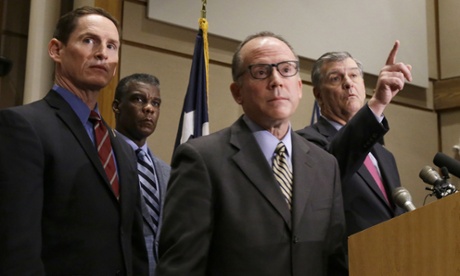
Here’s a photo of the press conference in Dallas earlier.
The Associated Press has more on the accusations by nurses at the Texas Health Presbyterian hospital of lax safety protocol in the handling of Thomas Eric Duncan’s Ebola case. The nurses allege that:
• Duncan was kept in a non-isolated area of the emergency department for several hours, potentially exposing up to seven other patients to Ebola.
• Patients who may have been exposed to Duncan were kept in isolation only for a day before being moved to areas where there were other patients.
• Nurses treating Duncan were also caring for other patients in the hospital.
• Preparation for Ebola at the hospital amounted to little more than an optional seminar for staff.
• In the face of constantly shifting guidelines, nurses were allowed to follow whichever ones they chose.
• Basic principles of infection control were violated by both the hospital’s Infectious Disease Department and CDC officials, the nurses said, with no one picking up hazardous waste “as it piled to the ceiling”.
We have launched a version of this story and you can read it here.
Updated
Ashifa Kassam in Madrid sends me this on Spain’s latest response to the crisis:
Spanish health authorities have begun rolling out a series of improvements after repeated complaints of inadequate training by those on the frontline of fighting Ebola in Spain.
Officials said they would begin offering specialised training courses to health workers on Wednesday. Earlier this week they promised training to anyone who might come in contact with Ebola, from doctors to firefighters, and said they would enlist the help of groups such as Doctors Without Borders in developing the training.
After experts from the European Centre for Disease Prevention and Control raised concerns about the layout of Madrid’s designated hospital for treating Ebola, emergency renovations have begun at the Carlos III Hospital. The tiny change rooms, which sparked concerns over infections when health workers are taking off the protective suits, are being expanded. Video cameras have been installed to catch any slip-ups in protocol.
The improvements come after months of lobbying by health workers. In July, more than 100 nurses brought a complaint before a judge over their “lack of training and knowledge regarding Ebola protocols.” The virus was spreading in Africa, and the nurses worried it would only be a matter of time before it reached Spain. For many of them, training had simply been a 10- or 20-minute demonstration, said the unions representing health workers.
Their worries turned out to be well-found when one month later, the Spanish government decided to repatriate a 75-year-old Ebola patient from Liberia. A second patient was brought in September from Sierra Leone. Both men died days after arriving in Madrid.
After a nurse who attended to both patients became the first known person to contact Ebola outside of west Africa last week, health workers again began lobbying for better training and equipment to fight the virus.
Teresa Romero Ramos remains in stable but serious condition. Another 15 people remain in quarantine in the Carlos III Hospital, none of whom have shown any symptoms of Ebola to-date.
'Chaotic scenes' described at Dallas hospital
The Dallas Morning News reports that staff at the Texas Health Presbyterian hospital have described chaotic scenes when Thomas Eric Duncan was brought in with Ebola:
Nurses at the Dallas hospital where a Liberian man died of Ebola described a confused and chaotic response to his arrival in the emergency room, alleging in a statement on Tuesday that he languished for hours in a room with other patients and that hospital authorities resisted isolating him.
In addition, they said, the nurses tending him had flimsy protective gear and no proper training from hospital administrators.
The allegations, made under unusual circumstances, provided the first detailed portrait of Thomas Eric Duncan’s second trip to the emergency room, where he arrived by ambulance days after doctors had sent him home with a fever, a headache, abdominal pain and a prescription for antibiotics.
Updated
Dallas press conference
City officials in Dallas have been holding a press conference about the new Ebola case. I missed the start of the comments by the city’s judge, Clay Jenkins, but according to local reporters (see tweet below) they are preparing for more possible cases. He said of new cases:
It’s a very real possibility.
Also speaking was Dr Daniel Varga, chief clinical officer of Texas Health Resources, who spoke about whether more could have been done to prevent health workers contracting the virus. He said:
We are a hospital that maybe could have done things differently, with the benefit of hindsight today.
The city’s mayor, Mike Rawlings, said the apartment and car of the second health worker to get the virus were being decontaminated today. The person, who has still not been named, lives alone and does not have any pets, he said. In all, he said, 48 people who were known to have come into contact with Thomas Eric Duncan, the Ebola patient who died, are being monitored. Rawlings said:
The only way we are going to beat this is person by person, moment by
moment, detail by detail … we want to minimise rumours
and maximise facts. We want to deal with facts not fear.
Judge Clay Jenkins says the city is preparing contingencies for more cases of Ebola. "It's a very real possibility".
— Alexa Conomos (@WFAAalexa) October 15, 2014
Updated
The New York Times has a fascinating piece about how the medical charity MSF (Doctors Without Borders), has been at the forefront of trying to combat the outbreak in west Africa. Here’s a taster:
When the Ebola virus began relentlessly spreading in Sierra Leone months ago, government officials made an urgent plea to Doctors Without Borders, all that appeared to stand between the country and chaos.
“They asked us to be everywhere,” recalled Walter Lorenzi, the medical charity’s former coordinator in Sierra Leone. “They didn’t know what to do.”
Not long after, the group opened a treatment center in Kailahun, in eastern Sierra Leone, that was hacked out of the bush in just 12 days. Before opening another center three weeks ago in the southern city of Bo, the organization ran three shifts of workers, 24 hours a day, when daily rain and equipment breakdowns delayed construction.
Updated
Max Miller sends me this on British companies currently seeing a rush in sales of protective medical equipment.
Sales of disease protection items have spiked in the wake of the Ebola outbreak in west Africa, according to one British firm which sells the equipment online.
As many as 10,000 protective suits, 5,000 Ebola kits, and 25,000 hand gel units have been sold in the last three months by SP Services, who are based in London.
While the overwhelming majority of sales have been to groups working in west Africa, the company has been fielding inquiries from concerned members of the public.
Steve Bray, managing director of SP Services said: “We have told those members of the public who have rang up that they do not need to buy anything.”
He added of the firm’s business in general: “Over the last two weeks both orders and enquiries have gone up. This weekend in particular has seen an increase.”
SP Services’ Ebola protection kits include a bio-mask, a clinical waste bag, and a pair of safety goggles, amongst other gear.
Sales have also spiked at survivalgear.co.uk, a UK based company who sell protective gear directly to the public online.
Stuart Hurd, the owner, said: “There has been an increase in sales and general traffic to our website, maybe 50-60% more than usual. A lot of it coincided with the cases in Dallas and Spain.”
He continued: “We have sold the same amount of NBC (Nuclear, Biological, Chemical) suits in the last couple of weeks as we did in the last year.”
They are planning on bringing out an Ebola specific kit in the near future.
Other companies have also been selling items specifically for Ebola protection, with protective suits available on eBay, and WHO-recommended medical face masks cropping up on Amazon.
Updated
My colleague Rebecca Davis has produced this timeline of the current outbreak’s spread, beginning with the death last December of a two-year-old child from a then-unidentified haemorraghic fever in the town of Guéckédou in Guinea.
My colleague Lisa O’Carroll sends this:
More than 2,000 health and logistics workers have volunteered to help the fight against Ebola after a global email campaign.
Avaaz petitioned 39m of its members over five days seeking volunteers with appropriate medical or logistical response and says that more than 363 doctors and nurses have put their names forwards.
These will now be trained by the International Medical Cops and Save the Children and Partners in Health to create a pool of qualified staff for aid agencies to draw from.
Save the Children’s Ebola response leader Matt Wingate said the volunteers “could make all the difference”.
Avaaz’s executive director Ricken Patel said it launched the campaign after relief organisations highlighted the dire shortage of medical workers willing to go to West Africa.
“To overcome Ebola and much more, we need to build a world of care and bravery without borders,” said Patel.
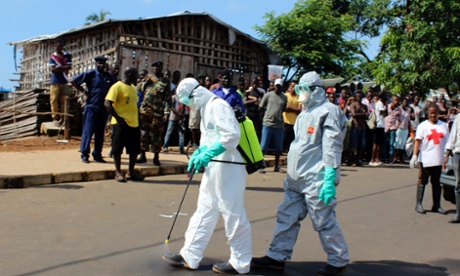
Another photo from the front line of the Ebola crisis, this time in Sierra Leone.
Wednesday’s conference call (see 11.17 update) will also involve the German chancellor, Angela Merkel, the French president, Francois Hollande, and the Italian prime minister, Matteo Renzi, as well as Cameron and Obama.
On Thursday, Cameron is due to chair a meetings of the British government’s Cobra contingencies committee to discussEbola, the Press Association reports.
PA quoted Cameron’s spokesman as saying:
We held an emergency exercise simulating two Ebola cases here at the weekend. We are constantly keeping our measures and procedures under review.
We do believe that they are robust, but it is right that they are tested in the way they were at the weekend.
Public Health England is in touch with their US counterparts and we will of course look at any lessons to be learnt from the US experience. Part of being able to say that we are confident in our procedures is that we test them and are always ready to learn if there are further measures that could be taken.
Updated
Why are nurses and other health workers catching Ebola, despite precautions? In USA Today, Peter Hotez, dean of the National School of Tropical Medicine in Houston, explains.
Ebola, he says, is unusual because the virus replicates very rapidly as the disease becomes more advanced. When people are first infected they are not contagious because levels of the virus in blood are too low to spread the infection.
However, as it develops – and as intensive care nurses get involved – the risk of infection goes up as the virus replicates. Hotez said:
So by the time you are in the end stages of your illness, your liver and your spleen and your kidneys are just teeming with billions of viral particles.
This useful interactive map tracks every outbreak of Ebola from 1976 to this year.
My colleague in Berlin, Philip Oltermann, sends this update:
The body of the Sudanese Ebola victim who died in a German clinic on Monday night has been burnt to stop further spreading of the disease.
Authorities at the clinic in Leipzig took the step to burn the remains of the UN worker, who was a Muslim, even though cremation is not permissible in Islam.
The head of Germany’s central councils of Muslims in Germany told Bild newspaper: “In principle, cremation is not permissible for Muslims. But when the situation requires that the man is burnt, then the protection of the wider population is more important.”
The 56-year-old man had been flown into Germany from Liberia last Thursday, but had succumbed to the disease on Monday night.
Returning to the cases in Texas, the US’s Centers for Disease Control and Prevention (CDC) has conceded that a quicker response to Thomas Eric Duncan’s diagnosis might have prevented the two healthcare workers catching the disease, my colleague Lauren Gambino (@lgamgam) reported last night.
The CDC director, Tom Frieden, said the agency should have sent a larger team to Dallas:
That might have prevented this infection. Ebola is unfamiliar. It’s scary and getting it right is really important because the stakes are so high.
Nina Pham, the nurse who treated Duncan and contracted the virus, received blood plasma from an American, Dr Kent Brantley, who recovered from Ebola earlier this year. In a statement released by the hospital she said she is “doing well”.
Updated
Today is the UN-organised Global Handwashing Day, marking a simple yet hugely effective public health measure which has a particular resonance at the moment.
Sanjay Wijesekera, from the UN children’s charity Unicef, said:
Handwashing with soap is one of the cheapest, most effective ‘vaccines’ against viral diseases, from the seasonal flu, to the common cold.
Our teams on the ground in Sierra Leone, Liberia and Guinea are stressing the importance of handwashing as part of a raft of measures that are needed to halt the spread of Ebola. It is not a magic bullet, but it is a means of additional defence which is cheap and readily available.
It is clear there is no simple fix, and it is going to take a massive international effort to stem the tide of this disease. But it is crucial to get the word out on what measures can be taken now in the hardest hit areas, even as additional help continues to arrive from the outside. Handwashing is one of those measures.
Updated
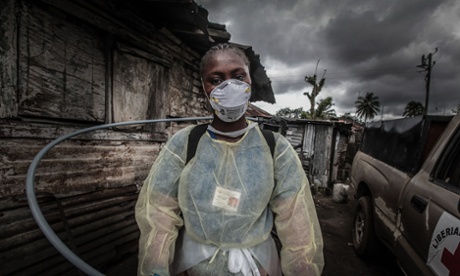
If anyone needed reminding about the devastating impact of the crisis on west Africa, photographs such as these, by photographer Marcus DiPaola, make the situation clear.
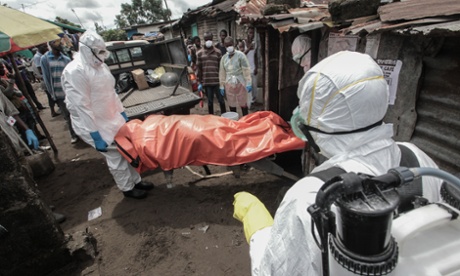
Updated
World leaders' conference call scheduled for 4pm BST
Amid a fast-moving global response to the crisis, Barack Obama will discuss the outbreak with David Cameron and other EU leaders in a video conference call on Wednesday afternoon. Our story on the subject says:
It is understood that the leaders will discuss what further action can be taken to help stop the spread of the virus in west Africa.
They will also discuss the steps that are being taken to screen air passengers arriving in Europe and the EU from west Africa.
Updated
On Tuesday the World Health Organisation warned that the outbreak could see 10,000 new cases a week within two months.
Dr Bruce Aylward, the WHO assistant director-general, said the number of new cases was likely to be between 5,000 and 10,000 a week by early December. While official figures show 4,447 deaths from 8,914 reported cases, Aylward said many deaths are not recorded officially, and it seemed only 30% of people were surviving, particularly in the hardest hit countries of Guinea, Liberia and Sierra Leone.
Second US healthcare worker tests positive for Ebola
The rapid global spread of the Ebola outbreak has been reinforced with the news that a second Texas healthcare worker has tested positive for the virus after having treated the first patient in the US to be diagnosed with the illness.
The worker, as yet unnamed, helped to care for Thomas Eric Duncan, a Liberian man who contracted the disease before arriving in the US and dying at the Texas Health Presbyterian hospital in Dallas last Wednesday. The worker was immediately isolated after reporting a fever on Tuesday, the department of state health services says.
A nurse, 26-year-old Nina Pham, became the first person infected with Ebola in the US while caring for Duncan during much of his 11 days in the hospital.
But while the spread to the US has created headlines, this is, of course, a global issue, with the crisis centred in west Africa, where virtually all the deaths so far recorded have taken place.
Updated