
Hillingdon hospital is the nearest acute healthcare provider to Heathrow airport and could be on the frontline of treating Ebola.
A twelve-hour flight is all that separates us from the virus and, while an outbreak is unlikely, would you take the risk of being unprepared as a nurse?
The answer came on a Saturday morning when I took part in a training exercise jointly organised by Public Health England and Department of Health.
I was working in A&E when I received an emergency bleep from the urgent care centre (UCC) next door.
A patient had walked in complaining of a high fever and vomiting, after returning from a family funeral in Sierra Leone – one of the countries at the centre of the Ebola outbreak.
It is our job to safely isolate and treat patients who “self-present” with symptoms of Ebola, minimising risk to staff and the public. If an ambulance picked up a patient with symptoms they would bypass us and take them directly to the Royal Free hospital as a precautionary measure.
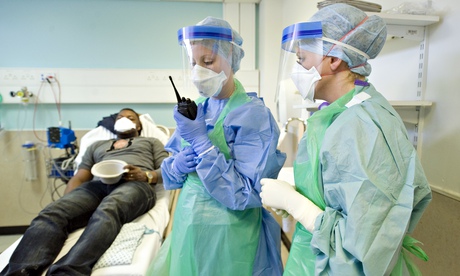
The bleep is my signal to get suited up with the help of a colleague – personal protective equipment (PPE) includes scrubs, a surgical hat and gown, apron, two pairs of gloves, a mask, goggles, face visor, plastic boots and over shoes.
It takes about ten minutes to put the PPE on, after which I proceed to the A&E ramp, where the patient has been given a face mask and asked to wait.
I take the patient through the ambulance entrance to minimise contact with the public and anxiety within the department. We go into a designated side room where we are met by senior house officer Amy Bibby, who is also wearing full PPE.
The room is kitted out with the necessary equipment to take blood, and medication such as intravenous fluids, paracetamol, and anti-emetics if required.
We are now sharing a small room with a virus that would normally be contained and handled in a biosafety level four environment – level three pathogens include rabies and SARs, indicating the importance of minimal contact. Previously, the closest I had come to caring for patients with serious infectious diseases were those with cases of tuberculosis, malaria and possible swine flu.
A colleague knocks on the door and a radio is slid across the floor to enable communication between ourselves and the A&E consultant supporting us outside the room. The consultant liaises with the on-call microbiologist and Royal Free hospital by providing them with details of the patient’s symptoms and history to see if bloods need to be taken or whether we need to transfer them directly to the hospital’s unit for patients with haemorrhagic fever.
We’re less than half an hour into the exercise and the PPE is already unbearably hot. We take the first of several unscheduled breaks and remove our masks. This would be foolhardy in a real life situation – it makes you think how difficult working conditions must be in Africa when wearing this equipment.
I keep physical contact with the patient to a minimum but constantly reassure him. The fact that he is being cared for by staff in PPE must be unnerving – it’s important to remember you are dealing with a person, not just a patient. An electric blood pressure machine, oxygen saturation probe and thermometer are on hand to monitor his condition.
The Royal Free come back and ask us to take a blood sample which is then put in a secure metal container and couriered to Porton Down military science park in Wiltshire for testing.
The “test” comes back positive and he is taken to the Royal Free hospital by the hazardous area response team (HART), highly trained paramedics and ambulance technicians within the London Ambulance Service, for treatment. We stand down after nearly two hours and begin the potentially dangerous task of getting out of our suits.
It’s almost impossible to avoid skin contact with the outside of the suit. It’s important to receive appropriate training as this has been acknowledged as a likely cause of transmission in America.
The key findings of the day include:
• Designated staff on each shift are to handle Ebola cases
• Staff work in 30-minute shifts to combat hot working conditions
• Adequate training for safely putting on/taking off protective suits
• Spray down suits with disinfectant as added precaution
• Isolation room with video/audio link to minimise physical contact
• Clear practical key cards instructing staff in event of a live case
Taking part in this training on a professional level is a valuable experience, and Hillingdon hospitals NHS foundation trust is holding fortnightly meetings to ensure everybody is adequately prepared. The media interest in Ebola is feverish at the moment and it is important to remain calm and focused on what we can do to help.
Are you a member of our online community? Join the Healthcare Professionals Network to receive regular emails and exclusive offers.









.jpg?w=600)



