People with food allergies will be having an easier time eating out. Though small restaurants and food events have been said to struggle with measures against food allergies, an increasing number of them give out information on allergenic substances in dishes and provide alternative menus for those with allergies. An online service where people can search for such information is now available, too.
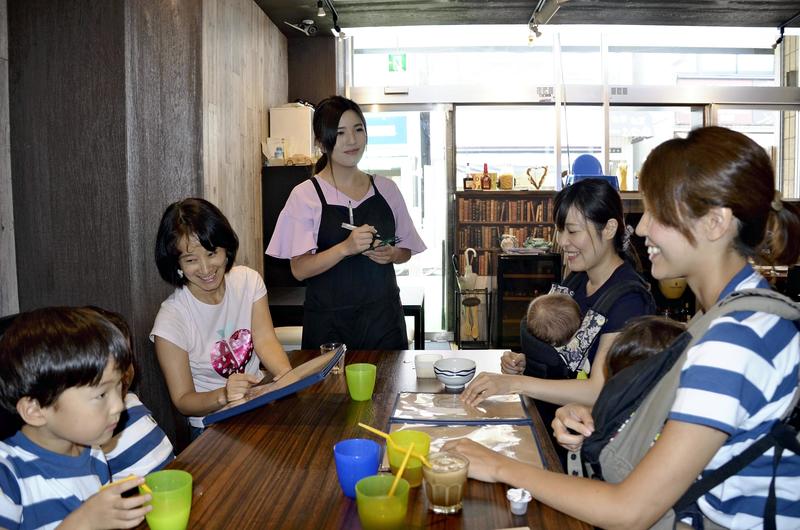
"Do you have any particular food allergies?" a waitress at Il Sole Gao, an Italian restaurant in Setagaya Ward, Tokyo, asked her customers after taking their orders. The menu also recommends those who want special attention because of their food allergies to notify the staff.
"It's a relief that they ask this, since I have children with food allergies," said an office worker from Suginami Ward, Tokyo. She was visiting the restaurant with her three children in early August. "I don't have to worry when eating here," she said.
Il Sole's chef Masahiro Tsuji suggests alternative menus or ingredients to his customers if he learns they have allergies. For instance, if a customer allergic to flour wants to eat the fish dish, which in the original menu is salmon grilled with herbs and bread crumbs, he will grill the fish with herb sauce without using bread crumbs for the customer. He will then explains about the food again before serving it.
Tsuji's service is based on his own experience; he had trouble eating out with his son, who used to have food allergies. That made him try to be as flexible as possible.
Tsuji would also separate the kitchen utensils and thoroughly clean up the kitchen -- which is essential for cooking -- to make sure dishes will be safer.
"Then, all I have to do is to cook with what I can use," explained Tsuji. "I'm simply doing what a chef should do," he said.
Small restaurants catching up
According to a 2017 survey conducted by NH Food Ltd., among the 614 respondents who have food allergies, or know someone close that has them, the largest group, or 49 percent, said they had difficulties when eating out and traveling.
While the Food Labeling Law obliged processed-food makers to indicate on labels if the product includes any of the seven allergenic materials, such as eggs and flour, restaurants are not obliged to do it.
Some major food service chains offer such information or special menus independently. But small restaurants had lagged behind in such initiatives. Today, more of them are trying to answer the need for customers with food allergies.
Check, a Tokyo-based nonprofit organization, started operating an online service called "Rare meshi," or rare food, last year. The website lists 4,800 restaurants that are friendly to those with food allergies, mainly based on word of mouth (http://www.raremeshi.com/).
Event organizers post allergy info
Organizers of festive events are paying attention to this trend, too.
When the Sayama Ike Matsuri in Osakasayama, Osaka Prefecture, was held in April, several of the booths that offered food, such as hot dogs, put up a panel referring to 27 allergenic items. The specific substances were marked if the food contained them. The operators were responding to requests made by a local group named Osakasayama food allergies and atopy circle Smile Smile.
Narumi Tano, the group's leader, said it would help people with allergies to choose the right food. "The most simple activity of eating something you bought together with your friends at an event would be a great experience for a child with food allergies," Tano said.
Tourists' dietary restrictions pose challenge for restaurants
With the number of foreign visitors to Japan rapidly increasing, many are unable to consume alcohol or certain foods such as pork for religious reasons. Others choose to be vegetarians out of concern for animal well-being or for health reasons.
As a result, Japan faces a need to better accommodate such visitors who wish to eat out.
According to the Japan National Tourism Organization, the number of foreigner visitors to Japan exceeded 10 million in 2013, with the figure rising to about 28.69 million in 2017. The government aims to increase the number to 40 million in 2020 when the Tokyo Olympics take place.
About 5 percent of foreign visitors to Japan are vegetarians, according to an estimate by Frembassy, a Tokyo-based firm that helps food companies create vegetarian products. The company runs a website called Vegewel (https://vegewel.com/) that provides information about restaurants for those with dietary restrictions in English and Japanese.
Frembassy Chief Executive Officer Taiki Hari said, "Our website has attracted attention as it has circulated on social media and is viewed by many vegetarians across the world."
In 2015, the Tokyo metropolitan government created a website that helps restaurants in Tokyo prepare menus in multiple languages. The website also displays for public use pictograms of 35 food items that many people cannot consume, such as beef, eggs and alcohol. "We'd like to spread these as tools to increase travelers' satisfaction," a metropolitan government official said.
Read more from The Japan News at https://japannews.yomiuri.co.jp/