Large enterprises run on thousands of decisions every day, some operational, some financial, and many that impact long-term strategy. Yet most organizations still rely on traditional analytics, dashboards, and human intuition to navigate fast-changing market conditions. This gap between “data available” and “decisions needed” is exactly where Decision Intelligence is rising as a business essential.
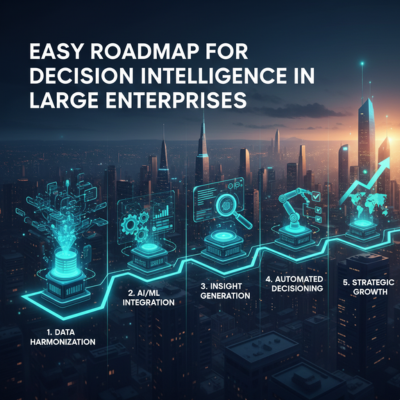
Decision Intelligence (DI) is no longer a futuristic concept. It is now a practical discipline used by leading companies to orchestrate, automate, and optimize decisions across their value chain. And thanks to AI, automation, and data engineering, enterprises can finally move from slow, manual choices to self-improving and autonomous decision systems.
If your organization has been planning a DI journey, here’s a simple, clear, and realistic roadmap that helps you get started, even if the idea feels big.
What Is Decision Intelligence (DI)? A Quick, Simple Definition
Before jumping into the roadmap, let’s keep the meaning straightforward.
Decision Intelligence (DI) is the optimization and orchestration of decision-making across an enterprise.
It uses a mix of:
- Data
- Analytics
- Machine learning
- Automation
- Feedback loops
to understand how decisions are made, evaluate them, and continually improve them.
DI shifts organizations from:
“Humans making decisions with machine support” → “Machines making decisions guided by humans.”
This model allows faster decisions at scale while keeping human oversight intact.
This approach becomes even more powerful when supported by platforms like Aera Technology, which bring real-time insights, autonomous actions, and continuous learning into enterprise decision-making processes.
Why Large Enterprises Need DI Now
Most enterprise challenges today share a common theme: complexity.
- Markets move quickly.
- Customer behavior changes overnight.
- Supply chains face disruptions without warning.
- Manual workflows slow down response times.
- Data grows faster than teams can interpret it.
Decision Intelligence helps companies transform this chaos into clarity. It brings structure to decision-making, ensures speed without compromising accuracy, and creates repeatable, intelligent systems that operate across departments.
Leading organizations are already leveraging DI to stay ahead. With Aera Technology’s Decision Intelligence platform, enterprises gain:
- Real-time visibility into business operations
- Autonomous recommendations or actions
- Consistent decision-making across teams
- Improved cost savings
- Higher operational agility
The Easy Roadmap: How Large Enterprises Can Implement Decision Intelligence
This roadmap breaks the DI journey into clear, achievable steps.
1. Start with a Decision Audit
Every enterprise makes thousands of decisions daily yet most don’t track them.
Begin by answering:
- Which decisions slow down the business?
- Where do delays or bottlenecks happen?
- Which decisions can be standardized?
- Where do small mistakes create large impacts?
- Which decisions rely heavily on guesswork?
Create a list of high-impact decisions across:
- Supply chain
- Procurement
- Finance
- Inventory
- Planning
- Customer operations
This decision inventory becomes your DI foundation.
2. Bring Your Data Together
Decision Intelligence thrives on connected data.
Ensure your organization has:
- A unified view of enterprise data
- Clean, reliable datasets
- Integration across systems like ERP, CRM, SCM, WMS, and finance tools
Most enterprises store critical data in silos, which slows down decisions.
A DI platform like Aera Technology integrates these systems so insights flow effortlessly.
3. Define the Decision Models
Once your data is connected, create decision models that define:
- What the decision is
- What data drives it
- What triggers it
- What constraints apply
- What outcomes matter
Decision models help clarify how automated or semi-automated decisions will work.
4. Apply AI and Automation Carefully
DI is not about replacing people, it's about enhancing their capabilities.
Introduce AI gradually:
- Start with predictions
- Move to recommendations
- Then enable autonomous actions where safe
Platforms like Aera Technology offer continuous learning, so the system becomes smarter with every decision cycle.
This helps enterprises make faster, more accurate choices without overwhelming teams.
5. Test, Monitor, and Improve
Before scaling DI across the enterprise:
- Run pilots in one or two business areas
- Measure accuracy and speed of decisions
- Compare automated vs. manual outcomes
- Review exceptions with human experts
Decision Intelligence systems improve through feedback loops.
The more they learn, the better they perform.
6. Scale Across Functions
Once the initial framework works, scale DI across major business units:
- Procurement
- Supply chain
- Finance
- Inventory management
- Demand planning
- Vendor management
Aera Technology makes scaling easier thanks to:
- Real-time insights
- Autonomous decision-making
- Ability to orchestrate decisions across interconnected teams
DI becomes a core operational capability rather than an isolated project.
Where Aera Technology Fits In the DI Roadmap
Aera Technology plays a pivotal role in helping enterprises operationalize Decision Intelligence.
Here’s why businesses trust Aera:
1. Real-Time Insights
Aera continuously gathers and evaluates enterprise data, delivering instant visibility into what’s happening right now, not last week.
2. Autonomous Decision-Making
The platform can take guided actions or fully autonomous actions, depending on your level of comfort and business need.
3. Continuous Learning
Aera’s DI engine improves with every cycle, refining decision quality and speeding up response time.
4. Cross-Functional Impact
The platform supports critical areas such as:
- Supply chain
- Procurement
- Finance
- Operations
5. True Business Agility
With Aera, enterprises make decisions faster, with higher accuracy, and at a scale that humans alone simply cannot achieve.
Benefits Enterprises See After Implementing DI
Many organizations experience rapid improvements, such as:
- Fewer operational errors
- Faster response to disruptions
- Better financial visibility
- Increased cost savings
- More consistent decisions
- A scalable, intelligent decision layer across the business
Decision Intelligence becomes a competitive advantage, not just a technology upgrade.
Final Thoughts
Implementing Decision Intelligence doesn’t have to be complicated. With the right roadmap and the right technology partner, large enterprises can move from slow, manual decision cycles to smart, automated, feedback-driven systems that elevate their entire business.
Aera Technology makes this transformation achievable. Their Decision Intelligence platform blends AI, automation, and real-time data to help enterprises operate with more confidence, accuracy, and speed.
In a world where decisions define success, DI gives enterprises a future-ready way to lead the market, not just react to it.