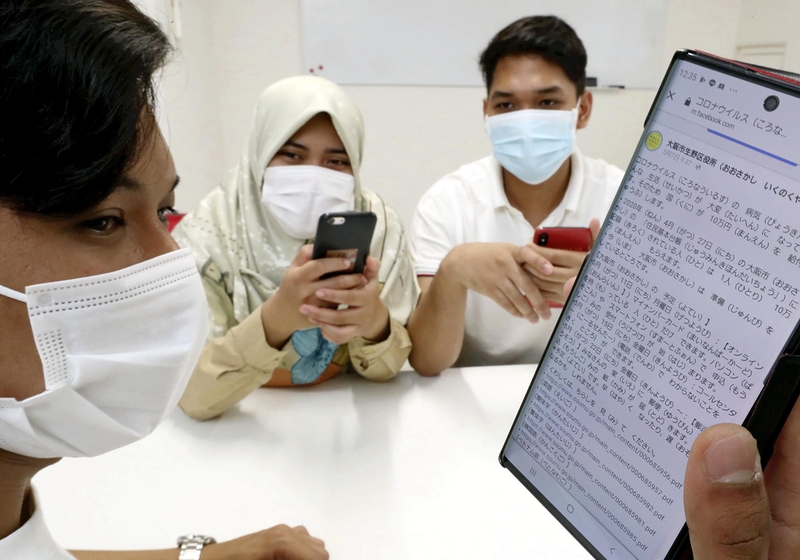
How should public information from governments, which directly affects people's lives and safety, be conveyed to foreigners living in Japan? This is increasingly important as the impact of the new coronavirus spreads.
It may be commonly thought that such information is best conveyed in English, but that's not necessarily the case. Recently, "easy Japanese" has been attracting attention as a common language among foreign residents, and the central government has started drawing up guidelines.
"When I heard the term 'jishuku' (self-restraint), I didn't understand," said a male Indonesian student, 22, who is attending a Japanese language school in Osaka Prefecture.
It's been a year since he came to Japan. He can speak Japanese and read not only hiragana plain characters but also some kanji characters. However, he was troubled by words that he had never heard before, such as "gaishutsu jishuku" (self-restraint from going out.)
A Vietnamese man, 33, attending a vocational school also finds administrative terms extremely difficult to understand. As for the special payment of 100,000 yen to every resident, he said: "I read postings among Vietnamese people on social media that we can receive money. But I don't know what to do."
Amid this situation, there is a movement to use simple Japanese to communicate with foreigners.
In addition to English and Chinese, the Tokyo metropolitan government's website for measures against the new coronavirus infection displays information in "yasashii nihongo" (easy Japanese).
The Sendai Tourism, Convention and International Association publishes government announcements regarding the new coronavirus as well as precautions for daily life in a blog in simple Japanese.
On April 24, during the state of emergency, the Sendai association explained "hankagai" (bustling shopping and entertainment districts) as "areas with lots of restaurants where people drink alcohol" in a blog post to call on people to refrain from eating and drinking at restaurants typically used for entertaining such people as business contacts and guests. The association also puts out information on various benefits provided by local governments in Vietnamese, Nepalese and other languages.
The concept of translating difficult Japanese words into simple Japanese emerged after the Great Hanshin Earthquake in 1995. Having learned from the failure to inform foreigners of evacuation information at that time, a study group at Hirosaki University came up with the idea of yasashii nihongo and called on municipalities to use simple Japanese. One example is changing "hinanjo" (evacuation center) in kanji to "minna ga nigeru tokoro" (a place everybody runs away to) in hiragana.
Easy Japanese is more and more necessary because there has been an increase in the number of foreigners and a diversification of the native languages of foreign residents in recent years. According to the Immigration Services Agency, there were about 2.93 million foreign residents as of the end of December. With people from more than 190 countries and regions, including Vietnam, Nepal and Myanmar, many of them can understand Japanese written in hiragana better than English.
Easy Japanese involves short sentences with a clearly distinguishable subject and verb, no double negatives and no ambiguous expressions such as "osoraku" (perhaps).
Easy Japanese tends to result in fewer mistranslations when non-Japanese use online translation services to translate it into their native languages.
Some local governments, including Tokyo's Kita Ward and Shimane Prefecture, have drawn up their own guidelines for paraphrasing information in easy Japanese, according to the Immigration Services Agency. Other municipalities are calling on the central government to create guidelines.
In February, the agency set up a panel of experts in linguistics. By this summer, the agency plans to compile guidelines containing example sentences using easy Japanese instead of administrative terms, and providing instruction on how to make sentences.
"We have to show consideration by using simple Japanese to make it easy for people to understand. That will be the first step for us to realize cultural differences we haven't been aware of and live together with foreigners," said Isao Iori, a Japanese language education expert who is a professor at Hitotsubashi University's Center for Global Education and Exchange. Iori is also a member of the agency panel.
Read more from The Japan News at https://japannews.yomiuri.co.jp/