Do not write in phonetic “Cod Cockney”, such as “Leave it aht!” or “You’re ’avin’ a laugh ain’tcha?” Never begin a line of dialogue with “Listen … ” or “Look … ” as the actors tend to put these in anyway. The opening gambit “Can I have a word?”, and its even more loaded cousin, “Can I have a quiet word?” are banned.
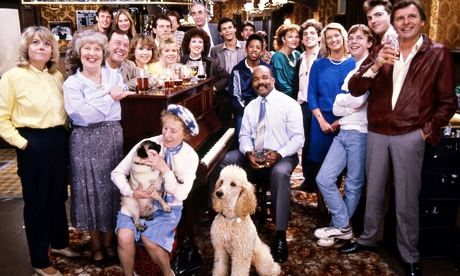
These were among the writers’ commandments handed down to me when I started work on EastEnders, 15 years ago. As the BBC1 soap behemoth celebrates its 30th anniversary, the same eternal questions arise about one of our most beloved cultural institutions: does it still matter? Do its stories still speak to us? Do we still care about who’s sleeping with who, and who’s sleeping with the fishes? And could it ever do the unthinkable and end?
When, as a proud alumnus, I try to address these weighty issues, I find myself instead slipping back into a somewhat stressed reverie about my two and a half years as an EastEnders scriptwriter. It’s a lot to do with the way Albert Square necessarily became my whole world, even though I only visited the set once. I remember vividly the colour-coded script draft system, in which “pinks” went to “blues” as production neared, and “going to white” signalled a sigh of writerly relief, as it meant the rehearsal script – and what might be your fifth or sixth hard-won draft – was signed off. The equally colourful jargon also comes flooding back: “double-banks”, “two-handers”, “cliffs” (actually, these turned out to be cliffhangers, but who has time to use three syllables when the equivalent of a feature film of high-quality continuing drama must be produced every week, all year round, for ever). And I miss the Elstree biscuits.
I wrote 11 individual episodes of EastEnders between 1999 and 2001, during which time I was privileged enough to introduce and kill off two new characters. Admittedly, they were a pair of goldfish called Posh and Becks who came with lovable toerag Billy Mitchell when he first moved into the Square, but you have to take your shreds of influence where you can get them as a soap writer. The first question people used to ask me was: “Which characters do you write for?” The answer: all of them, as writers are allotted individual episodes – it’s like being asked to fill a single slice of never-ending dramatic salami. The second question was: “Can you bring Dirty Den back?” to which I would reply, “No. He’s dead. The Firm shot him, he went into the canal, and his daughter Sharon identified his body and his signet ring in 1990. He ain’t never coming back.” He came back in 2003, of course. The ratings tail will always wag mortality’s dog.
I take no credit for the turn of the millennium being a golden age for primetime BBC1’s everyday story of Walford folk – I was just in the right place at the right time, having put in two intensive years on the Channel 5 soap Family Affairs, whose executive producer had moved to the BBC and encouraged me to try out for EastEnders (a process akin to applying for university, and incumbent on passing a written exam – or, at least, providing sample scenes). In retrospect, it was a thrilling time to be a small cog in the big machine, the solitude of writing offset by regular trips to Elstree studios in Hertfordshire for script meetings, albeit usually in faceless conference rooms, while the exciting stuff involving famous actors was happening elsewhere.
During this period, EastEnders experienced the growing pains of expanding from three to four episodes a week, but still pulled around 16 million people in those days before catch-up, iPlayer and the BBC3 repeats. (These days, with the available audience scattered by multi-platform choice, it’s closer to seven million, putting it neck and neck with its historic ITV rival, Coronation Street.)
When, 5,013 episodes ago, EastEnders made its debut on 19 February 1985 and the corpse of pensioner Reg Cox was discovered after Den, Arthur and Ali kicked down his door (“Stinks in ’ere, dunnit?”), it broke new ground for the BBC, which for years had let commercial TV do soap. To the surprise of some snooty Corporation mandarins, it had displaced Corrie in the ratings within the year, its famous 1986 Den and Angie divorce-papers Christmas episode pulling 30.15 million viewers, a peak not just for the show, but for any British soap. Its trough came in 2004, when a 6.2 million audience against an Emmerdale special led to resignation and reflection.
In 1999, for the first time, Bafta recognised the nation’s defining populist artform with a dedicated Best Soap award (since adjusted to include “Continuing Drama”, for long-runners that aren’t on 52 weeks a year, such as Shameless); it was won by EastEnders in 1999 and 2000, pipped by a resurgent Emmerdale in 2001. It is no surprise that the current incarnation is building up to its birthday with a Dallas-style “Who killed Lucy Beale?” storyline, climaxing next Friday with the now-traditional live episode, which retraces the final moments of the troubled twentysomething’s life. I was lucky enough to be around for “Who shot Phil?” in 2001, a slow-burning whodunit involving bullet-headed hoodlum Phil Mitchell, which pushed ratings up to almost 20 million for the big reveal, the second-most-watched non-sport programme of the decade. (I was nowhere near high enough up the pecking order to write it, but I did fulfil every scriptwriter’s dream when I was given an episode that had Phil on life support.)
Since this creative high, which coincided with the introduction of the popular and enduring Slater family, clans of all ethnic backgrounds have come and gone; some remain, others are best forgotten. EastEnders has constantly had to fight its corner against charges of stereotyping and simply presenting an outmoded view of the East End, but this spirit can produce brilliant, pugilistic television. There’s nothing to stop it clinging to its old traditions for another 30 years. Nor would a more realistic introduction of oligarchs and bankers make it any more entertaining, or, as I suspect, less. EastEnders never ends. Or at least, that’s the fervent hope, rather than the less noble fate of Brookside, Crossroads, Family Affairs, Albion Market and Eldorado.
Not a day goes by in my professional life as a scriptwriter and script editor when I don’t get down on my knees and give thanks to soap opera for all it taught me. It is a commonplace truth that soap has been a peerless training ground for some of our most celebrated TV writers: Jimmy McGovern (Brookside), Frank Cottrell-Boyce (Corrie), Sally Wainwright (The Archers, Corrie), Kay Mellor (Corrie, Brookside), Paul Abbott (Corrie). And yet snobbery still lingers in the idea that soap can only be a stepping stone to more respectable work, and never an end in itself. There was a quorum of around 50 freelance writers at EastEnders when I was there, all with sharp, empathic minds on the job, and none of us dreaming of escape. (For the record, I left when I was offered a five-days-a-week radio show and couldn’t squeeze both in.)
It still angers me that “soap” endures as lazy shorthand for something cheap, garish and artistically suspect; only this week, the Guardian’s film critic Peter Bradshaw denigrated the new Fifty Shades of Grey film by comparing it to “daytime TV soap”, the ultimate put-down in the self-admiring world of cinema. I once got into a below-the-line spat after describing a US cable drama – the kind that has all the money, but only deigns to make 11 episodes a year – as a soap. I meant it objectively, in that the show was a serial drama with multiple storylines running in parallel, as opposed to, say, a case-of-the-week procedural – but it was read as an insult. The truth is that soaps require the same emotional investment in stories about fictional people played by actors as anything else, but only in the case of the soap is that involvement carried over, week after week. This creates a phenomenal responsibility for the producers of continuing drama, and – something all too easily overlooked – requires a military level of planning.
The first thing I learned at EastEnders was the caste system: writers were at the bottom: valued and biscuit-fed, but essentially expendable, or at least replaceable. (I remember one writer far more established than me having an episode taken off him as he’d exceeded the reasonable number of drafts; it was handed to the writing equivalent of the emergency plumber, one of the old guard who’d been around for Dirty Den the first time.) Writers report to a script editor, who marks your work with a red pen and gives it back to you, with notes. The script editors on EastEnders – and I’m sure it’s the same on any soap – were like gods. One individual had to oversee a week of scripts from potentially four different writers and make sure they flowed together. EastEnders script editors worked so hard that their burnout rate was alarming. But the ones with the real power were the storyliners, who plotted the show at least 12 months into the future, with births, marriages, deaths and shootings built in. The glamour may lie with the cast, whose faces graced the cover of Inside Soap magazine, but the real work was done in cloistered secret. Nobody can name a storyliner.
The most common criticism fired at EastEnders is, of course, that it’s gloomy, bleak, depressing. And it is. Coronation Street – which is not averse to a bit of serial killing and drawn-out suffering – remains essentially a piece of northern English music hall. Brookside, in its mid-90s pomp, was still the left-wing community-theatre soap, and it has probably been the soap I’ve watched most religiously in my life. I came too late to write for the great ex-club comic Mike Reid in his prime, whose used car salesman Frank Butcher left in 2000, but writers I met used to love to put words in his mouth, so adept was he at comedy, even in dramatic situations – although his immortal line, “What do you take me for, some kind of pilchard?” was apparently ad-libbed. Another piece of advice the producers gave me when I first passed through the security barrier at Elstree was, “If you put a joke in the script, it will be the first thing that’s cut for timing.”
I managed to smuggle a line from Casablanca (“maybe not today, maybe not tomorrow”) and a subplot involving publican Dan trying to work out the clues of a crossword into my first ever episode, but, again, you have to take your influences where you can get them. Your job is to honour those existing story arcs and make sure you get Peggy from the Vic to the launderette in a realistic amount of time. Numerically, my maiden episode was #931, and it aired to those 16 million loyal people on Monday 21 January 2000. The Observer asked me to mark this momentous occasion and I was not overdramatising when I wrote, of my first ever commissioning meeting: “I arrived first, naturally, and assumed I was in the wrong place. Until I actually see episode 931 on my telly, part of me will assume that I still am.”
I was overdramatising when I said I only killed two goldfish in my time on the Square. One of my final acts in 2001 was to end the short life of Ashley Cotton, Walford villain Nasty Nick’s teenage son. My fingermarks were all over Mark Fowler’s motorbike, whose brake fluid had been drained the night before. It was I who manoeuvred Ashley, after an argument I had instigated, out of the Queen Vic to hop on the bike and rev it up. Off he roared, smashing into the laundrette and landing in a heap. This was the final stage direction I typed before the iconic “Doof! Doof! Doof!”: “DR TRUEMAN EXAMINES ASHLEY’S HEAD – WE SEE FROM HIS EXPRESSION THAT IT’S NOT GOOD.”
Next week’s live episode of EastEnders, when we’ll discover if it was Ian or Jane or Peter or Abi or Max or Bobby who killed Lucy Beale, will be nothing if not torrid and broad. But it will also be a prime example of British TV production that ought to be the envy of the 11-episode Americans with their “season breaks” and subscriber cash. And no, I ain’t ’avin’ a laugh.