The final day of the Victorian election campaign became a scramble for critical bayside seats and a continuing stoush over the biggest issue in this campaign, the East West Link toll road and tunnel.
Two opinion polls indicated Labor was leading 52% to 48% on a two-party preferred basis, although the Age’s Ipsos poll suggested the race had tightened considerably. The previous Ipsos survey had Labor ahead by 56% to 44%. The poll said that if preferences were distributed in the same way they were at the 2010 election, it was a neck-and-neck race at 50% each.
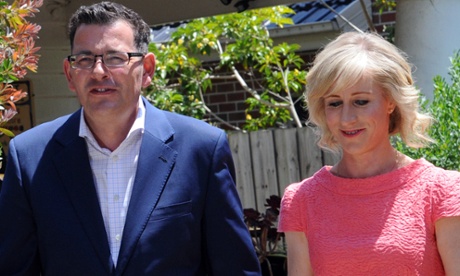
The final message of the premier, Denis Napthine, was that voters had “clear choice” to vote for a government with a “track reckon of sound financial management and a real vision to create 200,000 new jobs over the next five years”. Labor’s leader, Daniel Andrews, said the state needed “powerful change” to create jobs, fix Tafe and improve the ambulance service.
Napthine, 62, and Daniel Andrews, 42, both campaigned in the seat of Bentleigh, one of four so-called sand-belt seats in the south-eastern suburbs that delivered the Coalition victory at the last election. It is held by the government by a margin of just 0.8%.
Napthine was joined by the foreign minister, Julie Bishop, considered the most popular federal face in Victoria. Federal policies such as the $7 GP co-payment and the proposed deregulation of university fees have damaged the government’s chances of re-election, according to the Coalition.
The former prime minister John Howard campaigned in the marginal seat of Yan Yean in Melbourne’s outer suburbs, where the Liberal party said he was forced to take shelter in a shopping centre because of “thuggish” behaviour by firefighter unionists. The government is emphasising Labor’s links to unions, saying an Labor government would be beholden to the radical construction union the CFMEU.
Napthine sought to distance himself from his federal colleagues, saying he was opposed to any GP co-payment for children. The federal government needed to “go back to the drawing board” on the issue and discuss it with the states, he said.
“I think that [for] people who are on low incomes, there should be no cost whatsoever,” he said.
Tony Abbott’s unpopularity in Victoria has been exploited by Labor, which opinion polls have consistently indicated is likely to win. Abbott has visited Victoria three times since the election began but has not campaigned in marginal seats.
When Andrews descended on Bentleigh, he was joined by the federal Labor leader, Bill Shorten, and the former premier Steve Bracks.
Shorten remarked upon Abbott’s absence, saying the prime minister was in “witness protection”. Bishop said it was absolute rubbish that she was campaigning in Melbourne because the prime minister was not welcome.
A Galaxy poll published in the Herald Sun on Friday showed Labor ahead 52% to 48% on a two-party preferred basis, a consistent result for the past three months. It showed Andrews closing in on Napthine as preferred premier, up eight points from a week ago.
But the Galaxy poll had good news for the government, finding 60% of respondents wanted the Coalition’s $17bn East West Link project, the most contentious issue at this election. The contract for the first stage was signed just before the formal campaign began.
But other surveys which give voters a choice about which transport projects should be the priority suggested that people also supported boosting public transport and removing dangerous level crossings.
Andrews said the East West Link process had been “secretive, rushed and botched” and repeated that Labor would not honor contracts if it won the election, despite warnings from the Coalition that ripping up the contracts would leave the state exposed to a $1.1bn compensation bill.
Andrews denied compensation would be needed if contracts were not honored, although the party had contingency plans in case it was required. “I don’t think these contracts are worth the paper they’re written on,” he told ABC radio.
If he won the election, Andrews said: “Next week, I will make fully public every page of the business case to East West, the contract, there’ll be no redactions.”
The government has said these documents are commercial-in-confidence. Andrews also said that if Labor won, it would sit down with the winning bidders to discuss options, including other infrastructure projects, but denied the winning consortium would receive special treatment.
The Coalition, supported by business groups, said the link was critical to ease traffic congestion in Melbourne for residents and freight. It also emphasised that it has made public transport promises, including new trains and trams.
Labor is prioritising public transport projects over the link, as well as removing 50 level crossings, a big issue in Melbourne. Abbott has made clear the $3bn the federal government is providing to the link would not be offered to Labor’s signature Melbourne Metro rail project.
Shorten said Abbott was “a thug of a fellow” for threatening to remove the money if Victorians chose Labor on Saturday.
Labor needs a state-wide swing of 0.9% to win the election. It will be a historic achievement if it does. No Victorian government has lost an election after a single term in office since 1955.
The critical seats are the four sand-belt electorates along the Frankston train line – Frankston, Mordialloc, Carrum and Bentleigh, all held by the government on tight margins. Also important are the regional cities of Ballarat and Geelong and the outer suburban seats of Yan Yean, Monbulk, Eltham and Cranbourne.
Labor is battling the Greens in the inner-city seats of Melbourne, Brunswick, Northcote and Richmond. The Greens are also campaigning strongly in the seat of Prahran, which is held by the Liberal party by 4.4%. It hopes to gain the balance of power in both houses of parliament, although it is considered more likely in the upper house.
The Greens leader, Greg Barber, said he expected a Labor victory on Saturday, and he expected the Greens would do well. Polling indicates the Greens are on about 13% of the vote, up two points from the last election.
“All year, voters have been telling us they don’t want to see a party where one party controls both houses,” he said.
The Palmer United party’s leader, Clive Palmer, was due to campaign in Melbourne but cancelled due to the storm in Queensland.
On Friday, editorials in both the Herald Sun and the Age supported the Coalition’s bid for a second term.