If you know the full form of the acronym MICE, congratulations. You are probably an exhausted event manager whose life is about to get easier.
Recognising the "draconian" number of licenses and permissions involved in organizing MICE events - Meetings, Incentives, Conferences and Exhibitions - and other live in-person shows that send organizers scurrying around like... well... mice in the lead-up, the Event and Entertainment Management Association (EEMA), the apex body for the event industry in India, is working on a website to offer single-window permissions.
Announced at the recent Dubai Expo and greenlit by the I&B ministry, the online application project is being implemented by EEMA in tandem with the National Film Development Corporation's Film Facilitation Office (FFO), which has been granting single-window permissions to both Indian and international filmmakers for a while now in association with a private investment promotion agency set up by the ministry of commerce & industry. To be rolled out in six states, including Himachal Pradesh, Orissa, Gujarat, Maharashtra, Tamil Nadu and Madhya Pradesh, the pilot project entails the appointment of a nodal officer for each state. Once this framework is ready, the FFO - which is studying the nuances of conducting events in India with EEMA - will present it to the state governments.
"Ease of doing business has been quite a neglected area in event management," says Siddhartha Chaturvedi, general secretary, EEMA, referring to the "permissions bottlenecks" that organisers of "large-format concerts and events" have been facing for decades. In Bangalore, a key city for live entertainment shows, he says organisers have to apply to various channels and offices for permissions 45 days in advance. "There is a loop and you are granted permission only about two days prior to the event," says Chaturvedi. While Maharashtra and Delhi had started official single-window permissions for events a while ago, Chaturvedi emphasizes the need for a "nationwide model".
It was at a roundtable organised by the I&B ministry not too long ago that members of EEMA - a body that had long grappled with the question of which ministry its trade falls under - had stated that the business must be considered media and entertainment. "We are a way of broadcasting messages," says Roshan Abbas of EEMA, pointing out the industry's gamut spanning sports ceremonies and summits such as Indo-Africa to nation-branding events and festivals such as the Kumbh Mela.
This diversity in both scale and nature makes consolidating permissions a tricky affair. "Different events require different formats and permissions," says Chaturvedi, highlighting that most permissions come from state governments and district administrations. "And every state has a different process. Sometimes, 40 permissions from departments ranging from traffic to fire are required," says Abbas, referring to the labyrinthine process that won the sympathy of I&B ministry secretary Apurva Chandra during a meet with EEMA.
Riddled with Covid-induced problems such as staff reduction, the industry has limped during the last two years. Many agencies, which were doing corporate events, moved into weddings, says Abbas, who calls the Indian wedding industry "the sunrise sector" of the events business.
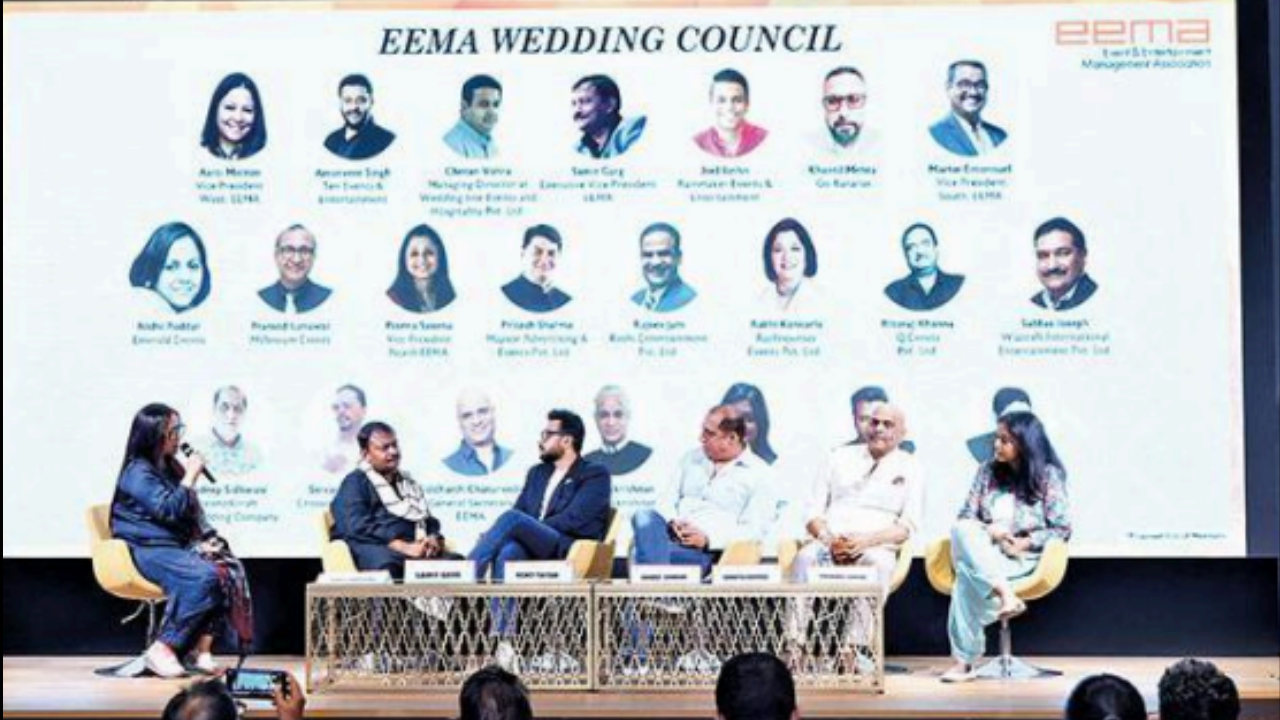
"Seventy per cent of the industry revenue came from weddings during the pandemic," says Chaturvedi, explaining why EEMA has also announced the forming of a wedding council - a separate body for the $50-million industry - that will focus on building better relations with hotel owners, understanding licensing copyright, providing training in the sector and looking after the safety of both guests and staff.
"Hotels, for instance, tend to treat a MICE operator differently from a wedding planner even though the latter is bringing you the same number of room nights," says Abbas, stating why there needs to be a separate team for the wedding sector whose tourism potential makes the I&B ministry hopeful. "India has to be an event-friendly state," says Abbas, citing that five per cent of UAE's GDP comes from events.
Meanwhile, the prospect of navigating fewer windows before events ventilates Dhawal Oza, an event manager whose Excel sheet of pre-event permissions contains a bevy of acronyms such as PPL (public performance limited) and IPRS (Indian Performing Right Society Limited). "Getting all the departments in sync will be a task for EEMA," says Oza, "but the I&B ministry's assurance is certainly a breather".