For years, astronomers have known that Earth has a tiny celestial companion quietly traveling alongside it through space. Now, that mysterious object has finally been seen up close.
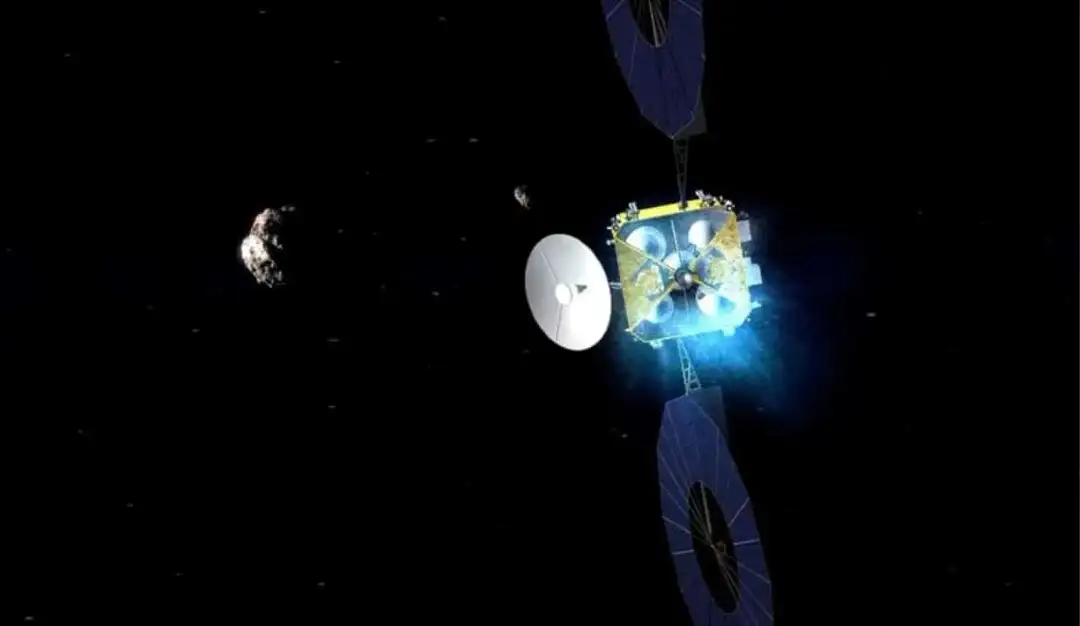
China's Tianwen-2 spacecraft has captured the first-ever close-up image of Kamoʻoalewa (also known as asteroid 2016 HO3), a rare "quasi-satellite" often referred to as Earth's "mini-moon." The historic image marks a major milestone in space exploration and could help scientists answer a fascinating question: Is this asteroid actually a fragment of Earth's Moon?
ALSO READ: Mitch McConnell brain dead, not coming back: Trump aide Laura Loomer
First close-up view after a billion-kilometre journey
The image was taken after Tianwen-2 traveled nearly one billion kilometres through space and approached Kamoʻoalewa to within about 20 kilometres. The spacecraft reached the asteroid in early July and photographed the object from remarkably close range, providing humanity's first detailed look at one of Earth's most unusual cosmic neighbors.
Released by the China National Space Administration (CNSA), the image shows the elongated asteroid that has intrigued scientists since its discovery in 2016. Kamoʻoalewa is estimated to be between 40 and 100 metres wide, making it one of the smallest asteroids ever visited by a spacecraft.
ALSO READ: Who is Graham Platner?
What exactly is Earth's "mini-moon"?
Despite the popular nickname, Kamoʻoalewa is not actually a second moon orbiting Earth.
Instead, it belongs to a rare class of objects known as quasi-satellites. These asteroids orbit the Sun, not Earth, but their orbital paths are synchronized with our planet in a way that keeps them relatively close for long periods. From Earth's perspective, the object appears to circle the planet, creating the illusion of a miniature moon.
Scientists consider Kamoʻoalewa one of the most stable and intriguing quasi-satellites ever discovered. It completes an orbit around the Sun in nearly the same amount of time as Earth, allowing it to remain gravitationally linked to our planet.
Could it be a piece of the Moon?
One of the most exciting aspects of the mission is the possibility that Kamoʻoalewa originated from Earth's Moon.
Previous research suggested that the asteroid's composition resembles weathered lunar material. Its Earth-like orbit, unusual spectral characteristics and proximity to the Earth-Moon system have led some scientists to believe it may have been blasted off the lunar surface during a massive impact event millions of years ago.
If that theory proves correct, Kamoʻoalewa could provide scientists with a rare opportunity to study lunar material without actually landing on the Moon.
Tianwen-2's next mission: Bring samples back to Earth
The close-up photograph is only the beginning of Tianwen-2's scientific work.
The spacecraft is expected to conduct a detailed survey of Kamoʻoalewa, studying its structure, surface features, composition and origin. After completing its observations, Tianwen-2 will attempt to collect asteroid samples and return them to Earth for laboratory analysis.
According to mission plans, scientists hope to retrieve at least 100 grams of material from the asteroid. The sample-return capsule is currently scheduled to arrive on Earth in late 2027.
A mission that goes far beyond one asteroid
Tianwen-2 is one of China's most ambitious deep-space missions to date.
Launched aboard a Long March 3B rocket in May 2025, the spacecraft is designed not only to study Kamoʻoalewa but also to continue its journey after the sample-return phase. Once the collected material is delivered to Earth, the spacecraft will perform a gravity-assist maneuver and head toward comet 311P/PANSTARRS for another round of exploration. The probe is expected to reach the comet in 2035.
Why this image matters
The newly released image represents much more than a technical achievement.
Small near-Earth asteroids preserve clues about the formation and evolution of the Solar System. By studying Kamoʻoalewa up close and returning samples to Earth, researchers hope to gain insights into the history of the Moon, the origins of near-Earth objects and even future planetary defense strategies.
For now, the image offers a rare glimpse of a tiny world that has quietly accompanied Earth through space for centuries—hidden in plain sight until a spacecraft finally came close enough to reveal its secrets.
Key facts about Kamoʻoalewa (2016 HO3)
- Discovered in 2016 by the Pan-STARRS survey in Hawaii.
- Classified as a near-Earth asteroid and quasi-satellite.
- Estimated size: 40–100 metres across.
- Often called Earth's "mini-moon," though it does not orbit Earth directly.
- May be a fragment ejected from the Moon.
- First close-up image captured by China's Tianwen-2 spacecraft in July 2026.
- Sample-return mission aims to bring asteroid material back to Earth in 2027.