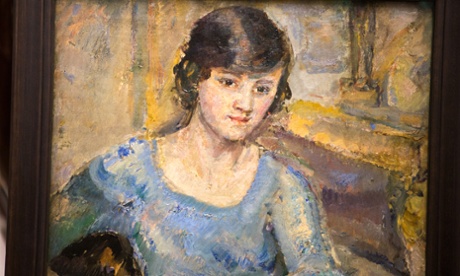
The identity of the meek young woman in the blue dress, with the dreamy expression and downcast eyes was forgotten for more than half a century. In the painting she looked what she was, a dutiful and conventional 17-year-old schoolgirl. But she would grow up to be one of the most famous and respected British sculptors of the 20th century, and a formidable and combative personality.
Newly identified as the earliest known portrait of Barbara Hepworth, painted around 1920 by Ethel Walker, the painting has come back to the UK as a gift from an American collector to the Hepworth Wakefield gallery in the Yorkshire town where the sculptor was born.
“It’s a thrilling acquisition, we have no really good early image of Hepworth and it is a beautiful painting by Ethel Walker, who is now little known but a very interesting artist in her own right. She has come home,” said curator Eleanor Clayton.
The collector, a lover of Walker’s work, bought the large canvas for £1,000 as a portrait of an unknown young woman. Cleaning revealed an early label identifying the sitter as Hepworth. It seemed so unlikely that he contacted Hepworth’s estate for more information.
Comparison with early photographs, before Hepworth adopted a more self-consciously arty hairstyle – described by Clayton as “Princess Leia headphones” – confirmed the identity. Despite this information hugely increasing the painting’s value, the collector presented it as a gift to the gallery named in Hepworth’s honour, which holds a valuable archive of her work.
The portrait will go on display for the first time as the centrepiece of an exhibition on Hepworth in Yorkshire, timed to coincide with a retrospective at Tate Britain.
The Hepworth Wakefield will show very late works, the abstract sculptures in stone, metal and wood that made her internationally famous, many made in her studio at St Ives, where she died aged 72 in a fire probably caused by a cigarette dropped by the chain-smoker artist.
There will be a separate display on her early life, including startling teenage work, and family photographs on display for the first time. The earliest watercolours, many made as gifts for school friends, are technically excellent but utterly conventional, including a ringleted Victorian girl in a straw bonnet which could be the cover of a sentimental period romance.
Another watercolour shows the house at Robin Hood’s Bay that was her family’s holiday home for many years. She recalled creeping out of her attic bedroom at dawn to wander by herself along the shore, collecting pebbles and bits of driftwood, before the rest of the household woke and recalled her to family duties.
Clayton believes the seaside village was where she met the much older Walker, who spent her summers there and her winters in Chelsea. Walker was born in 1861, trained with Walter Sickert and in 1900 became the first female member of the New English Art Club, where she first exhibited the Hepworth portrait.
She was a redoubtable figure, renowned for stopping women in the street and denouncing them for destroying their natural beauty by wearing makeup. Nevertheless, she was known for her sensitive portraits of women, including one of Vanessa Bell, Virginia Woolf’s sister, in the Tate collection.
Hepworth’s soft face-framing hairstyle dates the portrait to around 1920, shortly before she escaped the bonds of dutiful family life. She won a local authority scholarship to the Royal College of Art in London, and adopted bohemian life with gusto.
Clayton hopes the portrait will not only give visitors a striking glimpse of the young Hepworth, but will help revive interest in Walker. “There was an exhibition after her death in 1951, but since then very little. It’s nice to think putting this painting on display will be a double whammy, and could lead to a long overdue reassessment of the quality of Walker’s work too.”
• Hepworth in Yorkshire, Hepworth Wakefield 16 May–6 September.