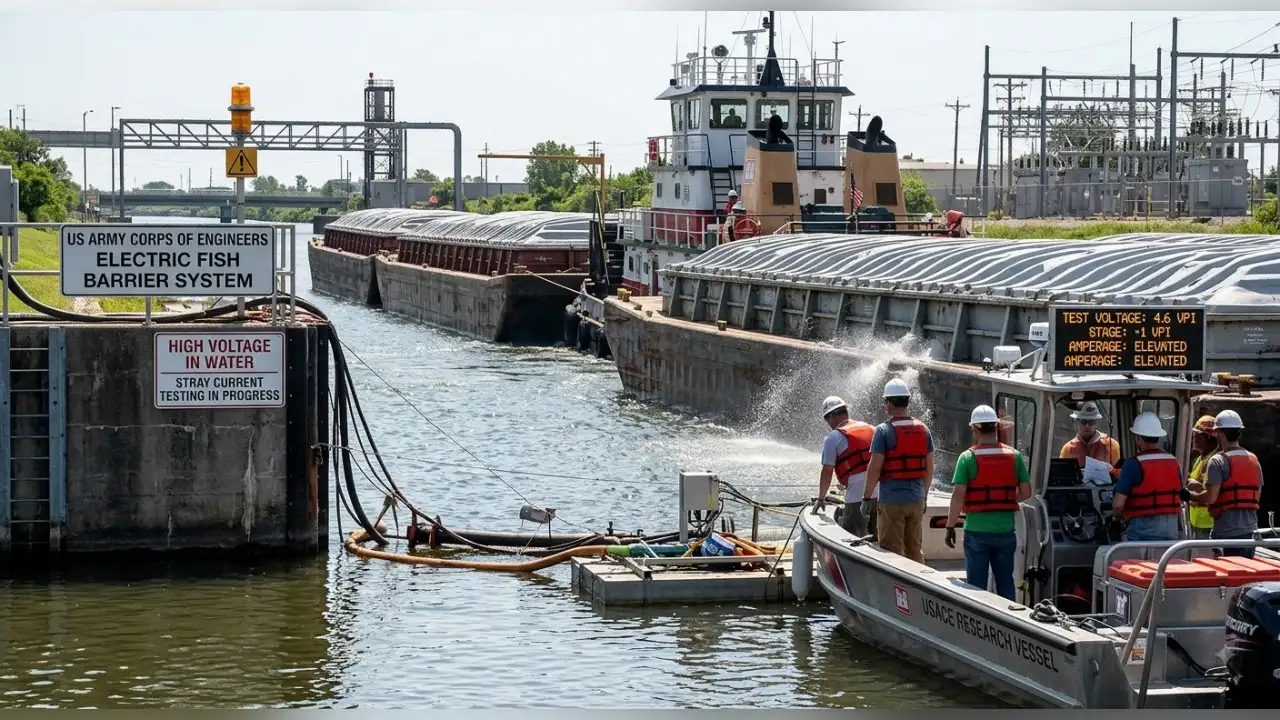
Earlier this year, engineers with the U.S. Army Corps of Engineers tested Chicago's electric fish barrier at electrical levels above its normal operating setting. The goal was to understand what happens if the barrier ever needs to operate at higher electrical levels to stop invasive carp from moving toward the Great Lakes, as per a report.
The Electric Dispersal Barrier System sits on the Chicago Sanitary and Ship Canal in Romeoville, Illinois. It creates an underwater electric field designed to deter invasive fish and direct them back downstream, helping block movement between the Mississippi River Basin and the Great Lakes, as per a USACE report.
During testing, engineers operated the system at three levels: its normal 2.3 volts per inch, followed by elevated settings of 3.7 and 4.6 volts per inch.
The highest setting is not part of normal operations. Instead, it allowed engineers to study how far electrical currents could extend and what that could mean for safety if the barrier ever had to be increased quickly because of an invasive fish threat.
Engineers tested the barrier in winter and summer
The testing took place in two phases, one in February and another in July.
Each phase lasted about two weeks. Testing in both cold and warm weather allowed engineers to collect data under different environmental conditions, including changes that can affect water conductivity and fish activity, as per the USACE report.
During the first week of each phase, crews collected baseline measurements without vessel traffic. The second week introduced commercial barge traffic to see how large vessels affected the electric field and surrounding stray currents.
For the tests, crews used one tugboat pushing five barges, representing the largest vessel configuration typically seen in that section of the canal.
Barges can affect the electrical field
The large barges were an important part of the testing because they can effectively act as an extension of the electrical field.
That means stray electrical current could potentially travel farther than it would under normal operating conditions.
As vessels move through the electric field, barrier operators also have to continuously adjust the voltage to maintain the desired field strength throughout the barrier.
USACE Chicago District Barrier Project Manager Josh Nickel said, "A lot of this effort is about capturing data at operating levels that we don't normally use," adding, "Under normal operations, the barrier runs at 2.3 volts per inch. It creates an underwater electric field that deters invasive fish from advancing and directs them back downstream," as quoted by USACE.
The higher settings allowed engineers to see what could happen if the system had to operate at significantly higher levels.
The 4.6-volt-per-inch test was about safety
The higher electrical settings were not simply about testing the barrier's operating range. Engineers also wanted to understand the safety implications.
At the highest test settings, electrical measurements could extend beyond the existing safety signage. The information collected will help USACE understand what personnel, stakeholders and others working around the site could encounter if the barrier ever needs to operate at higher levels.
Nickel said that "We need to understand exactly what happens from a safety standpoint for our personnel, stakeholders and anyone working in or around the project site," adding, "If we ever have to ramp up operations, we'll already know what to expect," as quoted by USACE.
If officials receive notification of an imminent invasive fish threat, operators may need to increase the barrier's operating level quickly.
The testing gives engineers data on how the system behaves under those elevated conditions.
Crews measured stray currents around the barrier
About 30 people from across the Chicago District supported the testing effort. They came from Operations, Construction, Engineering and Design, Vertical Construction and Geospatial, with additional personnel from the Rock Island District. Crews collected both static and dynamic electrical measurements.
Static measurements were taken at predetermined locations upstream of the barrier before and after barge movements to verify that electrical currents remained within expected limits. Other teams collected dynamic measurements at potential critical locations, documenting the highest levels of stray current observed during testing.
The data will help USACE better understand the system's performance under elevated operating conditions.
The testing also helped prepare for future maintenance
Engineers used the testing period to work on another safety-related task.
The team developed a detailed field map that can support future dive operations during normal barrier conditions. The mapping effort is intended to help establish safer procedures for future maintenance activities.
Nickel explained that having that information available when a future contract is awarded could help the team develop a safe dive plan, protect employees and carry out the work efficiently, as per the USACE.
Storms created another challenge
The weather presented additional challenges during the testing.
Storms temporarily halted field operations and disrupted portions of the barrier's electrical power supply. Crews had to adjust their schedule as conditions changed.
Despite the interruptions, the team completed the work ahead of schedule.