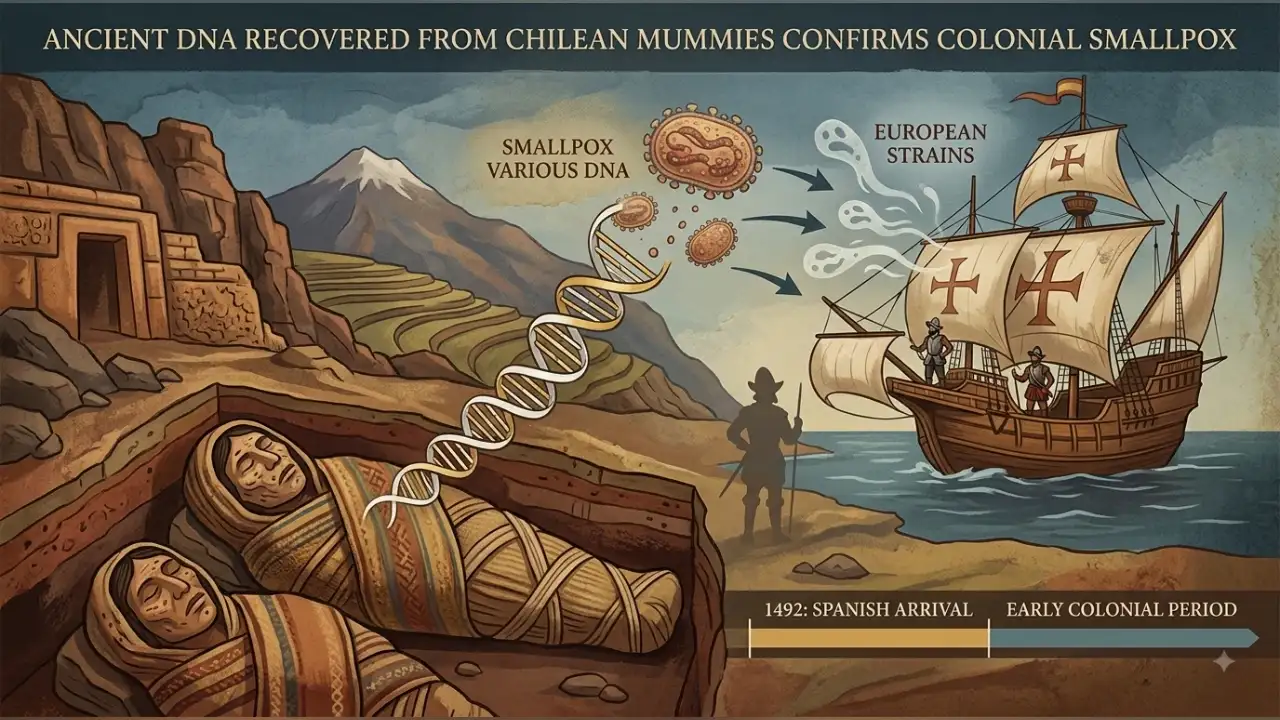
Smallpox DNA discovery : For centuries, historians have suspected that European colonists introduced smallpox to the Americas, where the disease devastated Indigenous communities. Now, scientists say ancient DNA recovered from two Chilean mummies provides the first direct molecular evidence supporting that long-held theory, as per a report.
The findings, published July 30 in Science, come from the naturally mummified remains of two people who were likely Inca and lived during the early Spanish colonial period.
Researchers found fragments of ancient smallpox DNA preserved in their skeletons. The virus was most closely related to European strains, while genetic analysis placed the northern Chile outbreak sometime between 1492 and 1631, as reported by Smithsonian Magazine.
Together, the findings provide direct biological evidence linking a colonial-era smallpox strain in Chile to European strains.
Smallpox DNA was hiding in ancient Chilean remains
The two individuals were buried at an Indigenous archaeological site known as Camarones 9 in what is now northern Chile.
One was a woman between 30 and 35 years old, while the other was a man between 18 and 20. After they died, they were wrapped in blankets and buried alongside various grave goods.
The site was first discovered in 1957, but researchers returned to the remains decades later. They were not initially looking for smallpox.
Scientists were examining bone samples collected in the 1990s in the hope of recovering human DNA that could reveal information about the individuals' ancestry and relationships. They were also searching for tuberculosis DNA.
The human DNA was badly degraded. Instead, the researchers were surprised to find well-preserved smallpox DNA. The samples from the woman and the man were nearly identical, indicating that the same strain was present in both remains.
READ ALSO: What happens when you spray vinegar on your walls? Here's why people recommend it
The DNA filled a gap in the historical record
No historical records indicate that a smallpox epidemic occurred in northern Chile during that period.
But the virus's genetic material had remained preserved in the remains.
Biological anthropologist Constanza de la Fuente Castro of the University of Chile explained that the evidence was essentially biological information that researchers could still recover and read centuries later, as per the Smithsonian Magazine report.
The researchers also found another possible clue at the site. Some of the individuals buried there had skin lesions that had previously been attributed to chronic arsenic exposure.
Smallpox is known for causing deep, painful, pus-filled sores that spread across the body before eventually scabbing over.
The discovery of smallpox DNA therefore raised the possibility that some of the lesions could have been connected to the disease.
The virus was closely related to European strains
The researchers combined the newly recovered Chilean DNA with previously collected samples of the virus from different periods and locations to build a smallpox family tree.
Their analysis suggests that the virus originated roughly 1,500 years ago, likely after jumping from an animal to humans. Scientists still do not know which animal was involved.
The strain found in northern Chile appears to have emerged around 1296 and disappeared sometime before the early 20th century.
Other strains also appear to have gone extinct. Some circulated during the Viking Age, while others, including strains associated with Lithuania in the 1600s and England in the 1700s, appear to have survived for centuries because they are closely related to modern strains.
The virus also changed over time. The researchers found that it lost roughly one or two genes per century. Those adaptations may have made smallpox deadlier to humans over time.
Smallpox devastated Indigenous populations
When smallpox arrived in the Americas, Indigenous communities had no natural immunity to the disease.
The Aztecs, Maya and Inca were among the populations affected as the virus spread across the Americas.
Matthew Ward, a historian at the University of Dundee who was not involved in the study, told NewScientist that smallpox may have killed as many as 95% of the Indigenous population, as per the Smithsonian Magazine report.
Smallpox was only one of the hardships Indigenous communities faced during colonization. Famine, poverty, enslavement and other diseases likely further weakened their ability to withstand outbreaks.
The disease also had consequences beyond the physical suffering it caused.
For some Indigenous people, the spread of smallpox delivered what researchers described as a psychological blow. They saw the disease as a sign that their traditional gods had forsaken them or were powerless against whatever spiritual force they believed was assisting the Spanish invaders.