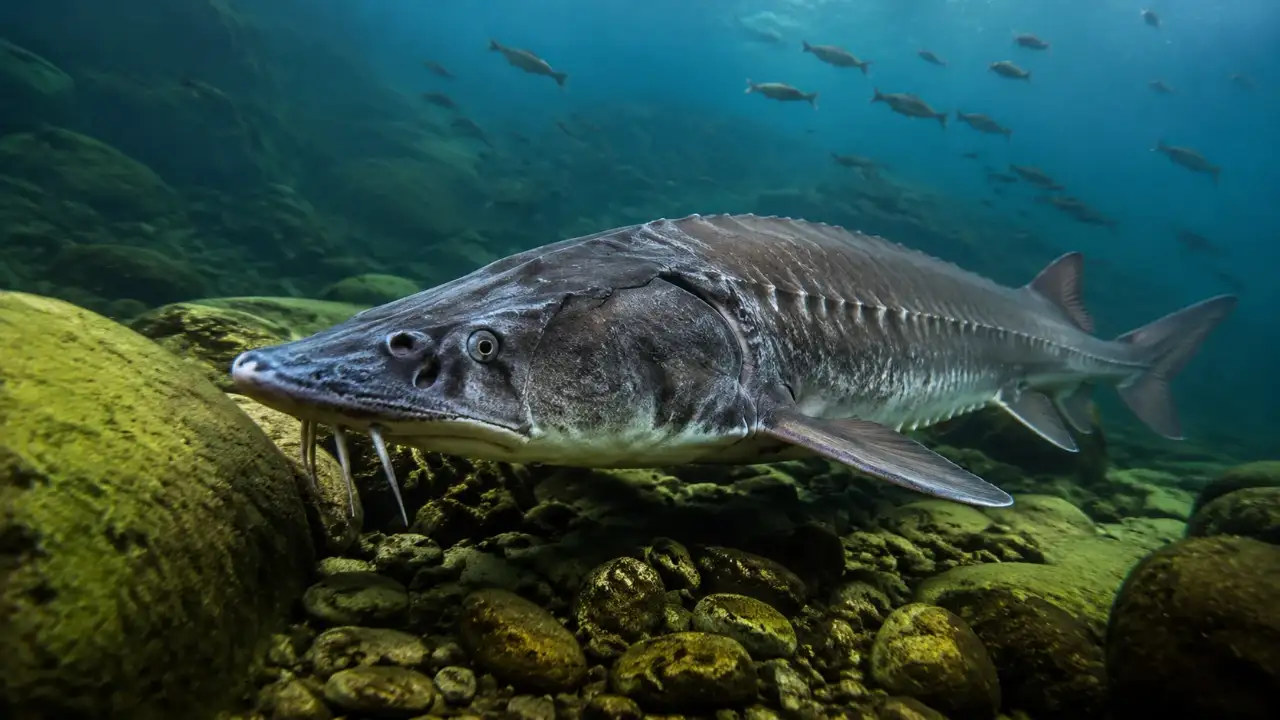
Some of the oldest creatures on Earth are not necessarily found in remote oceans or forests. The Great Lakes are home to lake sturgeon, an ancient freshwater species whose extraordinary lifespan may be much greater than scientists previously understood.
A new study published in the Journal of Fish Biology by researchers from the Michigan Department of Natural Resources and Michigan State University suggests that these fish may commonly reach almost 200 years, while some could be nearly 300 years. The discovery positions lake sturgeon among North America's most exceptionally long-lived freshwater fish and raises fresh questions regarding how scientists determine the ages of ancient aquatic species.
Lake sturgeon may survive for centuries
Lake sturgeon ( Acipenser fulvescens ) are impressive in both size and longevity. Some can reach around six feet in length and weigh almost 100 pounds, while their unusual vocalizations have earned them a reputation for being remarkably loud.
The latest research suggests that these fish may live for two or even three centuries. Their potential longevity places them along with other famously long-lived animals which includes the Greenland shark ( Somniosus microcephalus ).
“Scientists have long recognized that lake sturgeon are among North America’s longest-lived freshwater fish,” Scott Colborne, assistant professor in Michigan State University’s Department of Fisheries and Wildlife, states MSU Today. “But the new study suggests they may live far longer than previously appreciated. These fish are a living connection to history.”
That connection becomes especially striking when considering the historical events that could have happened during a single sturgeon's lifetime.
A fish that could have witnessed centuries of history
The possible age of lake sturgeon becomes even more remarkable when positioned against the timeline of human history. A fish that survives for many centuries could have inhabited the Great Lakes long before many familiar landmarks, institutions and modern states existed.
During such a long lifetime, a single sturgeon could theoretically have been alive when the Seven Years’ War (1756–1763) was taking place and when the Boston Tea Party happened in 1773. Its life could also have overlapped with the Lewis and Clark expedition of 1804–1806 and the formation of Ohio, Michigan, Wisconsin, Illinois and Minnesota as states.
Its possible lifespan could extend through Wisconsin’s first railroad trip between Milwaukee and Waukesha in 1851, the Great Chicago Fire of 1871, the opening of the Chicago Sanitary and Ship Canal in 1900, and even the 1975 sinking of the Edmund Fitzgerald .
That perspective shows just how extraordinary the proposed lifespan of these fish could be.
Why their ages have been difficult to determine
Finding the age of an extremely old fish is not straightforward.
Scientists traditionally estimate the age of lake sturgeon by analyzing growth rings in their fin spines. The method is similar in principle to counting the rings of a tree.
However, older sturgeon grow extremely slowly. As a result, their growth rings can become increasingly challenging to interpret. Researchers suspected that this approach might therefore cause the ages of the oldest fish to be underestimated.
Decades of tracking revealed their slow growth
To investigate the question, Colborne and his colleagues analyzed an extensive collection of long-term records involving tagged lake sturgeon.
The fish had been captured and measured repeatedly over periods of many years. Comparing those measurements allowed researchers to see how gradually the fish continued to grow as they became older.
The team then used mathematical models similar to those used to estimate the lifespan of Greenland sharks.
The results offered a striking picture: many lake sturgeon may live for almost 200 years, with some approaching 300 years.
Rather than depending solely on difficult-to-read growth rings, the researchers were able to use decades of observed growth patterns to build a different picture of the species' potential lifespan.
Indigenous knowledge provides another perspective
The research also led to a significant conversation between modern science and Indigenous knowledge.
While discussing the study with a tribal community member, Colborne learned that some Indigenous communities had long believed lake sturgeon could survive for as long as 400 years.
“That was one of those goosebump moments,” Colborne stated. “Here we were using modern analytical approaches, and they were pointing us toward something that Indigenous communities had long understood, that these fish live incredibly long lives.”
The connection emphasizes the importance of considering various sources of knowledge when studying species with long histories and deep cultural significance.
Scientists still need more evidence
The findings offer compelling evidence that lake sturgeon can live much longer than previously appreciated, but researchers say additional work is required.
Scientists still need to understand the biological mechanisms that allow these fish to age so slowly and survive for such extraordinary periods. The study could also encourage researchers to reconsider the methods used to estimate the ages of other exceptionally long-lived fish.
In particular, improving age-estimation techniques could help scientists determine whether similarly old individuals exist among other aquatic species.
Ancient survivors of the Great Lakes
Lake sturgeon have endured for millions of years, and their potential lifespan makes their survival even more remarkable.
The research indicates that some individuals may live for two or three centuries, allowing a single fish to span enormous periods of human history. Their longevity also reinforces the significance of conservation because a species that takes so long to mature cannot quickly replace lost generations.
The discovery offers a remarkable perspective on the Great Lakes: beneath the surface may be fish whose lives began generations before the world around them looked anything like it does today.
Source : Popular Science
FAQs:
Q1. What are lake sturgeon?
Lake sturgeon are large freshwater fish found in the Great Lakes and other waterways. They are known for their ancient lineage, large size and slow growth.
Q2. How long can lake sturgeon live?
New research suggests that many lake sturgeon may live for around 200 years. Some individuals could potentially approach 300 years.