Chip Kelly won a power struggle this winter, wresting personnel control from Howie Roseman, previously the club’s general manager. Now, it’s what he’s done with that power that’s turning heads.
On Tuesday, ESPN’s Adam Schefter reported the Eagles would trade star running back LeSean McCoy to the Buffalo Bills for linebacker Kiko Alonso. McCoy’s agent, Drew Rosenhaus, said discussions were still ongoing, but many reports say the trade is expected to become official not long after the NFL’s league year begins next Tuesday at 4pm ET.
The move came out of the blue for Philadelphia. Indeed, a Bills source told NFL Network’s Mike Silver the trade went down in 20 minutes. ESPN’s Josina Anderson said McCoy was frustrated by the move; a source told her he expected to be asked to restructure his contract this offseason. NFL observers were also shocked that the Eagles were able to move a player with such a large contract: He counts $11.95m against the salary cap next season.
Chip Kelly, heading into his third season in Philadelphia, has led the Eagles to consecutive 10-6 records. He made the playoffs his first season. He’s been lauded for his up-tempo offense and his forward-thinking ways, but trading LeSean McCoy is a bigger move than giving his players personalized smoothies.
Alonso is an upgrade for the Eagles, but a bit of a gamble. A second-round pick in 2013, Alonso finished with 159 combined tackles his rookie season. The linebacker even picked off four passes and recovered two fumbles; he finished second in the Associated Press NFL Defensive Rookie of the Year voting. But he missed all of last season with a torn ACL suffered last July. If he returns, he should shore up a linebacking corps that also includes Mychal Kendricks – another promising young player. Kelly coached Alonso at the University of Oregon.
Meanwhile, it’s the end of an era for Eagles fans. McCoy was labeled the Eagles’ running back of the future since the team selected him in the second round of the 2009 NFL draft. The Eagles released Brian Westbrook, the team’s previous stud running back, after a 2009 season where Westbrook suffered multiple concussions. McCoy was waiting behind him, having set the Eagles rookie record for rushing yards in a season while filling in at starter. He rushed for 1,080 yards on just 207 carries in 2010, an eye-popping 5.2 yards a carry. He caught 78 passes. Some stats made him look even better: ESPN Stats & Information ranked McCoy the best in the league at facing an eight-man front. He looked poised for stardom.
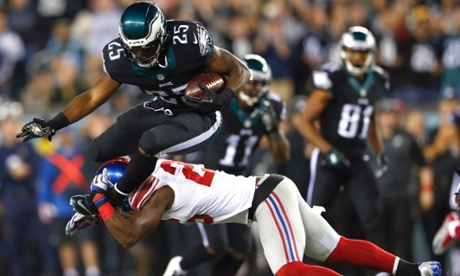
That season wasn’t a fluke. McCoy led the league with 20 total touchdowns in 2011, rushing for 1,309 yards and catching another 48 passes. He was named first-team All-Pro. In just his second year as a starter, he was already one of the best running backs in the league. Players who come up big in games against division rivals earn Philly fan praise, and McCoy did just that. With just a few minutes left in a Sunday night game against the hated Giants, McCoy rushed for a 50-yard score on fourth down. McCoy ran for a career-high 149 yards against the Cowboys – on just 16 carries. He signed a five-year extension with the Eagles that offseason. “I’m just so happy and so excited,” he said.
That he stumbled a bit in 2012 – he rushed for just 840 yards and two touchdowns, though he missed four games with a concussion – could be excused. In the final year of Andy Reid’s tenure as head coach of the Philadelphia Eagles, the team was in disarray for most of the season. The team lost 11 of its last 12 games.
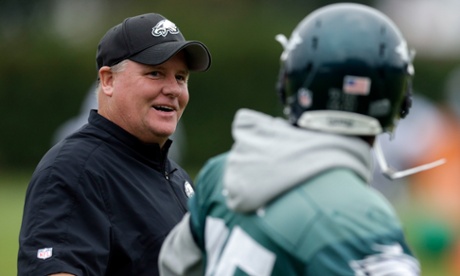
But McCoy returned to form in 2013, rushing for a team-record 1,607 yards and scoring 11 touchdowns. McCoy looked like a great fit for Kelly’s new offense, earning another first team All-Pro nod on a season where he carried the ball 314 times and averaged 5.1 yards a carry. His most memorable game with the Eagles came that year: In a game Philly fans call the Snow Bowl, McCoy rushed for a team-record 217 yards as the Eagles came back to beat the Lions. He scored on runs of 57 and 40 yards in the snow.
He did not repeat his 2013 season last year. But McCoy still rushed for 1,319 yards, third in the NFL, behind an offensive line riddled with injuries. It was decried as his worst year as a starter, however. And many noticed McCoy occasionally had trouble hitting the hole. After the trade, Sports Illustrated’s Peter King said he heard Kelly found McCoy too much of an east-west runner. McCoy struggled to start the season, even as the Eagles opened the year with a 3-1 record. In the Eagles’ three-game December losing streak that knocked the team out of playoff contention, McCoy rushed 55 times for 204 yards – 3.67 yards a carry. New Bills coach Rex Ryan is still getting a running back who has been one of the best in the league in two of the last four seasons, but it’s also a running back with a lot of mileage on the odometer.
And while the move was unexpected, it’s not like it hadn’t been in the realm of possibility. McCoy was from the old Reid regime. The previous offseason, the Eagles summarily released DeSean Jackson – who had caught 82 passes for 1,332 yards and nine touchdowns the year before. Martin Frank, of the News Journal in Delaware, speculated McCoy could be moved back in October. And credit Bleacher Report’s Adam Lefkoe and Chris Simms for prescience: the two discussed whether the Eagles should move on from McCoy just a day before the trade.
The move does seem to show the replaceable nature of NFL running backs. Running backs have the shortest careers in the league, just 3.11 years. On average, those who stay in the league hit a wall at age 27 and see their production decline. McCoy turns 27 in July. “Running backs of this generation picked, well, the wrong generation to be running backs,” ESPN’s Kevin Seifert wrote last year. “Teams want them young, cheap and fresh – and the data makes it difficult to argue their point.”
McCoy has carried the ball 1,461 times. The Eagles still have pass-catching scatback Darren Sproles on the roster, and it seems like they may acquire another RB once free agency starts or in next the upcoming draft. But currently Chris Polk is the top every-down runner on the depth chart: He’s 25, and has carried the ball 57 times in his career.
So Chip Kelly continues to tinker. But unlike Sam Hinkie, the GM of the Philadelphia 76ers’ tear down-and-rebuild strategy, Kelly doesn’t have the luxury of a several-year timeframe to build a winner. The NFL doesn’t work that way. His offense rewrote the Eagles’ record book his first year in charge, and he’s now moved on from the top rusher and receiver on that team. Every coach in the NFL is always under the microscope. Kelly just increased the magnification on the one above him.