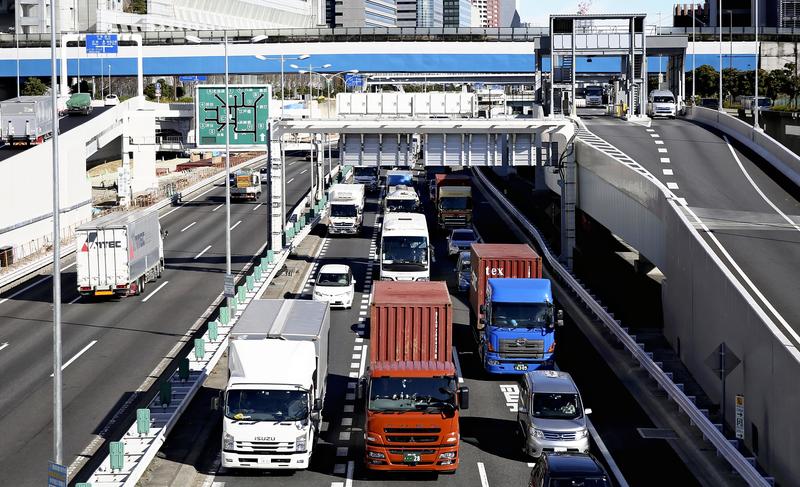
Major online retailing companies have been asked by the Tokyo Organizing Committee for the Olympic and Paralympic Games, the central government and the Tokyo metropolitan government not to hold "summer sales" during the Games from July to September, according to sources.
In an unprecedented move to reduce traffic congestion by reducing the number of trucks used to deliver goods, Tokyo residents will be urged to purchase goods before the event.
30% reduction target
According to an estimate by the organizing committee and the metropolitan government, traffic congestion on the Metropolitan Expressway is expected to be about twice as high as usual during the Tokyo Games, which will draw about 10 million people from around the world.
The organizing committee has set a goal of reducing traffic volume by 30% on the Metropolitan Expressway and by 10% on ordinary roads, as the start of competitions will be delayed if buses carrying athletes get stuck in traffic.
In recent years, the online shopping market has been expanding at a pace ranging from about 8% to 17% a year, reaching about 18 trillion yen in 2018. According to a survey by the Land, Infrastructure, Transport and Tourism Ministry, about 4.26 billion packages were delivered by trucks across the country in fiscal 2018, a record high for the fourth consecutive year.
The metropolitan government and others have asked major online retailers such as Amazon Japan G.K. and Rakuten Inc. not to hold summer sales during the Games. It also asked Yamato Transport Co., Sagawa Express Co. and Japan Post Co., which handle about 90% of all parcel deliveries, to review such services as re-delivery, delivery at specified times, and delivery hours.
The companies are considering how to deal with the request, but some have voiced concerns.
"We can't refuse a request for re-delivery from a customer. We want [the metropolitan government and the others] to thoroughly explain the issue to the public," said a spokesperson for a major home delivery company.
Shop ahead of time
Starting this spring, the central and metropolitan governments will launch a campaign to inform online consumers mostly in Tokyo that delivery services may be partially restricted. The campaign will seek to reduce road traffic from mid-July, when athletes and dignitaries from around the world will start arriving in Japan.
"We want people to buy daily necessities and foods that will keep for a long time before the Olympics, and to refrain from making unnecessary purchases during the Games." an official said.
Sixteen locations will be designated as specific areas where traffic needs to be reduced drastically. They will include the bay area of Tokyo where a number of Game venues will be concentrated, as well as the areas of Shinjuku, Shibuya and Shinagawa.
Briefings for local residents will be organized to inform them of the impact on their daily lives and ask for their cooperation. In addition, companies outside the distribution industry, organizations and residents will be advised not to drive during the Games.
A senior metropolitan government official said: "We're sorry to put a burden on companies and citizens, but we want them to understand it's for the success of the Games. We'll carefully explain the need to reduce traffic and try to minimize the impact on the economy."
Traffic control 'most important'
The organizing committee and the metropolitan government are preparing various measures to deal with the problem, positioning the transportation measures as "top priority for the success of the Tokyo Games."
In addition to encouraging companies in Tokyo to refrain from placing orders for non-urgent goods during the event, companies are urged to shift employees' commuting hours and let employees work outside the office.
As a key to easing traffic congestion, toll fees on the Metropolitan Expressway will be adjusted during certain hours from normal pricing during the Games. The operator plans to charge an additional 1,000 yen for privately owned cars driven between 6 a.m and 10 p.m. in the express network in Tokyo, while halving tolls from midnight to 4 a.m. for all vehicles equipped with the electronic toll collection system.
During the event, the Metropolitan Police Department will impose major traffic controls, such as closing the entrances of expressways depending on the amount of traffic.
Read more from The Japan News at https://japannews.yomiuri.co.jp/