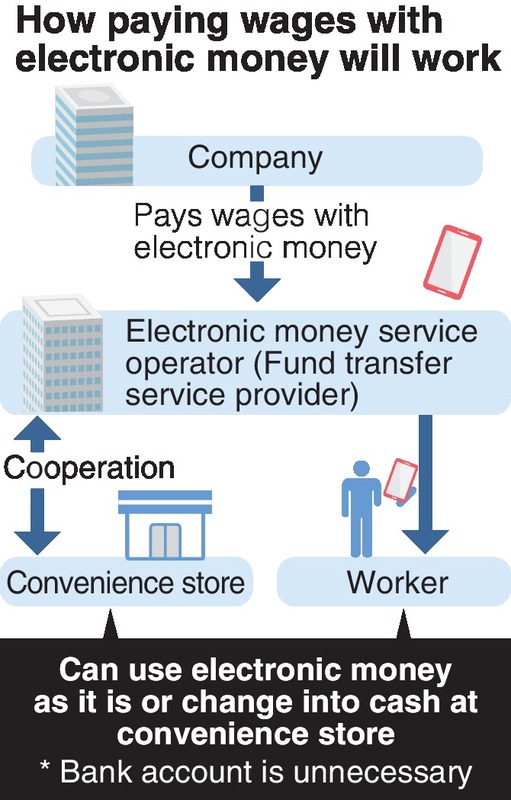
The Health, Labor and Welfare Ministry has decided on a plan to allow companies to pay their workers with electronic money, such as via smartphone apps, expanding the range of wage payment options, which are currently restricted to cash and transfers to bank accounts at financial institutions.
Opening up e-money wage payments is aimed at creating a more accommodating work environment for foreign and other workers who face hurdles in opening bank accounts in Japan.
The Labor Policy Council, an advisory panel to the health, labor and welfare minister, will soon consider the conditions for designating electronic money service operators able to take part in the payment process and other details, and aims to revise relevant ministerial ordinances around this summer.
The Labor Standards Law requires that wages "shall be paid in currency and in full directly to the workers." In principle, wages are paid in cash. However, as an exception, a ministry ordinance allows wages to be transferred to accounts at banks and other financial institutions.
Foreign workers can open a bank account in Japan provided they meet certain conditions, such as being an employee of a company in the nation. However, they must pass strict identification checks, and some banks even require them to be accompanied by a Japanese employee of their company, among other conditions. Small and midsize businesses that are stretched in terms of staff sometimes cannot help foreign workers set up bank accounts, so many apparently pay wages in cash.
Paying cash has sparked concerns that a company might unfairly keep wages low because no records of the payments remain, and it also carries the risk of the money being stolen.
Electronic money payments can be made even without requiring identification, and some services even allow for such money to be changed to cash at automated teller machines at convenience stores.
An increasing number of foreign workers granted the new "specified skills" resident status are expected to come to Japan from this summer and beyond, following the revised Immigration Control and Refugee Recognition Law coming into force in April.
E-money payments have become commonplace overseas, and the labor ministry decided to lift the ban on such transactions for wages due to reasons including a request by the government of Thailand, a nation that sends many technical intern trainees to Japan.
Japanese workers also could receive their wages as electronic money after the ordinance is revised.
Under the ministry's plan, the fund transfer service providers will be designated from among entities that are also electronic money service operators registered with the Financial Services Agency. In preparation for situations in which a worker is unable to receive their wages for reasons such as unauthorized access, the ministry plans to require these providers to take steps such as depositing the same amount of the money they are holding or more with the central government.
Even if a company introduces electronic money payments, a worker can still choose whether to receive their wages this way or in cash or through transfers to a bank account.
Payments in virtual currencies will not be part of the system.
Read more from The Japan News at https://japannews.yomiuri.co.jp/