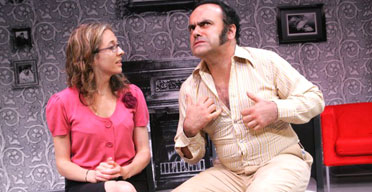
It's a familiar scenario. A couple aren't talking about the problems in their dysfunctional but durable relationship. Then a loose-cannon third party blasts in upon the status quo, catalysing dramatic changes. So what makes Dysfunction any different? Two things. One is that most of the characters (and actors) are deaf. The second is the sympathetic eye with which Steven Webb's production regards their idiosyncrasies and their heartaches.
Deafinitely Theatre aim to make plays that can be enjoyed equally by deaf and hearing audiences. The protagonists of Dysfunction communicate in sign language, and are (usually, but not always) interpreted by downstage voice-over performers. The effect, at least for non-deaf viewers, is a little disorienting. The dialogue, which is spoken rather than performed, comes across as rather flat. And the sign-language performances, because they have to be explicitly directed towards the audience, can seem broad and over-telegraphed.
But Webb largely succeeds in accommodating this dissonance, by creating a world in which characters are apt to break into monologues, or mime their inner lives to musical accompaniment. One sassy choreographed sequence sees frustrated housewife Sue finding erotic uses for her duster. Elsewhere, husband Nigel and his medallion-man brother John dramatise their lifelong bond by enacting the Beatles' When I'm 64.
Dysfunction reveals its big heart in these curious, human details; in Nigel's obsession with his own feet, or neighbour Shelly's glamorous dreams. But Shelly's love for Sunday Sport-reading John is played superficially, in a show that suggests its characters' deep reservoirs of loneliness, without ever really diving in. Webb's spoken script seldom transcends the cliches of communication breakdown. It's still a sweet and engaging play, but I did wonder whether there was nuance in its original idiom, sign language, which, en route to me, got lost in translation.
· Until Saturday. Box office: 0870 429 6883