IN a decision handed down yesterday morning, Justice Wendy Abraham of the Federal Court of Australia fined the construction division of the CFMMEU and two of its organisers a total of $554,600 over a series of 2018 actions in pursuit of an enterprise agreement with Hunter company Wheeler Cranes.
In a statement highlighting the verdict, the Australian Building and Construction Commission noted the "severity of the penalty".
The commission described the Newcastle case as completing a "trilogy of NSW crane cases" it had brought against the union, netting more than $2 million in penalties and legal costs.
The crane case comes a week after Newcastle magistrate Janine Lacy sentenced a 22-year-old Queensland anti-coal protester, Eric Serge Herbert, to 12 months' jail with a non-parole period of six months.
Herbert filmed himself atop a rail locomotive and entered guilty pleas to three "obstruct" or "hinder" charges.
He was released on bail on Thursday, pending an appeal.
The Hunter has seen dozens of such protests over the years. It has not been unusual to see cases proved but with no conviction recorded.
Others have been fined a few hundred dollars.
RELATED READING: Protesters target first trains out of controversial Carmichael mine in Queensland
It is too early to tell whether Herbert's jail sentence is an outlier or the signal of a shift in attitudes toward dissent, at a time, thanks to COVID, when Australians have had their movements restricted in ways previously unknown during peacetime.
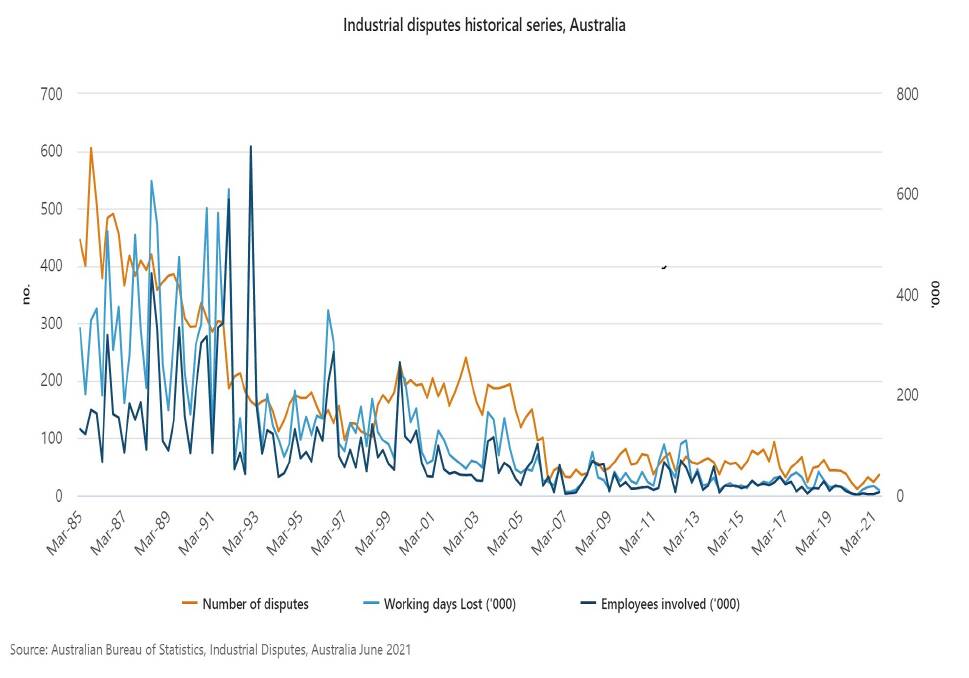
Either way, the demise of the strike as a tool in the traditionally combative world of industrial relations has been evident for some time.
The scale of the decline is clear in the records of industrial disputes kept by the Australian Bureau of Statistics.
In the June quarter of 1985, a workforce of 6.5 million registered 400 strikes involving 122,500 workers losing 202,100 working days.
In the three months to June 30 this year, it was 36 disputes, 6400 employees and 10,500 hours, in a workforce virtually twice the size, at 12.8 million.
Is the system stacked against collective action?
The NSW Teachers Federation might well say so, after the NSW Industrial Relations Commission sided with the NSW government on Monday, ordering a school strike planned for Tuesday to be cancelled.
The union's response will be instructive, and closely watched.
ISSUE: 39,734
The union's response will be instructive, and closely watched.
ISSUE: 39,734