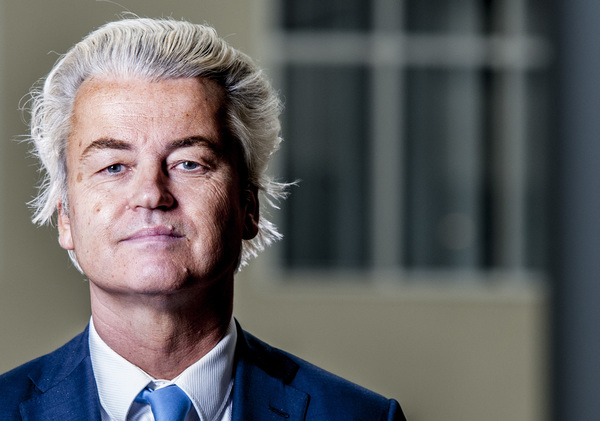
AMSTERDAM _ Dutch populist Geert Wilders may have Donald Trump to blame for the slide in his popularity _ at least in some part.
While Wilders's anti-Islam, anti-European Union Freedom Party, known as PVV in Dutch, has been ahead of Prime Minister Mark Rutte's Liberals for much of the campaign, recent polls show that lead has been evaporating as he has been less visible.
According to the latest Peil.nl poll published Sunday, the Freedom Party would get 25 seats in the 150-seat parliament, down from 29 a week ago, narrowing its lead over the Liberals to just one seat. Wilders had a lead of as many as 12 seats at the start of the year.
"There was a rise shortly after Trump was elected, but now support is falling," said Maurice de Hond, owner and founder of Peil.nl. "Voters have now become negative about the measures taken by President Trump. This could also be a reason for the somewhat weakened position of the PVV."
With just over a week before the March 15 vote, the Dutch election has become a bellwether for ballots in Europe this year that will determine whether the populist surge that delivered the Brexit vote in the U.K. and brought Trump to the White House will spread to Europe's core. Wilders, like his fellow populist leader Marine Le Pen in France _ which votes in presidential elections in April and May _ is running on an anti-immigrant, EU-skeptic platform.
A result of more than 30 seats for Wilders' party "could be seen as evidence that polling institutions again underestimated the true support for anti-establishment parties and increase market participants' worries about the French election," Nordea Markets's chief European analyst Holger Sandte wrote in a report Monday.
Wilders, who wants to stop all Muslim immigration to the Netherlands, has praised Trump's agenda. He has said he would bar immigrants from Muslim countries, close all mosques and ban the Quran. He also wants to withdraw from the EU, close the borders, and spend more on defense and police and less on international aid.
Originally a Liberal, Wilders, known for his bouffant dyed-blond hair, broke away to become an independent lawmaker before setting up the Freedom Party in 2006. His vehement opposition to Islam has led to him being given around-the-clock police protection.
Last year a court found him guilty of inciting discrimination with comments about Moroccan immigrants, but the judges imposed no penalty. He made global headlines at the start of his election campaign by calling some Moroccans "scum."
Wilders' poll slide is also a function of the fractured nature of the Dutch Parliament, which complicates his path to the premiership. No party ever wins a majority in the lower house, making coalitions inevitable. A coalition needs to have the support of parties totaling at least 76 seats to ensure it can get its legislation through.
In 2010, Rutte and the Christian Democrats relied on Wilders for just enough votes to get legislation through Parliament. It lasted just a year and a half. With Wilders withdrawing his support, new elections were called in late 2012.
Now, all the established Dutch parties, including the Liberals and Labor, have ruled out governing with Wilders, leaving him without the necessary allies to form a government. "Most parties have set up a cordon sanitaire around" the Freedom Party, Jesse Groenewegen and Nic Vrieselaar of Rabobank wrote in a paper outlining election scenarios.
That has some voters wondering why they should waste their votes on him, pollster GfK said last month.
"A protest vote for a party that is not going to govern makes little sense," GfK said, citing a participant.
The Freedom Party's election program is just one page long _ with no details on how, for example, he would close the Netherlands' borders or where he would find the funds to spend on defense and police. In contrast, the Liberals have a 102-page manifesto.
What's more, even if Wilders were to form a coalition government, it would be constitutionally hard for him to force a referendum on EU membership since it would require a new bill, and he would need the support of both houses of parliament, Macquarie said in a note last Wednesday.
"Most of the PVV voters don't actually believe that Geert Wilders will offer solutions," Jesse Klaver, leader of the Greens party, said in an interview with Het Financieele Dagblad newspaper published Friday.
With Wilders losing ground, the Dutch election is wide open going into the last full week of campaigning with polls showing five parties are now in contention to place first.
Wilders hasn't helped himself by being less visible in recent weeks, said Peil.nl's de Hond. "He decided not to attend debates, leaving other parties on the right to attract his voters," he said.
Still, no one is writing Wilders off quite yet. Wilders has something that Trump was able to successfully zero-in on, Labor Party member and former Deputy Prime Minister Wouter Bos suggested in a De Tijd interview Saturday.
"He has a flawless sense for where the anger is," Bos said.