2019 is set to mark a crucial turning point for Thailand’s economy, with external headwinds and domestic uncertainties poised to spoil the new year’s celebration by potentially causing a downturn in economic growth.
Although the much-awaited general election will likely usher a boost of confidence and joy among investors and consumers, numerous domestic and external factors promise a bumpy ride for all stakeholders this year.
Thailand's much-touted strength in its economic fundamentals will more than likely be tested by continuous adverse effects from the Sino-US trade disputes, protracted Brexit negotiations and global financial volatility induced by monetary policy tightening and rising interest rates.
On the domestic front, exports and tourism, seen as champions helping to propel economic growth over the past few years, are expected to record a slowdown as downside risks cast a shadow over growth prospects in these lucrative sectors of the Thai economy. Compounding domestic economic woes are high household debt, the uncertain competitiveness of small and medium-sized enterprises (SMEs) and the greying demography.
From financial regulators to chieftains of commerce and exports, here are the thoughts of prominent Thai policymakers on the economic outlook this year.
Veerathai Santiprabhob Governor, Bank of Thailand
With the US-China trade spat dampening global demand and the underlying momentum weakening to some extent, the central bank remains confident that Thailand's economy will continue to grow at its potential in 2019 and the external position is solid.
Although the country's economy is forecast to grow at a slower pace in 2019, it can still expand at close to potential because investment and consumption are gaining speed, Mr Veerathai said.
"It's the first time in a decade when the economy has expanded at 4% for two straight years," he said. "It suggests a stronger economy."
After the country's economy grew at a slower pace of 3.3% year-on-year during the July-to-September quarter and amid the heightening trade row between the world's two biggest economies, the Bank of Thailand in December trimmed its economic GDP forecast to 4.2% growth for 2018 from 4.4% predicted earlier and to 4% this year from 4.2% previously.
The payment-based export growth projection for 2018 was cut to 3.7% from 5.5% predicted in September, while the forecast for this year was kept unchanged at 4.1%.
A public investment delay will also dampen the country's economic expansion.
The central bank cut the growth forecast for state investment in 2018 from 6.1% projected in September to 4.6%, and from 7.7% to 6.6% for this year.
Capital and financial markets' wild swings are apt to continue in 2019, due to the monetary policy normalisation of several central banks.
Eliminating fragility on the domestic front is the central bank's crucial task if it wants to prevent hefty capital outflows, Mr Veerathai said, adding that if foreign investors view Thailand as fragile, the baht will no longer be a safe-haven currency.
Both the state and the private sector globally are experiencing higher leverage, while geopolitical tensions also warrant monitoring, he said, pointing to protests in some European countries and uncertainty surrounding Brexit and the Middle East.
On the domestic front, vulnerabilities are seen in big companies and credit cooperatives, so the central bank is building buffers.
Mr Veerathai said big companies have borrowed cheaply for riskier investments.
Pakorn Peetathawatchai President, Stock Exchange of Thailand
2019 will be another year full of challenges and opportunities. While the US-China trade conflicts and tighter monetary condition may continue to dampen global economic growth and lower investors' risk appetite, there are still opportunities for Thailand due to the country's strong economic fundamentals and future growth potential, Mr Pakorn said.
Here are the Thai capital market's key themes in 2019.
Amid global financial volatility, the Thai economy is well insulated given the country's strong domestic demand, as seen by 5% growth in third-quarter private consumption, low public debt and ample international reserves. A shift towards domestic growth drivers will likely continue, Mr Pakorn said.
Thailand 4.0 and the Eastern Economic Corridor investment plan will help enhance economic growth and investment. S-curve industry investment in advanced automotive, aviation and robotics will bring Thailand to the fourth development era and sustain high economic growth ratios for decades to come.
"With improvement in growth comes investors' confidence and risk appetite, which should help bring [financial] capital that had flown out back into the economy and domestic capital market," Mr Pakorn said.
With strong economic growth anticipated, demand for capital for investment will increase and become more diverse.
"Over the past five years, our market capitalisation has been expanding with new initial public offerings at around 250 billion baht per year," Mr Pakorn said. "We are also expanding into family [businesses], as well as SME and multinational businesses, as there has been growing [listing] demand in recent years, while promoting the 'market of well-being' sectors [consisting of] businesses related to agriculture, commerce, fashion, food and beverages, healthcare, transport and logistics, and tourism and leisure, which are [segments driving] Thailand's competitiveness."
Thailand plays a central role in bridging opportunities for investors and regional markets. The SET has recently launched the first depository receipts on a Vietnamese exchange-traded fund, allowing Thai investors to explore Vietnam's growth potential.
As trade and investment become more interconnected, linking capital markets in Cambodia, Laos, Myanmar, Vietnam and Thailand seems to be the next logical step, Mr Pakorn said.
In future, investors will want a more diverse range of products and mutual funds. Wealth management businesses will have to prepare for the imminent changes.
"At the SET, we have been focusing on analysing investors' data to enhance services and efficiency and meet stakeholders' needs through regulatory reforms, transforming infrastructure into open platforms, as well as promoting investment tools and education," Mr Pakorn said.
"In sum, in 2019 and going forward, all businesses have to transform themselves to catch up with challenging factors that will affect the global economy, such as technological disruption, changing consumer behaviour, demographic and psychographic elements, and globalisation."
The SET's ongoing efforts to bring together all stakeholders will bring stability and benefits to society and the economy in the long run, he said.
Kalin Sarasin Chairman, Thai Chamber of Commerce
Thailand's economy is likely to face myriad thorny challenges in 2019 despite continued growth of more than 4% in 2018, according to Mr Kalin.
"The world's economy is expected to grow on a par with 2018's rate or slightly lower, while the Thai economy is forecast to grow in a range of 4-4.3% in 2019 as projected by the Joint Standing Committee on Commerce, Industry and Banking," Mr Kalin said. "But still, there is a spate of uncertainties and risk factors, be it the international political conflicts, especially among the big markets such as the United States, China, European Union and Britain, stiffer competition in the traditional market, higher oil prices, or relatively low farm prices."
The International Monetary Fund (IMF) in October forecast 3.7% global growth in both 2018 and 2019, down from its July forecast of 3.9% growth for each year.
According to Mr Kalin, other challenges include limitations on infrastructure such as the adequacy or readiness of airports, facilities to accommodate tourist arrivals, effective water management, international trade/customs linkage and the readiness of skilled workers in handling the government's new initiatives such as the government's flagship Eastern Economic Corridor (EEC).
Foreign exchange is another area of concern, he said, citing the baht's strength making Thai products less competitive.
Domestic trade, meanwhile, is also expected to see more intensified competition in 2019, thanks to an anticipated influx of cheap products from China and customers' tendency to buy more products online.
Integration of working processes, seamless collaboration among state agencies and ministries, legal amendments to facilitate trade and ease of doing business, and educational reforms are desperately needed to cater to changing business, industry and trade environments, Mr Kalin said.
He also expressed concerns about the rising policy rate and the single account scheme that could hit the financial liquidity of small and medium-sized enterprises.
Under the single account scheme, the central bank requires banks to consider only financial statements submitted to the Revenue Department when considering SME loans, starting from Jan 1, 2019.
But the requirement has raised concerns that it will lessen access to finance for most SMEs, which tend to use more than one financial account and submit the one with the least value to understate or avoid tax while turning in another for loan applications.
The central bank will reportedly stick to its Jan 1 deadline of requiring banks to use financial accounts submitted by SMEs to the Revenue Department for loan approval, but it may offer a three-year grace period for full compliance.
The Bank of Thailand on Dec 19 raised the policy interest rate for the first time since 2011, by 25 basis points.
The central bank was among the last central banks in Asia to join the rate-hike bandwagon, as high foreign reserves, a current account surplus and subdued inflation allowed the rate to be kept below the US Federal Reserve's benchmark rate to support broad-based economic growth.
The policy rate hit a record low of 1.25% in 2009 after the financial crisis of 2008.
Mr Kalin expects active political campaigns for the long-awaited general election, with new and innovative policies declared by political parties.
"Most importantly, the general election should be run on a transparent, fair and peaceful basis, while the policies announced by the political parties should come up with implementation processes and how to execute them," he said.
Supant Mongkolsuthree Chairman, Federation of Thai Industries
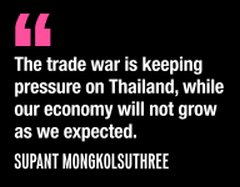
Mr Supant said Thailand's economic outlook is more muted because of the trade war between the US and China.
"The trade war is keeping pressure on Thailand, while our economy will not grow as we expected," he said. "Meanwhile, the extended Brexit will affect the global economy as well."
The FTI forecasts Thai GDP in 2019 to grow by 4-4.3% as the country's export sector expands 5-7%.
The federation sees an inflation range of 0.8-1.2% this year.
"We project that local purchasing power will become weaker than in 2018, due to low prices of farm products," Mr Supant said.
He said all fragile factors will be obstacles to any future investment flows in many countries, including Thailand.
Moreover, the FTI is concerned about the upcycle trend of interest rates in 2019, particularly the effect on small and medium-sized enterprises (SMEs), because each 25-basis-point hike will be on top of their existing financial costs.
SMEs lack the cash flow of large companies, so the difference in interest rate is a more important factor for them.
The rate hike will attract foreign capital inflows, he said. Meanwhile, the Fed's expected decision to increase rates in 2019 will lead to fluctuations in global currencies.
Nonetheless, the FTI sees the country's tourism and export sectors boosting the domestic economy this year.
"Chinese tourists will be back to a normal situation after shrinking in the second half of 2018," Mr Supant said. "The sector still relies on tourists from China, representing the largest group now."
In addition, the planned general election in February will be a positive factor to increase overall investor confidence.
Mr Supant said the FTI will closely monitor the election results and revise economic figures accordingly.
The flagship EEC scheme will be implemented in 2019 after enactment of the 2018 EEC Act.
"Investment, construction and infrastructure are projected to expand very well as business operators gain confidence to expand operations in the corridor," Mr Supant said.
The EEC is a key mechanism for Thailand to overcome the middle-income trap in the next 20 years.
Ghanyapad Tantipipatpong Chairwoman, Thai National Shippers' Council
Although the US and China declared a 90-day halt to new tariffs in early December, the trade war still needs watching in 2019.
The new wrinkles of a Chinese businesswoman arrested in Canada and Canadian businessmen detained in China have laid bare the risks to the global order.
These events may have a negative impact on Thailand's export expansion opportunities, Ms Ghanyapad said.
"Even though it is unforeseeable how long the trade war will be protracted, it is expected that the global trade economy is unlikely to fall into a serious crisis," she said. "To cross over this challenge, Thai exporters should alter their product lines to have an assortment of choices to meet consumers' consumption trend and seek other replacement markets. Close monitoring and a continuous search for new channels to replace products that are able to fulfil the supply chain gap among the two giant countries are essential. This is the strategy of changing the crisis situation into market-expanding opportunities."
According to Ms Ghanyapad, Thai economic growth must brave myriad challenges and obstacles, including the ongoing trade war, volatile foreign exchange, increasing trade barriers, and political and financial troubles in importing countries.
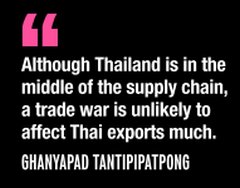
"Although Thailand is in the middle of the supply chain, a trade war is unlikely to affect Thai exports much," she said. "There is only a small proportion of Thai product items that appear in the list of US-China tariff measures, compared with total export items from Thailand. Anyway, business operators shall prepare for a flexible business plan, especially for financial reserves and cash flow management to handle either a positive or negative situation that might occur in the future."
One more key issue is preventing products from being dumping from the US or China onto Thailand's domestic market, Ms Ghanyapad said.
The image of the completely democratic system of Thailand will unlock trade conditions in some countries and make existing trade partners feel more comfortable, she said. These will encourage Thai business operators to be more proactive in trade.
"Investor and consumer confidence in the political situation after the general election in Thailand is the key factor, as well as a number of world situations," she said.
"Nonetheless, against all odds, the Thai economy still has structural problems that need to be addressed, such as the shortage of skilled labour, the ageing society and an increase in many new laws that reduce the competitiveness of the private sector. The world economy, which is still fluctuating from trade wars, may lead to sluggish trade. These challenges are likely to affect overall companies' capacity building."
Sign up to read this article
Read news from 100’s of titles, curated specifically for you.