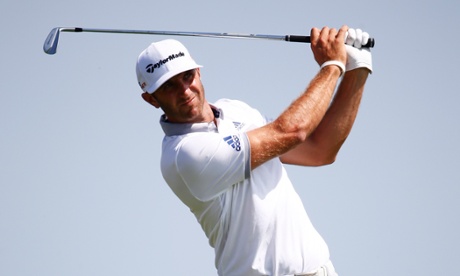
Whatever accusations can be thrown towards Dustin Johnson, and there has never been a shortage of them, no one can legitimately claim recurring failure has dampened his appetite for success. Time and again Johnson has fallen short on golf’s biggest stages; time and again, like the wannabe street-fighting drunk on a Saturday night, he comes back for more. For all the demons that must haunt the Johnson mind, he is not scared of tournament prominence.
“I can’t do anything about the past. But I can take care of today,” is a highly appropriate Johnson motto. Perhaps the wounding experiences which recur with astonishing regularity spur Johnson on far more than he cares to admit. Back in 1992, when finally claiming the US Open, Tom Kite famously admitted to “lying to the public for years” about being nonplussed by an inability to convert major chances. Having done it, Kite could open up on the extent of his psychological turmoil.
So here we are again. At Whistling Straits, the 2010 venue for one of Johnson’s most painful stumbles, he has shot to instant prominence at the 97th US PGA Championship. Johnson’s opening round of 66 endorsed every theory about this venue suiting long drivers. More pertinently, it highlighted the 31-year-old’s hunger to end his major drought, thereby turning tales of woe into something replicating his immense level of natural talent.
Johnson was afforded the easier of day one conditions. Only through the closing stretches of his morning round, before the likes of Rory McIlroy and Jordan Spieth took to the course, did the wind properly whip up. Still, Johnson’s touch was flawless during an opening nine of 32. His only dropped shot of the day came at the 3rd, his 12th, but was instantly rectified by a birdie. Johnson is a combined 22 under for his last six opening major rounds.
The key question, then, concerns what happens next. When, sceptics will ask, precisely will the wobble arrive? There would be a temptation to fast forward to the final round, so often the backdrop for Johnson troubles, but for events at last month’s Open championship. There, he established himself as the man to catch when backing up an opening 65 with a 69. An unforeseen St Andrews struggle followed as Johnson carded back-to-back 75s for a share of 49th place.
Johnson need not look far for danger. Jason Day, another man looking to shake off a nearly-man tag, reached five under par with four holes to play. The Australian handed a shot back to the course but still has cause to be content. Matt Kuchar matched Day’s 68.
Justin Rose recovered admirably from a position of two over after only four holes to produce a 69. Afterwards, the Englishman pointed to the value of remaining under the radar.
“That’s the perfect start, really,” Rose said. “I think obviously when you go and shoot seven, eight, nine under par in a major in the first round, it’s a lot of pressure to absorb for the rest of the week because you’re in contention.
“And I feel like that was a great start for me after being two over and it’s a platform on which I can build now for the rest of the week. You can never win it on Thursday, you can only lose it. That’s a good job done today.
“You have got to be resilient to win these tournaments. So whatever happens at the beginning or middle of the week, you have got to suck it up, forget that and realise that you’re not the only one making that mistake.”
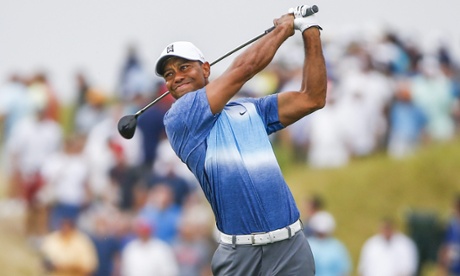
Between 1997 and 2013, Tiger Woods missed only three major championship cuts. Barring a fine recovery on Friday, he will make it three missed major cuts in a row. Woods had birdie chances on each of his first five holes and converted none, an ominous sign from which the 39-year-old never recovered. He left putt after putt short of the hole, triggering curse after curse.
Woods signed for a 75, three over par, and cut an increasingly disconsolate figure. Martin Kaymer, one of Woods’s partners, fared better in opening with a 70 but double-bogeyed his final hole to rather ruin his lunch. The third member of that group, Keegan Bradley, slipped to a 76.
The sad thing for Woods is, his woes are as increasingly irrelevant as they are predictable. Johnson, on the other hand, is seeking to buck a trend.