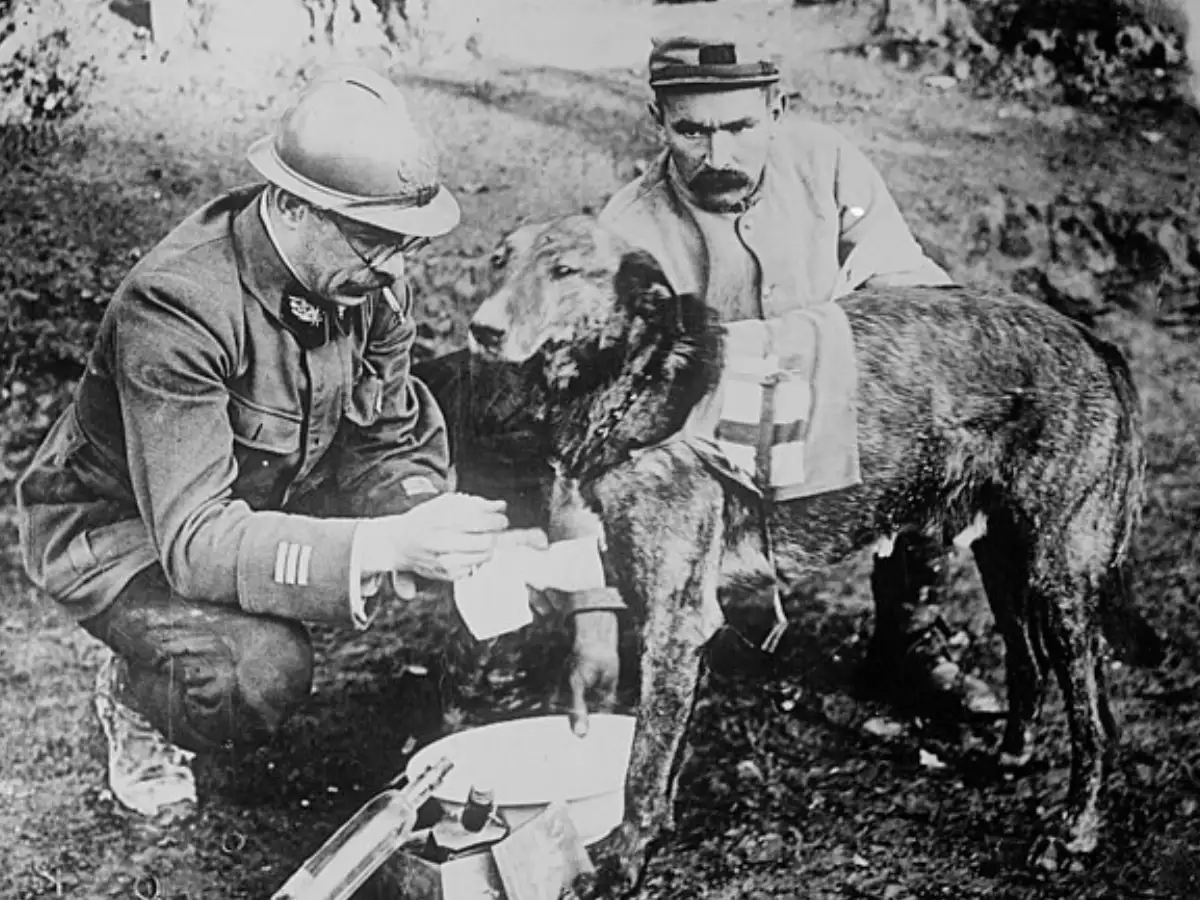
Long before the term “service dog” was even a thing, dogs were already putting their lives on the line in some of the most deadly battlefields in human history. In World War I, a special breed of trained dogs, mercy dogs, or ambulance dogs, did something no soldier, medic, or stretcher-bearer could be counted on to do: they sniffed out the wounded in the dark, crawled through mud and gunfire, and refused to leave the dying alone.
It’s one of the war’s most moving chapters, and most people have never heard of it.
What was a mercy dog?
Mercy dogs, also known as casualty dogs or Red Cross dogs, were trained to roam battlefields after heavy combat to locate injured soldiers who had been left behind. They were German Shepherds, Boxers, Dobermans, Airedales, breeds that had been chosen for intelligence, endurance, and loyalty.
The dogs were all wearing Red Cross vests, and each carried a small saddlebag containing first-aid supplies, water, and liquor. A wounded soldier who could still walk would take a dose from the bag, then follow the dog to safety. Those too badly wounded to move would tear off a piece of uniform, a glove, a cap, a scrap of cloth, and the dog would bring it back to the handlers as a signal. Then it would return and direct a stretcher team right to the man.
In WWI, as many as 20,000 dogs served in front-line roles, with an estimated 10,000 of those working specifically as mercy dogs. They are credited with saving thousands of lives, at least 2000 in France alone, and some 4000 wounded German soldiers.
The training was extraordinary
They were not simply obedient dogs performing tricks. Their training was sophisticated in a way that still impresses today. They had been told to look only at the living one and to ignore the dead body. They got to know the enemy soldiers and kept out of their way. They were trained to freeze or flatten out when they came under enemy fire, basically play dead to live.
Animals, including dogs, filled gaps that human soldiers simply couldn’t, and played an irreplaceable role in WWI operations, Jennifer Nalewicki writes for Smithsonian Magazine. Mercy dogs, in particular, worked under conditions a human medic could never have safely worked in, particularly at night or in heavy brush.
One French soldier, lying beneath a heap of corpses and too wounded to call out for help, felt what he described as warm, wet kisses on his face. It was his regiment’s mercy dog. The soldier managed to pat the animal, and the dog trotted away, coming back shortly after with an ambulance team. He survived. Almost certainly, he wouldn’t have without the dog.
A French dog named Captain found 30 wounded men in a day. Another, named Prusco, during one engagement found more than a hundred soldiers, many of whom he dragged to shelter himself.
They didn't just save lives; they stayed with the dying
What mercy dogs did when a soldier’s injuries were fatal might be the devastating part of this story. They were trained to stay put. To lie beside men who were dying in no man's land, far away from their families, far away from anything familiar, so that those men wouldn't die alone.
There is something about that fact which cuts through the distance of a century.
The bond between man and dog runs deep, and never was it more apparent than in the trenches. A 2019 study published in Frontiers in Veterinary Science found that the bond between military veterans and their service dogs is a measurable, meaningful force, one that positively impacts mental health outcomes for veterans with PTSD. The idea that dogs are naturally inclined to comfort humans in distress is not just folklore. It's real, and it was real a hundred years ago too.
Why this story matters for Americans today
The U.S. didn’t have a formal military working-dog program during WWI. American troops just copied their British and French counterparts. That quickly changed. In 1942, the U.S. Army started its own military dog training program, partly based on lessons learned in WWI. Today, American military working dogs serve in Afghanistan, Iraq, and beyond, and the country even has a National War Dog Cemetery at Naval Base Guam.
The most famous American dog of the war is likely Sergeant Stubby, a stray bull terrier who became the most decorated war dog of WWI and whose preserved remains are on display at the Smithsonian National Museum of American History. But the mercy dogs, most of them anonymous, saved many more lives.
They asked for nothing. They were given nothing but a vest and a purpose, and they showed up anyway, each time.
That is the kind of loyalty that deserves to be remembered.