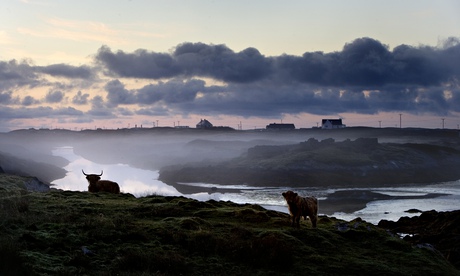
A mile away, where the land meets the sea, the blue tractor was seen again this morning making its way along the sandy track that runs behind the dunes.
Every few days, through everything the weather has thrown at the island, it’s been out there ensuring there is silage available for the cattle that are wintering out on the machair.
Where the cattle have congregated the state of the land tells a story. Pocked ground and masses of old droppings show where the animals repeatedly took what shelter they could find from the savage gales by standing in the lee of the dunes.
Two circular areas of churned, muddy soil reveal the original sites of the metal cages around which the cattle stood to feed on the silage they contained.
The effect of their repeated trampling is a more robust and far larger version of the series of installations made by the sculptor and landscape artist Andy Goldsworthy‚ with the assistance of several sheep.
Placing a mineral lick in the centre of a stretched canvas, he recorded the animals’ comings and goings in the form of their muddy hoofprints and other, more personal, leavings.
After several days, the lick was removed to reveal a circle of unblemished white in the centre of a textural pattern of varied browns.
Around the new feeding site for the cattle, the ground is still fresh and unmarked. There is a fresh delivery of silage in the cage and the animals stand round it pulling nutritious mouthfuls free from the compressed bale. About their feet rock doves forage for fallen grain.
At my approach the birds take off in a noisy clatter of wings while the cattle look up from their feeding, stalks hanging from their mouths, breath steaming from their nostrils in the chilly air.
Though most of them spare only a moment’s attention before getting straight back to the business at hand, the more cautious lumber a few paces away before turning to fix me with a look full of reproach for this interruption.